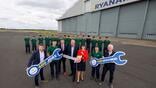
BIRMINGHAM, England—Dunlop Aircraft Tires is seeing aftermarket growth potential through its retread facilities in the UK, U.S., and China as it intends to capitalize on rising market demand using localized support.
The company supports tires across commercial, cargo, military and rotorcraft platforms. These include Boeing 737, 747, 757, and 767 aircraft, Embraer regional jets, ATR turboprops, and military aircraft such as the F-35, C-130, and AW139 helicopter.
Dunlop’s history dates to 1910, the year when the company first commercialized aircraft tires during the golden age of Birmingham as an industrial powerhouse. The company became a dedicated aircraft tire company in 1996, following the acquisition of the wider Dunlop brand by Japan-based Sumitomo, which allowed it to focus solely on aviation.
Lee Timbrell, the company’s chief commercial officer, said the company benefits from its aviation focus in contrast to its larger manufacturing competitors, as Dunlop doesn’t produce automotive tires. “Our entire focus is aviation, which gives us deep specialization,” he said.
Dunlop operates three facilities—its primary manufacturing and retread site in Birmingham, UK, and two retread and distribution facilities in Jinjiang, China, and in Mocksville, North Carolina, in the U.S. The Mocksville facility recently celebrated its 10th anniversary. Dunlop employs around 450 people globally.
The focus on developing regional retreading capacity reflects wider trends across the MRO sector, where operators are increasingly seeking to reduce operating costs while improving sustainability performance.
Timbrell said that extending the usable life of components is becoming a growing priority for operators. “Aircraft tires are particularly suited to lifecycle management strategies because a properly maintained casing can undergo multiple retread cycles before retirement,” he said. According to Timbrell, one of the key measures airlines evaluate is a tire’s retreadability—the number of approved retread lives that can be achieved before the casing reaches the end of its working life.
“Having a good new tire is important, but having a high retreadability rating is equally important in the marketplace,” he said. “Customers are looking at the total lifecycle cost, not simply the initial purchase.”
Dunlop has invested heavily in radial tire technology and manufacturing capability, as have its main competitors; however, it has also chosen to continue investing in bias-ply technology, as it continues to see strong demand for bias-ply products, particularly on cargo and military platforms, where durability and retreadability remain critical factors. Retreading has become particularly important in the cargo sector, where Timbrell said that operating conditions can accelerate tire wear.
To support its global aftermarket business, Dunlop uses a global network of strategically selected stockists and distributors with approximately 25% of the company’s sales handled via these channels across North America, Europe, Africa, the Middle East and Asia-Pacific.
Beyond retreading, Dunlop is focusing on technologies to improve tire durability and lifecycle performance. Areas of development include advanced materials, composite-bead technology to reduce weight, digital tire design tools, and simulation technologies that model tire wear under different operating conditions.
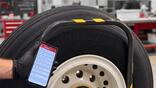
The company is also investigating technologies that could eventually help operators monitor tire wear more effectively and refine maintenance intervals. “We’re looking at how simulation can help us understand wear characteristics and improve tire design,” Timbrell said. “Whether it’s landing loads, taxi speeds, cornering forces or heat generation, all of those factors affect tire life.”

Related Content