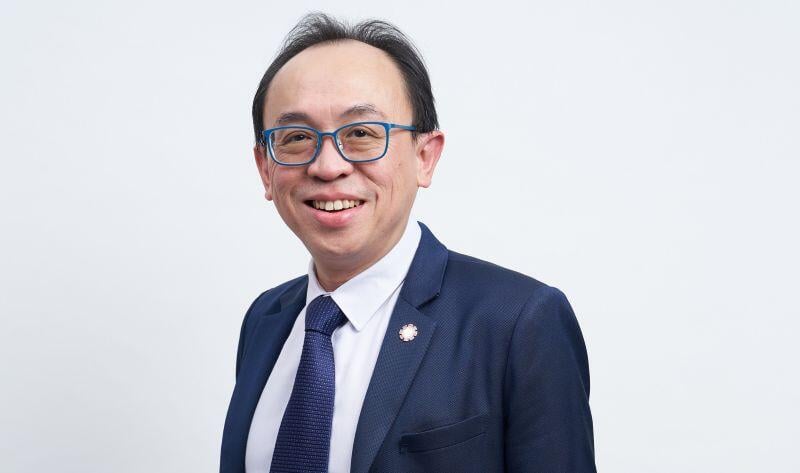
ST Engineering commercial aerospace division president Kevin Chow
ST Engineering recently unveiled a series of expansion initiatives across its aviation portfolio, including nacelles, engine services, special-mission cabin modifications and passenger-to-freighter (P2F) conversions. Kevin Chow, newly appointed president of ST Engineering’s commercial aerospace division, spoke with Aviation Week about how these investments are expanding capacity and capabilities, supporting growth and helping address persistent supply chain challenges across the aftermarket.
ST Engineering signed a multiyear agreement in February with Xiamen Airlines for CFM International Leap-1A performance restoration shop visits. How are you preparing for growing Leap maintenance demand and tighter turnaround expectations?
We are doubling engine MRO capacity in Singapore to support more than 300 engines annually by 2027, including CFM Leap-1A and -1B models. Capacity growth is supported by automation, robotics and data-driven inspection technologies to improve throughput and reduce turnaround times.
Beyond engine overhaul, we also support Leap nacelles through both aftermarket services and OEM manufacturing capability in the U.S., giving us vertical integration across engine and nacelle support—an increasingly important differentiator as operators seek bundled solutions.
ST Engineering’s EFW joint venture with Airbus also recently signed a new Airbus A330 P2F contract with Hengqin Winglet Aircraft Technology in China. How will it influence how you scale conversion capacity for fast-growing cargo markets?
While narrowbody feedstock remains constrained in the near term, long-term demand for freighter conversions—particularly in Asia-Pacific—remains structurally strong. We scale capacity through a geographically diversified P2F network, including sites in China, Türkiye and Japan, allowing us to align conversion slots with feedstock availability and customer fleet plans. That distributed model provides flexibility to ramp output in high-growth cargo markets while managing regional supply constraints.
What strategic opportunities does the Airbus A330 MRTT+ cabin modification program create for ST Engineering in the defense and special-mission sector?
The A330 MRTT+ program extends our role beyond cabin installation into integrated engineering and certification support. With European Union Aviation Safety Agency and FAA Part 21 approvals and a portfolio of more than 40 supplemental type certificates, we can manage design, certification, modification and lifecycle support under a single framework.
For special-mission operators, that integrated model reduces program complexity and timelines. It strengthens our position in defense programs that require highly customized interiors and mission-specific configurations.
ST Engineering unveiled a business aviation thrust reverser demonstrator earlier this year. What differentiates it, and where could it be applied?
The demonstrator is designed for long-duct, mixed-flow nacelle configurations increasingly used on next-generation business jets. It integrates high-temperature composite materials and a fully electric actuation system, reducing weight and mechanical complexity compared with traditional hydraulic systems.
Ground-tested performance indicates gains in aerodynamic efficiency and acoustic characteristics, and the design is scalable across multiple business jet segments—from midsize to large-cabin platforms. Strategically, it positions us for future propulsion architectures where lightweight materials and electrification are becoming baseline requirements.
Across airframes, engines, nacelles and P2F conversions, where do you see the next integration opportunity?
The next opportunity lies in lifecycle integration—connecting engine, nacelle, airframe and conversion services to reduce downtime and improve asset utilization. Our new integrated nacelle and airframe service center in Singapore is an early example of that approach.
As aircraft utilization becomes more critical for operators, the ability to provide coordinated, multi-disciplinary support under one industrial framework will increasingly differentiate MRO providers.

Related Content