This article is published in Aviation Week MRO part of Aviation Week Intelligence Network (AWIN), and is complimentary through Jul 09, 2026. For information on becoming an AWIN Member to access more content like this, click here.

STS Eyes Deeper CFM56 Inductions At Stansted Shop

STS CFM56
Credit: STS Engine Services

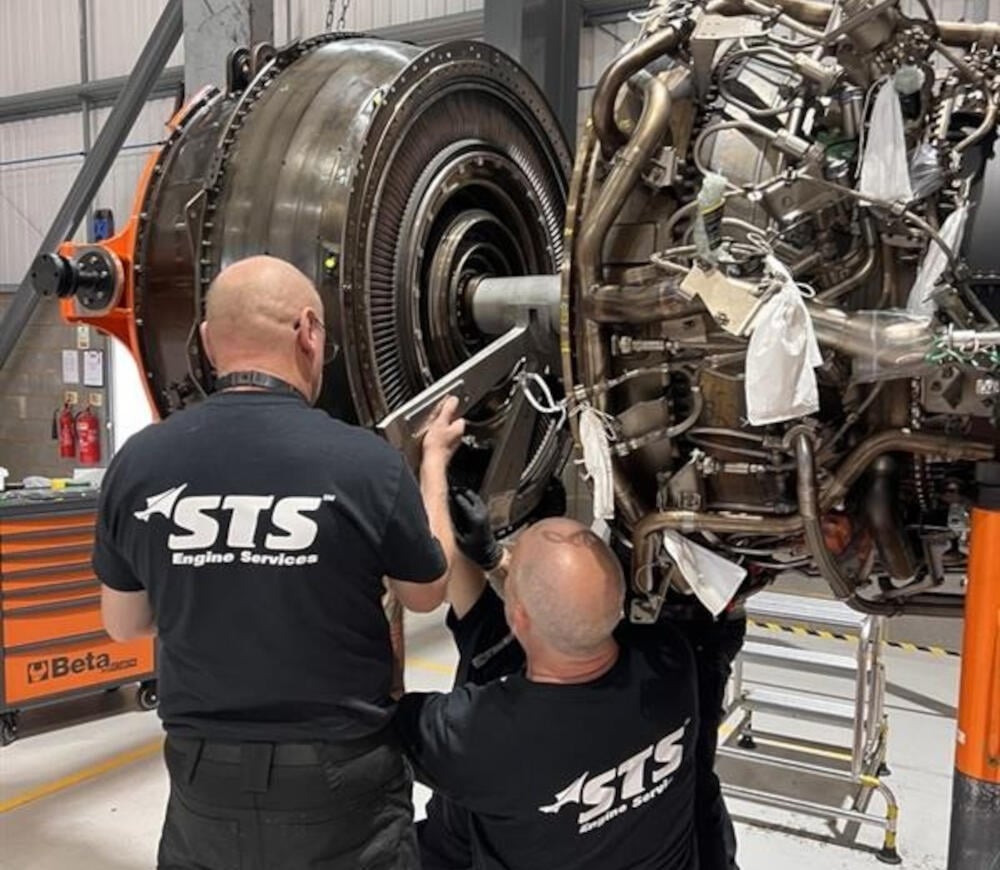
STANSTED, England—UK-based STS Engine Services has expanded the repair scope it performs on CFM International CFM56 engines as operators extend the lives of legacy narrowbody fleets amid ongoing delivery delays for new aircraft.

STS is targeting deeper work scopes and hot-section repairs from its shop near London Stansted Airport, located around 40 mi. northeast of London.

Eddie O’Dwyer, VP of Global Business Development at STS Engine Services, said the MRO provider is focused on performing targeted repairs to help owners and operators avoid lengthy, costly shop visits. “We are expanding what we do on the CFM56-5B and -7B and going further into the hot section of the engine,” O’Dwyer said. “Historically, there were work scopes where we could complete perhaps 60% of the work required, but because we didn’t have some of those hot-section capabilities, we wouldn’t win the induction at all.”

The company already performs a broad range of maintenance activities on the engine family. Services include fan case replacements, compressor blade changes, combustion chamber work, high-pressure turbine nozzle guide vane replacements, and low-pressure turbine module changes.

O’Dwyer said the next step is to position STS Engine Services as a provider of increasingly targeted repairs that can defer or reduce the need for full overhaul shop visits, though there are no plans to venture into full overhauls.

“If a customer has a specific piece of hardware that needs replacing because it’s cracked or damaged, we can go in and carry out that targeted repair rather than sending the engine into a full overhaul environment,” he said. “That can greatly reduce turnaround times and costs.”

The strategy indicates continued demand for mature engine platforms despite the growing CFM Leap fleet. According to O’Dwyer, airlines that had previously planned to retire older Airbus A320ceo and Boeing 737NG aircraft have been forced to extend operating lives by two to three years because replacement aircraft are arriving later than expected.

“Everything has been extended,” he said. “With the delays on both Airbus and Boeing deliveries, and then COVID in the middle of that, operators are keeping aircraft longer. We still see plenty of life left in the CFM56-5B and -7B.”

The inflection point for Leap engines aligning with CFM56s in the global fleet is expected in the next one to two years. Leap-related activity volumes are increasingly growing as a share of STS’s engine business. Over the past 24 months up to April 2026, the company has completed approximately 100+ LEAP QEC (Quick Engine Change) builds on both the 1A and 1B variants; 25+ off-wing Leap reverse bleed system (RBS) modifications, and 10+ on-wing Leap RBS modifications.

Despite the increased Leap volumes, the company expects legacy CFM56 platforms to remain a major contributor to workload for years to come. “We still get a huge number of requests for CFM56s,” O’Dwyer said. “The Leap fleet will continue to grow, but the 5B and 7B are where we see substantial opportunities for deeper repair capability and larger work scopes.”

The company formerly operated as GT Engine Services until 2024, when it was acquired by U.S.-based STS Aviation Group. STS plans to support growth in its shop visit activity by continuing to invest in tooling, training and capacity at Stansted, where the company operates 24 engine bays.

James Pozzi

As Aviation Week's MRO Editor EMEA, James Pozzi covers the latest industry news from the European region and beyond. He also writes in-depth features on the commercial aftermarket for Inside MRO.