This article is published in Aviation Week & Space Technology and is free to read until Nov 05, 2026. If you want to read more articles from this publication, please click the link to subscribe.
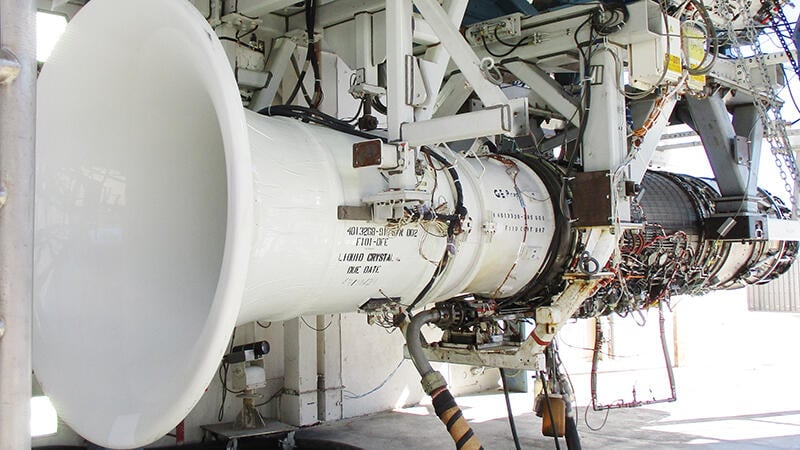
Dust-ingestion tests with representative RISE high-pressure turbine blades have been conducted on both an F110 donor engine (pictured) and a Leap-1.
As CFM International builds up toward full-scale tests of the Open Fan propulsion system, the GE Aerospace-Safran joint venture is shifting gears from focusing on efficiency to emphasizing the expected durability and cost benefits of the unducted engine concept.
Designed to be 20% more fuel-efficient than the CFM Leap-1, which powers the Airbus A320neo and Boeing 737 MAX, the Open Fan is targeted at next-generation single-aisle designs. However, as operators have continued to flag higher-than-anticipated maintenance and repair costs to tackle durability issues with the current engine family, CFM says prioritizing extended time on wing for the Open Fan is as vital as fuel efficiency.
The Open Fan’s performance gain is designed to come primarily from the propulsive efficiency of the fan stage with a 60:1-plus bypass ratio.. The balance—roughly 30%—is expected to come from thermodynamic efficiency improvements provided by the compact core.
However, because ducted designs will necessarily have to rely more heavily on thermodynamic improvements to compete with the Open Fan, CFM says the unducted design will have the benefit of an additional operating temperature margin with which to meet the required balance between fuel burn and durability.
CFM plans to demonstrate the 20% fuel-burn target when it runs the initial Open Fan engine in the next few years. “But when we do an actual product, maybe I put a little less in the core, maybe I dial down my temperatures a little bit in the core,” says Arjan Hegeman, vice president of future of flight engineering for GE Aerospace.
“Think about what this unlocks,” Hegeman says. “Now I have a stack that still far exceeds what a ducted [engine] can do, so I have better performance, but I also blow it away from a durability perspective. And if there’s anything we’ve learned over the last years, it is that durability matters as much as if not more than fuel efficiency.”
The demonstrator will prove the concept’s maturity and technology readiness level, he adds. “When we do the actual programs, we’ll be working very closely with the overall industry, airframers and operators on what exactly it is,” Hegeman says.
“The ultimate deliverable for an operator is not fuel efficiency—that’s how Leap and [Pratt & Whitney’s PW1000G geared turbofan] were done,” he notes. “The overall deliverable for the operator is cost of ownership. So, with all the learnings we’re getting through this demonstrator program, we’ll be able to optimize it from an overall cost-of-ownership perspective, which is fuel efficiency, durability, overall maintenance cost and so on.”
Meanwhile, manufacturing of initial parts for the first ground demonstrator engine is underway following the completion of the preliminary design review for key components including the core, fan blade and outlet guide vanes. More than 500 tests have been completed since the Revolutionary Innovation for Sustainable Engines (RISE) technology program was launched in 2021.
As part of its early focus on durability, CFM says this work includes more than 5,000 cycles of endurance and dust-ingestion tests with representative RISE high-pressure turbine blades in Leap-1B and F110 donor engines.
CFM says the architecture of the Open Fan, including an adaptive-cycle feature for dust particle extraction, will give the engine inherent durability advantages compared with a next-generation conventional engine design. “The Open Fan will ingest 50% less dust than a ducted architecture,” Hegeman says.

Related Content