This article is published in Aviation Week & Space Technology and is free to read until Mar 08, 2026. If you want to read more articles from this publication, please click the link to subscribe.

Trump’s Strategic Defense Pivot Pressures U.S. Suppliers

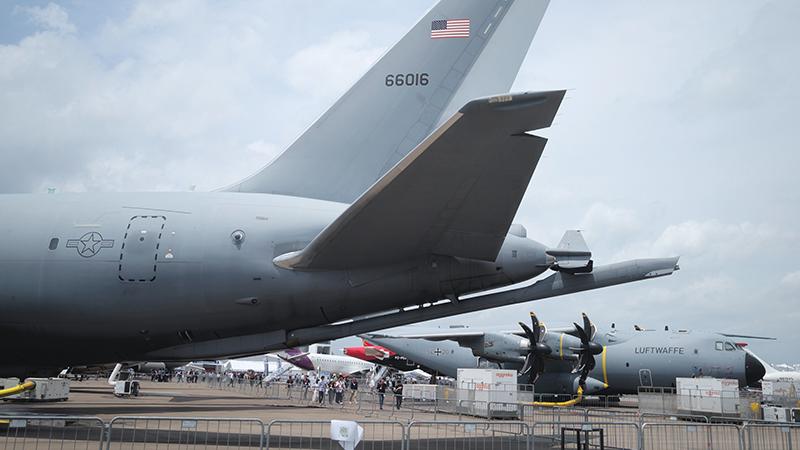
Boeing KC-46

A Boeing KC-46 was displayed near an Airbus A400M (background) at the Singapore Airshow as both companies pitched their aircraft to global buyers.

Credit: Brian Everstine/AW&ST

An uncertain trade policy from the White House reverberated around the world to the Singapore Airshow, where European and Asian companies said they have seen increased interest in their products and U.S. officials sought to ensure the desire to buy American will remain.

Individual announcements made both before and at the show reflected the ramifications of the uncertain trade policy under President Donald Trump. Boeing, for example, announced on Feb. 3 that it will no longer pursue the sale of Boeing F-15EXs to Indonesia. Jakarta subsequently announced a plan to buy Leonardo M-346Fs.

  • Indonesia steps away from the Boeing F-15EX
  • Airbus and Saab highlight increased opportunities

In a briefing that included talk of increased interest in the new Airbus A330 Multi-Role Tanker Transport Plus after Thailand’s order, announced in September, Airbus leaders said they have seen an “uptick” in inquiries due to both American leadership and a push to diversify suppliers.

“I think that countries not only in this region but other regions as well [are looking] at diversifying the choices that they make to ensure they have sustainability, dependability, reliability as well,” said Zakir Hamid, head of the Asia-Pacific region for Airbus Defense and Space. “So yes, diversification is something that is of interest in looking for . . . defense capabilities.”

Mikael Franzén, Saab’s chief marketing officer for the Gripen fighter, said the momentum of nations increasing defense spending, bolstered by concerns about Russia’s 2022 invasion of Ukraine, has led to a specific interest in fighter aircraft. Canada, for example, recently raised the possibility of buying the Gripen and decreasing its purchase of Lockheed Martin F-35s.

“The demand and the interest and the urgency in the questions has increased a lot,” Franzén said.

At the air show, host nation Singapore made a surprise announcement that it will buy used Lockheed Martin C-130Hs to replace its four oldest C-130Bs instead of purchasing new C-130Js. The move is a deferral of full recapitalization and appears to indicate that the Republic of Singapore Air Force is considering procurement of the Airbus A400M and/or the Embraer C-390.

Some at the show and in Washington raised concerns about the American ability to deliver products or be a reliable supporter. During a Feb. 3 Senate Foreign Relations Committee hearing, for instance, Sen. Jeanne Shaheen (D-N.H.) highlighted an Algerian plan to buy Russian-made fighters instead of U.S. ones, although Algeria had not announced publicly an intent to purchase U.S. aircraft.

“Public reporting currently suggests that the Algerian government has purchased Russian fighter aircraft, and it’s in talks to purchase even more, because it would take too long to get American planes delivered,” Shaheen said.

The urgency can be seen within the American aerospace and defense industry’s top lobbying and advocacy group, the Aerospace Industries Association. The group’s president and CEO, Eric Fanning, told Aviation Week that he still sees a lot of desire to partner with the U.S. despite the uncertain trade policy and the new National Defense Strategy that shifts the Pentagon’s defense focus toward homeland defense in the Western Hemisphere and away from competition with China.

While there is intense frustration in Europe, bolstered by threats from Trump to take Greenland and comments downplaying the contributions of NATO forces in Afghanistan, allies and partners in the Asia-Pacific region remain interested in maintaining business relations with the U.S.

“Their alternative is China,” Fanning said of Asia-Pacific nations looking to buy. “And they want to counter that and not be dependent on China, not be under the thumb of China. And we still make the best stuff.”

Trump announced a new trade deal with India on Feb. 3, the day the air show kicked off, which included a reduction in tariffs on Indian goods once that nation agreed to stop purchasing Russian oil. Fanning said this is an example of America keeping the Asia-Pacific region as a priority.

“There is optimism the U.S. will remain focused on this region and a lot of desire from these countries to continue partnering,” Fanning said. “This region is going to demand our attention, whether we want it to or not.”

Brian Everstine

Brian Everstine is the Pentagon Editor for Aviation Week, based in Washington, D.C.

Singapore Airshow 2026

For all the latest news live from Singapore Airshow, visit our Airshow News site section.