This article is published in Aviation Week & Space Technology and is free to read until Mar 01, 2026. If you want to read more articles from this publication, please click the link to subscribe.
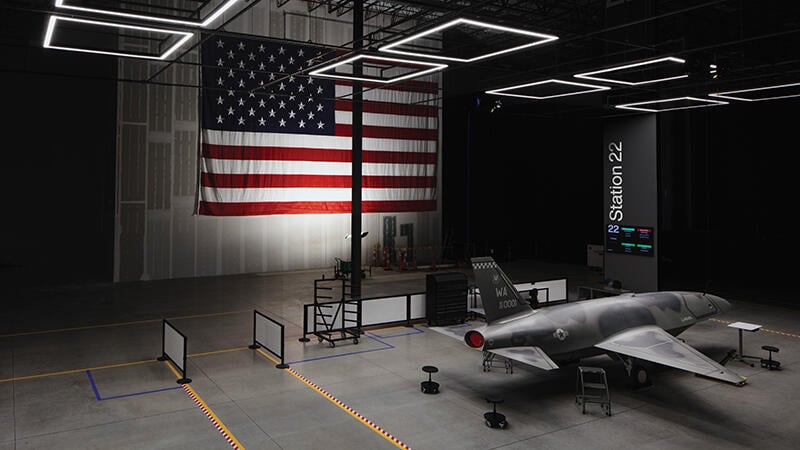
Anduril is testing the production system for a Fury mockup inside the first building opened within Arsenal-1.
Standing on the side of a barren soybean field, Keith Flynn pointed to a speck of a structure lying a few miles away, beyond a line of trees in the distance.
“That is Building 1,” said Flynn, a former Tesla and Toyota executive who is now senior vice president of manufacturing for U.S. defense technology company Anduril.
- The YFQ-44 assembly system is in place
- Missiles, drones and submarines could follow
The 365,000-ft.² empty factory on the edge of Rickenbacker International Airport near Columbus, Ohio, stands alone on Anduril’s recently acquired property here, but not for long. On the few miles between Building 1 and the empty field where Flynn stood on a cold December day, Anduril envisions establishing the Arsenal-1 defense manufacturing complex over the next 10 years. The company intends for the massive complex to churn out hundreds of Collaborative Combat Aircraft (CCA), thousands of missiles, tens of thousands of drones and pieces of other major systems in its increasingly diverse product portfolio, including autonomous submarines and spacecraft.
If 9-year-old Anduril realizes its goal of becoming one of the largest defense prime contractors over the next 10 years, the company’s $900 million bet to create this site will be the reason.
As of mid-January, that investment depends on Anduril’s ability to win future production orders on a large scale, starting with a still-pending U.S. Air Force decision on building the YFQ-44 Fury as the first production CCA.
Anduril also is waiting for the Air Force to award production contracts for the Family of Affordable Mass Munitions (FAMM) program to manufacture a palletized, low-cost cruise missile, possibly in the thousands. The service selected the company’s Barracuda system to be one of the bidders for the FAMM production contracts.
Still more opportunities may come with the military’s growing interest in hybrid-electric vertical-takeoff-and-landing systems. Anduril has teamed with Archer Aviation to develop a candidate for mobility aircraft programs under consideration by the U.S. Air Force, Army and Marine Corps.
The products of all those programs—and potentially others—will need to be built somewhere. Traditional practice in the defense industry is to wait for production contracts to be awarded, then invest the capital necessary to deliver the systems for which the Pentagon has already paid. But Anduril is not waiting. As the Pentagon faces urgent pressure to ramp up production capacity, officials have demanded that the defense industry invest in that infrastructure up front and accept the risk that orders may not follow.
“What we want to do is change an acquisition problem of ‘how do I get a factory?’” Flynn said. “I have a factory, so what’s the proper way to allocate it? Which [product] line is going where and at what time? Developing the Arsenal site allows us to go do that.”
Anduril is designing the Arsenal-1 complex to be uniquely interchangeable. The same building that produces missiles can be reconfigured to build drones or parts for submarines. It is an approach that will influence how the company designs products and trains the workers who build them.
According to the company’s 2025 application for tax incentives from Arsenal-1 host Pickaway County, Anduril expects Building 1 to open early this year and employ an estimated 301 people by year-end.
Anduril plans to add about 5 million ft.² of factory floor space across another eight buildings within nine years. The company intends to add 3,707 more employees to the Arsenal-1 payroll by the end of 2035 who would receive about $530 million total in taxable salaries, averaging $132,235 per employee.
For now, visitors see mostly empty fields, although work has started on the exterior walls of two more buildings on the site. “We are at the other corner of the property, so when . . . you try to conceive of 5 million ft.² under one roof and a property that supports that, it is [this],” Flynn said, gesturing to the rolling, empty fields.
But Arsenal-1 is not completely empty. During the mid-December tour, Building 1 was in the final stages of preparation to become operational.
The first production opportunity for Arsenal-1 illustrates the many challenges Anduril faces as a relatively new defense contractor attempting to break into the exclusive club of makers of large combat aircraft. To be successful, the company has to be ready to scale up production rapidly while navigating the uncertainty built into the Air Force’s retooled acquisition plans for the CCA program.
The first hurdle came two years ago, when the service awarded contracts to build CCA Increment 1 prototypes to the Anduril YFQ-44 Fury and the General Atomics Aeronautical Systems Inc. YFQ-42 Gambit, which defeated competing designs offered by defense giants Boeing, Lockheed Martin and Northrop Grumman. That set up Anduril to face a second hurdle. The Air Force plans to select at least one company to launch production for CCA Increment 1 this year. The candidates include at least the YFQ-42 and YFQ-44, and Northrop has not ruled out offering the Talon, a CCA prototype derived from the Model 437 that was unveiled in early December.
Among those three candidates for CCA Increment 1 production, Anduril stands out as the only one that has not conducted serial manufacturing of a large, jet-powered aircraft. The company has a track record of production in other areas, including small drones, launched effects, missiles and solid rocket motors. But Anduril’s experience with fighter-size aircraft is limited to the Fury’s first prototypes, which rolled off an interim production line last year in Costa Mesa, California.
Even so, its executives say they are prepared to win the CCA Increment 1 production contract and move immediately into serial production. The first Ohio-based employees are undergoing training in Costa Mesa to build the Increment 1 prototypes, and they will move back to Arsenal-1 to build production versions of the YFQ-44 if the type wins the contract.
Moreover, Anduril is confident in its new production system, which combines features of Industry 4.0 manufacturing techniques with what it considers more practical and conventional methods.
Among the advanced features of the production system, Building 1 lacks fixed tooling monuments, including overhead cranes usually found in factories that produce aircraft weighing thousands of pounds. That absence is intentional. It leaves Anduril with total flexibility to reconfigure the space, allowing manufacturing managers to account for shifts in production volumes or product mix.
At the same time, the approach influences the design of Anduril’s production system. In the absence of cranes, the Fury is guided through the first 13 stations of final assembly on specially made wheeled cradles. Landing gear and wheels would be installed on the Fury in Station 14, allowing workers to usher the aircraft through the next eight stages without cradles.
The production system is focused on keeping things simple. Automation is increasingly common among aerospace companies using smart manufacturing techniques, but Anduril plans to keep the Fury as manually built as possible as it attempts to scale up production, assuming it wins the contract.
“The fact is, it is generally easier if you train a human to go do something than to make the investment in facilities and equipment and everything for automation,” Flynn said. “And so, quite often, we are trying to actually design products that don’t require automation. I can always—as the volumes [grow], and it makes sense from a financial standpoint—I can always add automation.”
In some cases, Anduril’s production system adopts a measured approach to using new manufacturing tools. Full-size determinant assembly (FSDA) revolutionized automotive manufacturing with predrilling holes at the component level, which saves time in final assembly with the installation of fasteners. Aerospace manufacturers have adopted the practice widely on commercial and military aircraft, with mixed results. In some cases, struggles to implement the FSDA method on an aircraft’s more advanced shapes and materials caused schedule delays and cost overruns.
By contrast, Anduril plans to take a slow approach to introducing FSDA techniques on the assembly line. Roughly one-third of the holes in the first lot of Fury aircraft would be predrilled, Flynn said. Application of the FSDA method could be expanded from there, starting with the simplest shapes in the structure and proceeding to more complex areas later.