This article is published in Aviation Week & Space Technology and is free to read until Feb 22, 2026. If you want to read more articles from this publication, please click the link to subscribe.
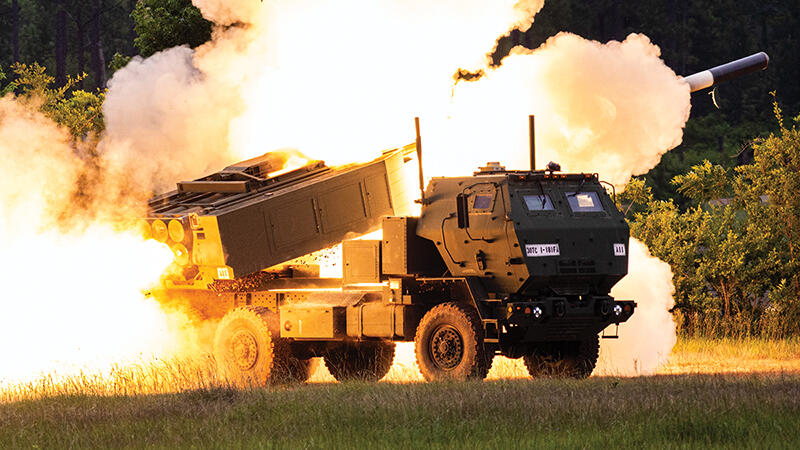
Prime breakups are not new, but now even Lockheed Martin is being eyed as a candidate. One of its spinoffs could be missile-focused, including the M142 High-Mobility Artillery Rocket System.
L3Harris Technologies, which has branded itself the “sixth prime,” is breaking up this year, as is Honeywell International. At least one longtime Wall Street analyst has been shopping a similar idea about Lockheed Martin. For years, industry chatter has marveled that Boeing, General Dynamics and even relative newcomer RTX have held together this long.
Believe it or not, 2026 could be the last year of the post-Cold War large legacy defense prime marketplace as we know it. Suddenly, analysts, investors and consultants are seriously considering the possibilities of major primes breaking up en masse.
“Could the primes get higher valuation broken into pieces? One-hundred percent,” declared Peter Arment, Baird senior research analyst for aerospace and defense.
“A breakup of the defense primes has been discussed in our recent investor discussions,” BNP Paribas Equity Research senior analyst Matthew Akers said Jan. 13. The Defense Department “appears to want to rebuild the defense ‘middle market’ following years of consolidation since the end of the Cold War in the 1990s.”
Akers said Lockheed and RTX stand out as companies with large missile growth opportunities buried in more diversified portfolios. “Investors have expressed interest in potentially breaking up both,” he noted.
Baird’s Arment presented a case last fall for breaking Lockheed into three companies based around space, missiles and everything else, namely aeronautics. On the first two breakouts, related business units are “well positioned” for the Golden Dome and missile replenishment rooted in restocking in the wake of Russia’s 2022 invasion of Ukraine.
In aeronautics, the problem is that the F-35 is about a quarter of Lockheed’s annual revenue, but the program is set to peak in 2030, Arment noted. In the meantime, in recent years the company has missed winning the U.S. Air Force F-47, the Army’s Future Long-Range Assault Aircraft and other new franchise opportunities while corporate leadership has mystified investors with their focus on “5G.mil,” a proposed battlefield connectivity capability.
Combined with a “market shift” toward large numbers of uncrewed and attritable aircraft, such as the Collaborative Combat Aircraft program, the future holds a “math problem” for Lockheed as it currently exists. “We think separating the company into separate companies would create significant shareholder value in the new defense and space tech ecosystem,” Arment said at Baird’s 8th Annual Defense and Government Conference in November.
If Lockheed were to do so, it would follow a pattern set by General Electric, Honeywell and now L3Harris, which in January announced two major divestitures. L3Harris, which struck a deal with an activist investor two years ago to explore strategic alternatives, is seizing on investor interest in defense and space tech as well as Trump administration efforts to take stakes in national security companies. L3Harris aims to carve out parts of its Space Propulsion and Power Systems group to private equity investor AE Industrial Partners. Another spinoff of the L3Harris Missile Solutions business will include a $1 billion equity stake from the Pentagon.
Setting aside Trump administration eccentricities, analysts see the prime breakups as driven by a bipartisan, deep-seated belief in Washington that the large legacy providers overconsolidated after the Cold War. Between the need to move fast and produce more weaponry and the rise of more agile defense and space tech companies akin to SpaceX that view hardware as a vehicle for services, leadership from Pennsylvania Avenue to Richmond Highway, where the Pentagon is, want the legacy primes to be more responsive.
President Donald Trump made this clear with his Jan. 7 executive order and social media tirade against large prime shareholder rewards and executive pay (page 42). Ironically, if those limitations have proverbial teeth and take effect this year, analysts expect that tens of billions of dollars of what would have been shareholder returns will instead go to mergers and acquisitions and particularly toward vertical integration, where large primes attempt to take more control over—and more value out of—their supply chains.
Successful companies evolve and change with market-places. It is worth remembering that a century ago, Boeing included everything from what is currently United Airlines to parts of Super Tier 1 supplier RTX. It has broken up and conglomerated a few times, including the McDonnell Douglas acquisition in the 1990s and the recent Spirit AeroSystems reacquisition. Perhaps it is time for others to give it a shot. You can bet investors are interested.