This article is published in Aviation Week & Space Technology and is free to read until May 29, 2026. If you want to read more articles from this publication, please click the link to subscribe.
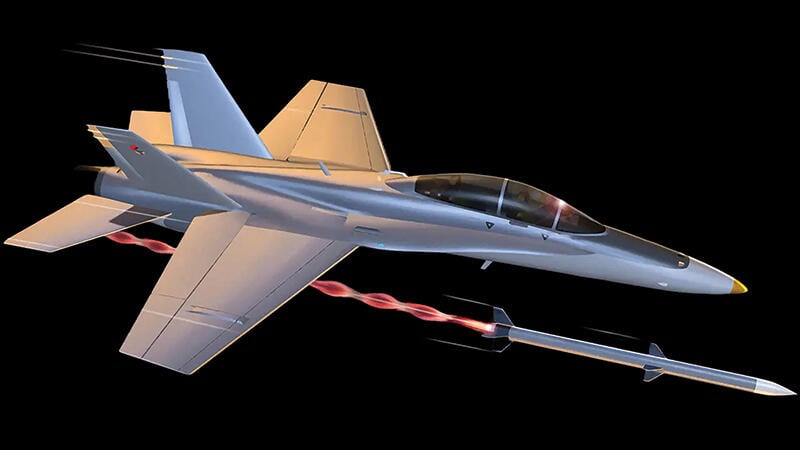
Castelion has released a rendering of a Boeing F/A-18 firing an air-launched variant of the hypersonic missile.
A binary choice in the cold arithmetic of modern air warfare has long seemed to stump U.S. military planners.
The first option meant paying for a few exquisite, costly aircraft because they could reliably penetrate contested airspace, which would enable them to deliver large quantities of short-range and therefore lower-cost munitions.
- Hypersonic Blackbeard missile emerges as big winner
- More than 27,000 orders planned for low-cost cruise missiles
The alternative saved money on the launch platforms but spent much more per missile. In that case, the Pentagon would invest in less expensive aircraft and launch platforms. Those were not expected to survive against modern air defenses, but they would lob many long-range—and necessarily much pricier—missiles at targets hundreds or thousands of miles away.
Now a third option has emerged—and the Defense Department’s newly revealed long-term spending forecast goes all in, committing more than $77 billion across the next five years, beginning in fiscal 2027.
This strategy is intended to unite what the Pentagon views as the best parts of the first two choices. If Congress approves, the approach would invest in acquiring a new class of low-cost, long-range precision weapons from nontraditional suppliers to be launched from fighters, bombers and even transports made by traditional defense contractors.
The newly published Future Years Defense Program (FYDP)—a nonbinding, five-year spending forecast produced by the Pentagon nearly every year—signals the Trump administration’s intent to buy nearly 50,000 offensive strike missiles over fiscal 2027-31. By comparison, the previous forecast, released by the Biden administration two years ago, called for about 7,000 strike missiles over fiscal 2025-29.
That does not mean a drop-off in demand for more expensive classes of standoff missiles. Orders for the roughly $1.5 million Lockheed Martin AGM-158B Joint Air-to-Surface Standoff Missile – Extended Range (JASSM-ER) are expected to surge to 896 by fiscal 2028. The FYDP also doubles down on two of the most expensive conventional missiles in the Pentagon’s weapons portfolio, with $5.8 billion combined for procurement of the Lockheed AGM-183A Air-launched Rapid Response Weapon and the scramjet-powered RTX-Northrop Grumman Hypersonic Attack Cruise Missile.
Low-cost, long-range precision weapons come in two main categories: air- or ground-launched hypersonic ballistic missiles and air-launched subsonic cruise missiles.
Castelion, a nearly four-year-old startup based in Torrance, California, personifies the first category. An air-launched version of its hypersonic Blackbeard ballistic missile is on track to enter service next year with the U.S. Navy. The company received a $105 million contract on April 24 to integrate the weapon on the Boeing F/A-18E/F Super Hornet and reach an early operational capability in 2027.
“The U.S. Navy’s commitment to fielding affordable, innovative hypersonic capability reflects the kind of leadership this moment demands and clear determination to move fast for the warfighter,” Castelion CEO Bryon Hargis says.
Castelion and the Navy developed the air-launched Blackbeard missile for the Multimission Affordable Capacity Effector (MACE) program. In 2025, MACE quietly replaced the service’s canceled effort to develop an air-launched high-speed cruise missile under the Hypersonic Air-Launched Offensive Anti-Surface Warfare (HALO) program.
The Navy had projected the scramjet-powered HALO missiles to cost several million dollars each. By contrast, the MACE program is expected to spend less than $400,000 each for 4,500 Blackbeard missiles, including the first 343 to be acquired this fiscal year and the 4,157 in fiscal 2027-31.
Castelion, which was founded by former SpaceX employees, also plans to disrupt spending flows to traditional contractors for surface-launched hypersonic missiles.
The Army’s Long-Range Hypersonic Weapon (LRHW) program has paid Lockheed Martin since 2018 to develop and produce the hypersonic Dark Eagle missile, which includes the Dynetics Common Hypersonic Glide Body and a two-stage Northrop Grumman booster rocket. However, each Lockheed missile—also being supplied for the Navy’s Conventional Prompt Strike program—came with a roughly $40 million price tag, which limited annual orders to 2-3 dozen.
Castelion entered the missile business in 2022 with a new approach, informed by the founders’ experience at SpaceX. The company bypasses traditional aerospace suppliers of low-volume, high-cost components that come qualified for the rigors of rocket launches. Instead, the company acquires as much as possible—electronics, pumps and more—from the high-volume, low-cost automotive industry, then adapts them for aerospace. Castelion also builds its own thermal protection systems, propellant and rocket motors.
Although the company has yet to produce at scale, the Army’s leadership has embraced its low-cost concept for hypersonic missile manufacturing. The fiscal 2027 budget proposal calls for shutting down Dark Eagle production for the service and transitioning all management of the program to the Navy, which will continue acquiring the Lockheed missile for submarines and ships.
Starting in fiscal 2029, the LRHW program is to ramp up orders substantially, buying 500 that year and 2,000 each in fiscal 2030 and 2031, according to budget justification documents. Castelion selected a 1,000-acre site in November for a solid-rocket motor manufacturing campus in Sandoval County, New Mexico.
MACE and LRHW may not be the only opportunities for future orders of Blackbeard variants. Army Brig. Gen. Patrick Costello told the Fires Symposium in mid-April that service leaders had approved a plan to stop work on a Lockheed contract to develop Increment 4 of the Precision Strike Missile (PRSM).
The baseline PRSM is a ground-launched Lockheed ballistic missile with more than 400-km (250-mi.) range. Increment 4 is expected to exceed 1,000-km range by integrating a ramjet propulsion system. The Army plans to shift to a low-cost option for PRSM Increment 4, opening up another opportunity for a future combined-cycle variant of Blackbeard.
Hypersonic ballistic missiles are only part of the Pentagon’s plan for rapidly mass-producing high-speed weapons—and the fiscal 2027-31 FYDP reveals the extent of the U.S. Air Force and Navy’s new obsession with low-cost subsonic cruise missiles. More than half of the 50,000 offensive strike missiles expected to be acquired over that five-year period come from the Air Force’s Family of Affordable Mass Munitions (FAMM) program.
The service plans to buy 26,910 produced by FAMM program suppliers—currently Anduril, CoAspire and Zone 5 Technologies. CoAspire and Zone 5 are developing cruise missiles for the FAMM-Lugged program, which integrates low-cost cruise missiles at about $335,000 each for fighters and bombers. Zone 5 and Anduril, meanwhile, will compete for orders on the FAMM-Palletized program, an equally priced subsonic cruise missile to be launched in large quantities from the cargo holds of transports such as Boeing C-17s and Lockheed C-130Js.

Related Content