This article is published in Aerospace Daily & Defense Report part of Aviation Week Intelligence Network (AWIN), and is complimentary through Mar 14, 2026. For information on becoming an AWIN Member to access more content like this, click here.
AURORA, Colorado—The U.S. Air Force is focused on near-term tanker recapitalization—extending purchases of the Boeing KC-46 and planning minor situational awareness upgrades—while mobility advocates and some companies pitch accelerating a full developmental effort.
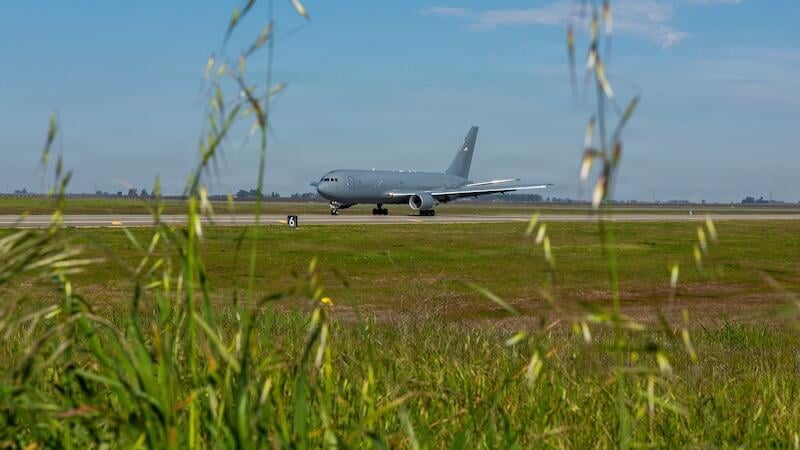
The service is fielding its KC-46 fleet, with 103 tankers delivered as of mid-February. Boeing is contracted for 183, and another 75 are to start fielding after the original program of record wraps up in the early 2030s.
The Air Force is in the early stages of the Next-Generation Air Refueling System (NGAS) program, a full-scale acquisition effort to follow the KC-46. An analysis of alternatives is underway, with the last public push in a summer 2025 request for information.
Air Force Secretary Troy Meink, speaking at the Air and Space Forces Association’s Warfare Symposium on Feb. 24 in Aurora, Colorado, focused on KC-46 progress when asked about future tanker plans. He said that Boeing is working through some “challenges,” notably replacing the Remote Vision System that has caused longstanding issues with the tanker.
“Right now, we are going to be producing a significant number of those,” Meink said of the KC-46, although he avoided specifics because the fiscal 2027 budget has not been released.
He added that the Air Force will keep the aging Boeing KC-135 in its fleet for a “long time” as it brings on more KC-46s.
“That is a focus, to get the -46s and modernize the tanker fleet,” Meink said. “What’s going to happen after that, we’ve got analysis going on.”
He later added: “Boeing, if we asked them to build more tankers, can build more tankers. . . . They will build the tankers we need. It’s not a question of [whether they can] produce them right now. I couldn’t ramp production and double it next year, but they can ramp production if they need to. It’s really a question of how you optimize all the funding we have.”
In a separate appearance with reporters at the conference, Lt. Gen. Rebecca Sonkiss, interim commander of Air Mobility Command, pressed for an acceleration for NGAS and broader tanker recapitalization. She noted that the rest of the Air Force is modernizing with the Northrop Grumman B-21 Raider and Boeing F-47.
“What you’re going to hear us consistent about is the need to recapitalize the tanker force,” Sonkiss said. “We can call it tanker modernization. Yes, I cannot have a 90-year-old tanker refueling a B-21. . . . That’s reality, right? I can’t have that.”
For now, the Air Force and Boeing are on a solid buy rate with the KC-46. Fifteen of the tankers are expected to be delivered per year for the rest of the program.
“But it doesn’t stop there,” Sonkiss said. “I’ve got to keep going. I’ve got to keep modernizing the tanker forces, and we’re getting after that.”
In the near term, that means upgrading the tanker and airlift fleet under a program known as Mobility Air Force (MAF) Nexus. The program builds on work done with prototype systems, such as the SNC Airlift/Tanker Open Mission System (ATOMS), which is a roll-on rack coupled with satellite communications equipment that can quickly bring beyond-line-of-sight internet protocol connections onto the aircraft. ATOMS and similar systems like Borsight’s Real-Time Information In the Cockpit have been evaluated in both exercises and small-scale real-world use to set requirements for a program of record. Air Mobility Command is bolstered by funding from measures such as the One Big Beautiful Bill Act to make MAF Nexus happen.
“We have been woefully negligent on this front for way too long,” Sonkiss said.
Current funding for future tanker work is focused on the analysis of alternatives for NGAS, and Air Force headquarters is “working through that right now,” Sonkiss said.
Broadly, NGAS needs to fit in with the greater force planning for operating at long distances and in high-threat areas. This could mean a “family of systems” approach, coupling large aircraft with smaller, more survivable uncrewed systems. Northrop Grumman is putting forward a similar plan, partnering with JetZero for a large strategic tanker and with Embraer to use the KC-390 as a tactical tanker for operating in more austere locations, plus its own uncrewed system design for high-threat areas. Similarly, Lockheed Martin has released renderings of a high-end, crewed stealth tanker and another uncrewed tanker with two refueling booms as an option. Boeing has previously pitched a larger version of its MQ-25 Stingray for Air Force use.