This article is published in Aerospace Daily & Defense Report part of Aviation Week Intelligence Network (AWIN), and is complimentary through Oct 29, 2026. For information on becoming an AWIN Member to access more content like this, click here.
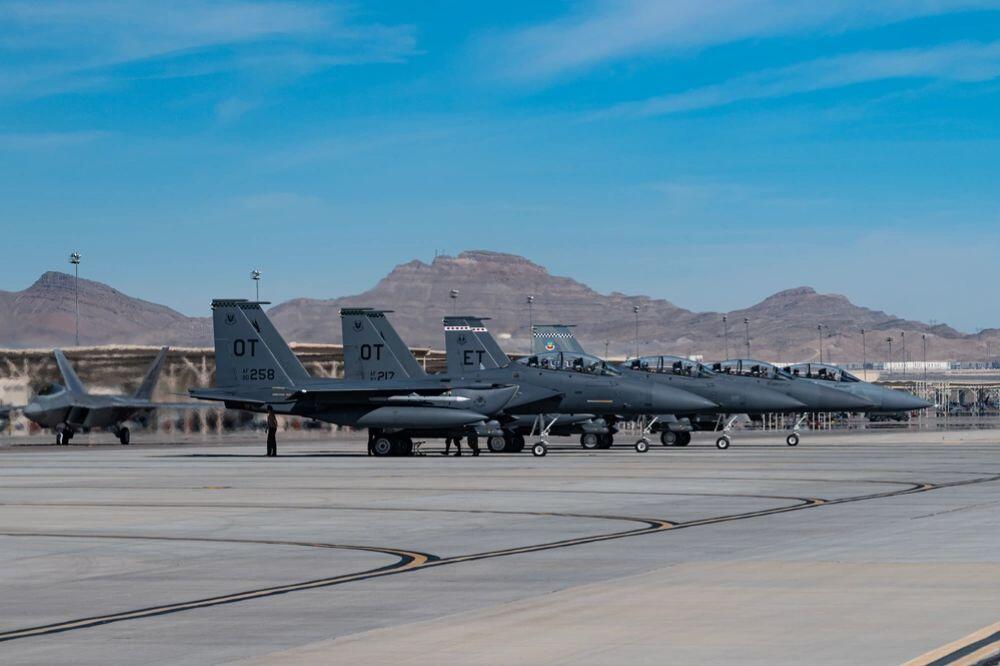
F-15s, F-15EXs and an F-22 at Nellis AFB, Nevada, in 2023.
The U.S. Air Force faces an uphill climb to increase its fighter end strength, telling Congress it needs steady funding and a healthy industrial base to meet its target.
In the meantime, it may be looking to its bomber force to help meet its air-to-air combat requirements.
The service in a report to Congress outlining its fighter end strength goals says it is planning a “medium risk” total of 1,509 combat-coded aircraft by 2035—up from the previous target of 1,271. Reaching this requires increased, steady investment coupled with smooth production from industry. This is a challenge that requires the new thinking, the service acknowledges in the document, which was obtained by Aviation Week.
“Accordingly, the USAF is also evaluating additional recapitalization options, including a new capacity fighter, increased reliance on CCAs [Collaborative Combat Aircraft], and developing air-to-air capabilities on bombers,” the report says.
The service in the report did not elaborate on the air-to-air role for bombers, particularly where this evaluation stands now and which bombers, such as Northrop Grumman’s new B-21, are being considered. It is also not clear if the “increased reliance” on CCAs means a hike beyond the plan to field 1,000 total CCAs. The new capacity fighter likely refers to the improved F-16G that Lockheed Martin is pitching to the Air Force, though no decision is expected in the near term on this possibility.
Getting to the total of 1,509 requires maximized production of F-15EXs and F-35As, something that has been difficult to this point. For example, the report highlights Boeing workforce issues impacting the production rate and the continued saga of F-35A’s long-awaited Block 4 capability. Long-term, the service hopes to have 20% of its fleet air superiority fighters, the F-22 and F-47; 40% F-35A; 20% F-15E/EX; and 20% F-16. The breakdown is currently 10% F-22, 30% F-35A, 14% F-15E/EX and 38% F-16, the report says.
The total goal is still a reduction from what would be hoped for. The report says there is a projected demand of 1,723 combat-coded aircraft. The goals are an increase from last year’s estimate of 1,271 combat-coded aircraft the service would need, with the adjustment based on new analysis of data that was already dated by the time the previous report was created, according to Lt. Gen. David Tabor, the deputy chief of staff for plans and programs.
The service’s fighter force structure challenges are twofold. One is the production of new aircraft and the second is sustaining the current fleet. Current aircraft availability (AA) rates have declined to 53.9%, which is well below the standard of 70%. The service in fiscal 2026 funded weapons system sustainment accounts to 87% of its requirements and 1.1 million flight hours, with the fiscal 2027 request increasing sustainment funding to 93%.
This increase is reducing the need for maintainers to cannibalize current aircraft—taking parts from active service jets to keep others flying—but it cannot recover the rate to the standard, the report says.
“The persistent decline in AA rates across the USAF tactical fighter fleet is the direct mathematical consequence of operating an inventory with an average age exceeding 31 years,” it says. “As legacy platforms—such as the F-16C/D, F-15E, and A-10C—operate well beyond their original engineering service lives, they experience compounding structural fatigue, widespread corrosion, and subsystem degradation.”
Increasing spending on sustainment, to include expanding long-term depot maintenance, has reducing returns as the aircraft will still face issues related to age compared to new production fighters. Investments in depot infrastructure would require more than 10 years to yield increased availability, though it would perpetuate the reliance on a fleet that averages more than 30 years old.
“Achieving the mandated AA rates required for a peer-conflict scenario necessitates aggressive divestment of the oldest airframes to fund the procurement of highly available, modernized platforms like the F-35A and F-15EX,” the report says.
The unclassified report to Congress is light on specifics related to CCA and F-47 planning. For the latter, it says development is on track.
On CCAs, the Air Force says the program is exceeding all planned timelines. Though the aircraft, at least in the first increment, are not expected to be one-for-one replacements, they will still “significantly alter” the service’s tactical aircraft landscape. This is specifically needed to counter China and its expanded manufacturing ability.
“To counter the [Chinese] industrial capacity and numerical advantage in fielding fighters like the J-20 and J-16, the USAF must embrace a hybrid force of manned and unmanned systems. This strategy is anchored in the concept of ‘affordable mass,’ which leverages CCA acting as autonomous loyal wingmen,” the report says.

Related Content