This article is published in Aerospace Daily & Defense Report part of Aviation Week Intelligence Network (AWIN), and is complimentary through Oct 16, 2026. For information on becoming an AWIN Member to access more content like this, click here.
Debrief: U.S. Air Force Hopes For Deployment ‘Reset’ Following Iran Conflict
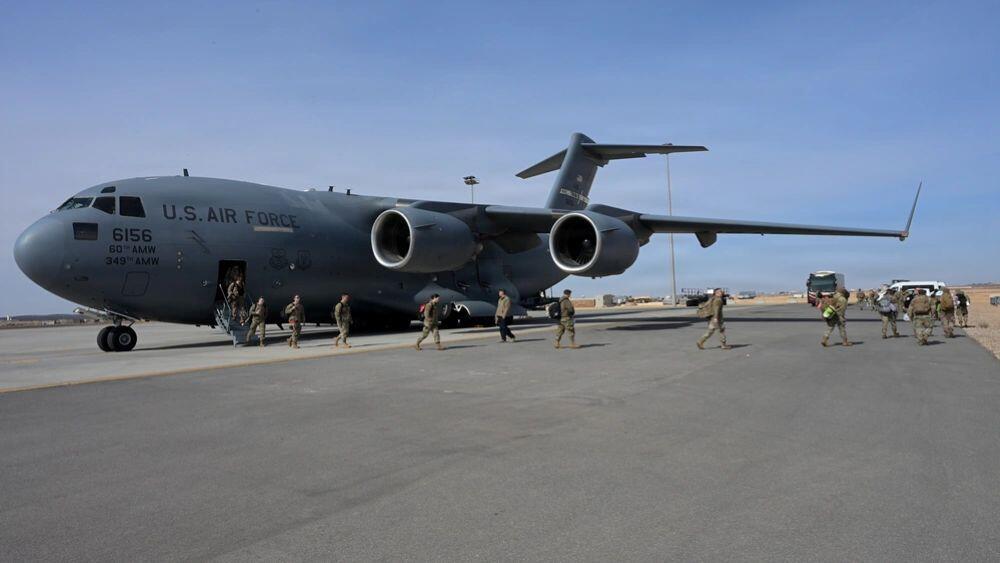
A U.S. Air Force C-17 and airmen arrive in the Middle East for a deployment in January.
In early 2026, the U.S. Air Force announced a new deployment construct designed to meet global needs while providing more predictability to its own forces.
The plan, known as the Air Expeditionary Wing 2.0, was not enough to generate forces for the conflict with Iran. Now, the service’s top officer says some units will have longer deployments as the Air Force looks to reset into the new model once the conflict ends.
“With Epic Fury, you had to deploy a lot more than what AEW 2.0 is capable of generating,” Chief of Staff Gen. Kenneth Wilsbach told reporters last week at the Air and Space Forces Association’s annual conference. “And so, as we come out of Epic Fury, when that happens, we’ll have to take a period of reset.”
The Air Force has developed, announced and then rescinded multiple deployment models and a new Force Design in recent years as leadership changed and the Pentagon’s overall strategic focus has shifted. The service has finalized a new force design to replace the last one rolled out last year, though it has not yet been outlined publicly.
“Internally, we have the new force design. Air Expeditionary Wing 2.0 is the plan, and the Global Force Management process is the process,” Wilsbach says. “And the point of AEW 2.0 was to allow predictability and a consistent way that we could cyclically deploy forces in a very predictable way.”
The global force management process is the Pentagon’s method of allocating joint forces to global combatant commands, a classified procedure that analyzes the current posture and readiness of military personnel and equipment around the world.
Under AEW 2.0, the Air Force would bring together a modular expeditionary wing that is formed 18 months prior to a deployment. The wing would be able to train and certify together before a six-month deployment. The model was introduced shortly after the Trump administration and current Air Force Secretary Troy Meink took over and replaced a separate “Deployable Combat Wing” construct introduced in the later stages of the Biden administration.
As part of the conflict with Iran, deployments for some units have stretched longer than that. For example, earlier this month the Air National Guard’s 158th Fighter Wing in Vermont, which flies the F-35A, deployed for more than nine months. While much of the focus has been on the stress on other deployed forces, notably the U.S. Navy and the USS Abraham Lincoln’s record-setting deployment, the Air Force has also seen extensive stress keeping combat aircraft in the Middle East.
Getting to this reset will mean longer time away from home for some units, Wilsbach says. Some airmen will need to deploy for longer than six months, while some will have fewer than 18 months at home.
“That’s the only way that we can reset,” Wilsbach says. “But ultimately, when we get back to a more normal place, we’re going to stick with AEW 2.0.”
It is not yet clear how much the public will know about the Air Force’s new force design when, and if, it is rolled out. The previous construct, officially titled “One Force Design,” outlined a framework for stand-in vs. stand-off forces. Leadership at the time said the short-lived model would be a “North Star” for modernization, aligning programs with different mission areas for operating within an enemy’s threat area compared to those with relative sanctuary. The plan raised concerns on Capitol Hill and within top leadership of the service itself.