This article is published in Aviation Week & Space Technology and is free to read until Oct 16, 2026. If you want to read more articles from this publication, please click the link to subscribe.
The U.S. Air Force Wants Safety Through Numbers For MQ-9 Replacement
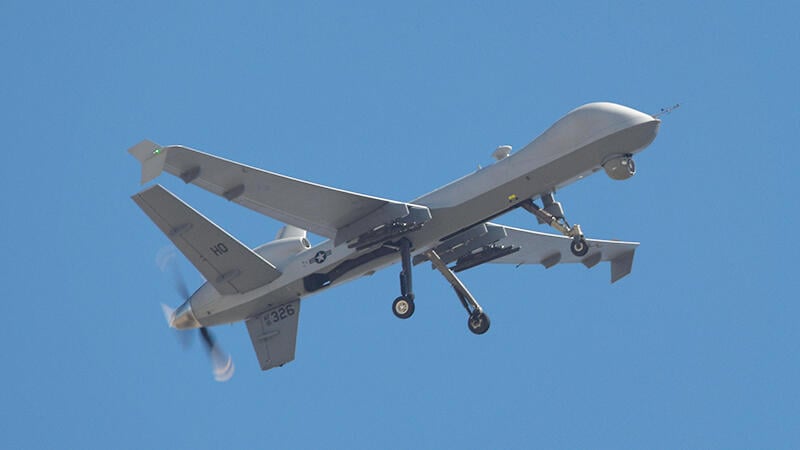
The loss of dozens of MQ-9s in Iran is driving the schedule for the Reaper replacement.
The U.S. Air Force has a unique focus for a new surveillance aircraft program: It is planning for a lot of them to be shot down.
In August, the Air Force and the Defense Innovation Unit (DIU) released a solicitation to industry for the Massed Modular Aircraft (MMA), hoping to develop a prototype in one year and build it at scale within about three years. Shortly after releasing the solicitation, Air Force Secretary Troy Meink called for the program to move faster.
- The service seeks to obtain a prototype in a year
- The program is building on CCA lessons
“As we get to the end of the [General Atomics] MQ-9 life, there was some early talk of, ‘Where do we want to go afterwards?’” said Lt. Gen. Chris Niemi, the Air Force’s chief modernization officer. “And candidly, as a result of some of the losses that we’ve experienced in combat operations, that discussion sort of got accelerated.”
The Air Force has lost at least 45 MQ-9s in combat operations over Iran. While Air Force Chief of Staff Gen. Kenneth Wilsbach told lawmakers in May that the Reaper has been the “most valuable player” of the conflict, the unit price of about $50 million plus sensors and weapons has been too much for the service to bear as it looks at potential larger conflicts.
“What we’re seeing, in part based on our assessment of the threats around the world and in part based on our real-world experience, is that you’re going to lose more military hardware in future conflicts than you have historically,” Niemi said. “And that’s what’s driving us to this sort of fundamental principle that we need things that are easier to produce, cheaper to buy and that we can afford to lose more of.”
The Air Force has laid out general goals for the MMA, most notably a price of $10 million per air vehicle—a target that has raised criticism. General Atomics Aeronautical Systems Inc. (GA-ASI), for example, has pressed the Air Force to buy MQ-9Bs to replace the MQ-9As. The B variant is more capable, but also more expensive.
“The reality is that there’s not a lot of good options to immediately replace those aircraft that have been lost,” Niemi said. “And so what we’re trying to do is have a thoughtful discussion about what [it looks ] like if you go all-in on something like MMA versus other alternatives, whether it’s MQ-9B or something else.
“I think there is a sort of a misconception that because the MQ-9B is in production, we can walk down there with a big fat check and have 100 of them this year,” he added. “That’s not reality.”
GA-ASI has since announced a new, cheaper aircraft for the program called the Wildfire.
The DIU solicitation calls for an aircraft that has an unrefueled combat radius of at least 2,300 nm and can self-deploy one-way at least 8,000 nm. It should be able to carry a payload of up to 2,800 lb. and have a Modular Open Systems Approach in order to take on new capabilities—such as sensors, radios and weapons—more easily.
Maj. Gen. Joseph Kunkel, the DIU’s military deputy, says he is pressing for the aircraft to be developed with private capital covering much of the research, development, test and evaluation instead of full military funding. The DIU, which has a direct goal of increasing private funding and broadening the defense industrial base with more startups, has seen better results from companies that have more skin in the game, he says.
“It’ll be interesting to see, as source selection goes through, who we get out of this,” Kunkel says. “Some names that you may not have heard might be on that list.”
The initial requirements in the solicitation are meant to be an “umbrella of attributes that we want as a whole” but give companies enough flexibility to interpret how they will be addressed, says Lt. Gen. Luke Cropsey, the Air Force’s military deputy for acquisition, technology and logistics.
The program draws on the service’s separate Collaborative Combat Aircraft (CCA) program and includes some of its key tenets, such as an incremental approach to field aircraft quickly and iterate for upgrades and different variants down the line, Cropsey says. The MMA will use the CCA’s “government-reference architecture” and agile mission system suite, the standard operating system type model for bringing on autonomy software from different vendors.
Because of the timeline and low-cost goal, Niemi expects the MMA will not necessarily be state of the art. It will likely have the same low-aspect-ratio wing as the MQ-9 and turboprop propulsion. The Air Force wants to replace the stick and throttle of the MQ-9’s operator station with clicks and keystrokes.
“The aircraft that I think we will actually get for MMA, I don’t think is going to be cutting-edge technology in terms of manufacturing, the engine, the flight controls,” Niemi says. “I think it’s all going to be proven stuff because that’s how I’m going to drive down the cost.”
Companies need to design their proposals from the outset for mass producibility so more aircraft could be built quickly in case of a conflict. The goal for survivability is in numbers for the MMA, as opposed to the exquisite stealth or self-protection of the typical Air Force asset, such as the Boeing F-47 and Northrop Grumman B-21 that will have to survive the air defenses of an adversary like China.
“I think that if I were China and I were to see the United States invest heavily in things like one-way attack, things that are relatively cheap, that they, the United States, buy in very large numbers and shoot at me to empty my magazines of very expensive defensive missiles—that would probably scare me,” Niemi says. “And so, MMA can be part of that solution, too, because of that mass. MQ-9 isn’t because I can’t afford to send them up and lose one out of four each time, day after day after day. But if I lower the price point, and I can build them at a much higher rate, now there’s maybe some trade space where I get into the ‘scare China’ category.”