
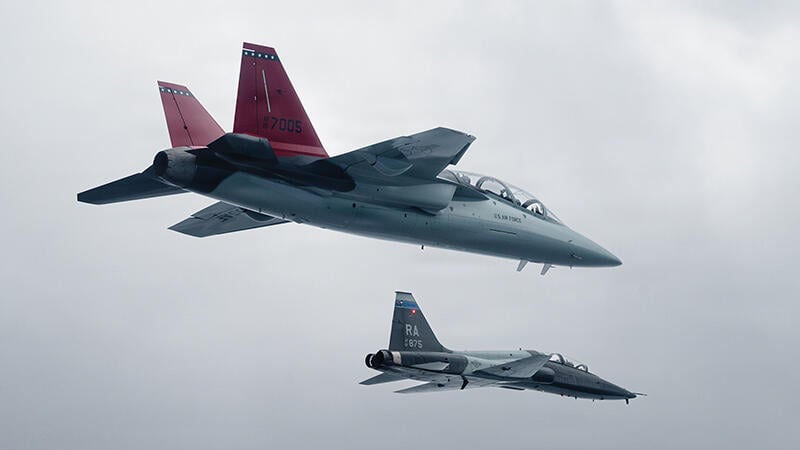
The U.S. Air Force expects to receive one Boeing T-7 per month next year to begin replacing its aging T-38s.
For the first time in 35 years, the U.S. Air Force will meet its goal of training at least 1,500 pilots amid a shortage across the service.
The Air Force has done this against the odds as well: Its aging fleet is falling short of the mission-capable rate goal, a pilot shortage is limiting how many instructors can teach, and it has one fewer base than when the service last trained 1,500 pilots—in 1991.
- An outsourcing model has sped up progress
- The service is starting Boeing T-7 syllabus development
Top generals in charge of teaching the new generation of aircrew say that to meet the goal, the service has enacted major changes to its training process, outsourcing what it could to free up resources and focus on what is needed. Air Education and Training Command (AETC) has pushed higher-end training to combat units, a model that is likely to be expanded.
“The pilot shortage is something that we’ve been working for a number of years,” says Maj. Gen. Travolis Simmons, commander of the 19th Air Force. “And just solving the production challenge is not enough to get to the entire ecosystem, which is what we’re going to have to do in order to really navigate that pilot shortage.”
The AETC has pressed to increase pilot production for years and has taken steps to do so amid challenges. In 2024, the command instituted the Initial Pilot Training (IPT) model, moving the basics outside of the military and into FAA Part 141-certified schools. This step, now fully implemented, has enabled students to enter training more rapidly. Previously, they had to wait a year or more to start.
“The key to getting to 1,500 is, we’ve driven down those delays to a point where we’re actually able to cycle through those pilots in one fiscal year,” says Brig. Gen. David Berkland, AETC director of operations and communications. “If we had those delays that we’ve seen in the past, we wouldn’t be hitting our 1,500 target.”
This means prospective Air Force pilots are arriving at AETC bases with instrument and multi-engine training, allowing military instructor pilots to train them on military-specific skills on the North American T-6 Texan II and then the Northrop T-38.
The service recently also moved some training out of the AETC, further reducing the workload on instructor pilots. The Air Force reassigned combat formal training units to Air Combat Command (ACC); pilots now go to operational bases to develop mission-specific training. Before the change, the AETC managed formal training units (FTU) for specific airframes for advanced training beyond the T-38.
This model might be expanded, AETC Commander Lt. Gen. Clark Quinn says. A decision was teed up for a meeting of the service’s top generals in October, which will focus on moving more FTUs to other major commands.
While the shift frees up the AETC’s aircraft, the ACC has long faced challenges in maintaining aircraft readiness and giving pilots enough time in the cockpit. To that end, the command on Sept. 24 released a solicitation for its new Combat Air Forces Continuum Flight Training Support plan, which focuses on hiring contractor-owned, government-operated aircraft beginning in fiscal 2028.
According to a notional schedule, six or more aircraft would be delivered before the end of fiscal 2028 to primary combat air force operational fighter bases. Subsequently, two aircraft would achieve initial capability at Nellis AFB, Nevada, for sixth-generation fighter “tactics development, test and high-end readiness priorities.” A second phase would follow across other operational fighter bases to address gaps in training and other currency requirements.
The Air Force has looked at similar models before to mitigate the stubborn issue of keeping pilots trained. A September report from the Mitchell Institute for Aerospace Studies found that pilots were flying just about one sortie per month when not deployed.
Within the AETC, the aging T-38 has brought problems as the command awaits its replacement, the delayed Boeing T-7A Red Hawk. The AETC and Air Force Life Cycle Management Center have worked to improve the readiness rate of the T-38’s GE Aerospace J85s, which have been plagued by age-related and spare parts issues.
“Old airplanes are really good at finding new ways to break, and so when you get to some of the sustainability challenges that we’re having to work through with the T-38, we’re just having to power through it,” Simmons says.
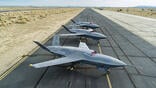
The AETC has received three T-7s at Joint Base San Antonio–Randolph, Texas, and at least two more are due by year-end. Starting in January, the command expects to receive one per month, Quinn says, and it anticipates initial operational capability in August 2027 with 14 aircraft and aircrew qualified. AETC instructor pilots are training on the aircraft and writing the initial syllabus for student pilots who start to train in 2028, Simmons says.
The new aircraft will help increase the throughput of student pilots and make them more capable for fifth- and eventually sixth-generation aircraft. However, even with growing throughput, the Air Force’s pilot shortage is expected to linger. The service is short about 2,400 pilots now, Simmons says.
As the Air Force prioritizes operations, it is suffering a more critical shortage of staff for jobs that require more experience, a problem that could take decades to resolve.
“I can’t erase that pilot deficit in a short period of time,” Quinn says. “They’re 15-year, 20-year people. It’s going to take 15 or 20 years to get those type of people. . . . I can make them today, but those jobs won’t be filled for quite some time. . . . I do know that if we don’t make 1,500, we’re never going to get that number down.”

Related Content

Comments