This article is published in Aviation Week & Space Technology and is free to read until Oct 19, 2026. If you want to read more articles from this publication, please click the link to subscribe.
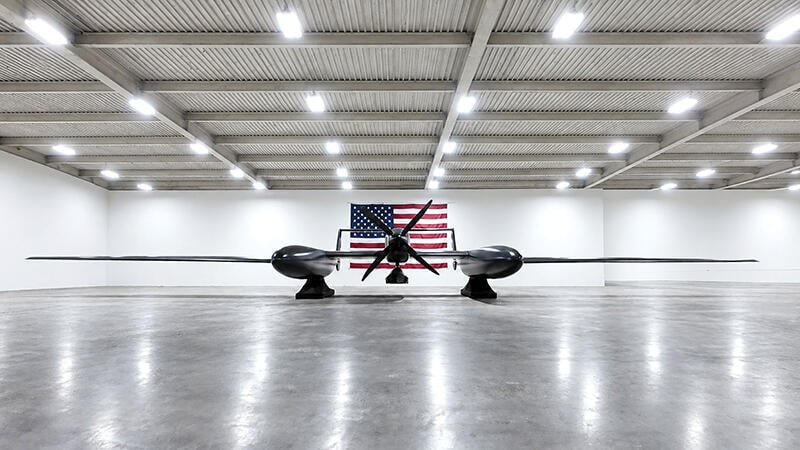
The 72-ft. wingspan of the twin-boom Gamera demonstrates a new way to build aircraft affordably and go after targets at extreme ranges.
Tipped off by data relayed from a space-based communications network about the location of a moving target tracked by yet another constellation of distant satellites, a future armed and autonomous Massed Modular Aircraft will consummate this so-called long-range kill chain, firing a stealthy anti-ship missile upon some unlucky enemy vessel still hundreds of miles away.
That vision had been on the U.S. Air Force’s wish list in various forms for nearly a decade. But Air Force and U.S. Space Force leaders focused their message at the Air & Space Forces Association’s (AFA) yearly Air, Space and Cyber Conference Sept. 14-16 on achieving that vision as quickly as possible—and with a new kind of uncrewed aircraft system (UAS).
- U.S. Air Force chief calls for 500 MMAs by 2032
- The concept introduces designs based on long-range kill-chain approach
Air Force Secretary Troy Meink committed Sept. 14 to fielding more than 500 of the Massed Modular Aircraft (MMA) by 2032, doubling down on a new acquisition priority revealed less than four months ago. Meink’s projection nearly tripled the number of MMAs compared with the “more than 180” estimate offered by Lt. Gen. Christopher Niemi, the Air Force’s assistant chief of staff for force modernization, in remarks to reporters only a few weeks before.
With an estimated unit cost of no more than $10 million each, Meink’s commitment could cost roughly $5 billion over six years on production aircraft alone.
“MMAs will provide affordable, attritable, long-range combat power,” Meink said in his AFA keynote speech. “And we’ll field them at scale. With budget support, we will field 100 MMA by 2029 at half the cost of a [Collaborative Combat Aircraft] and 1/10th the cost of a fifth-generation fighter so that by 2032, 500 of these platforms will join our Air Force’s operational fleet.”
The MMA acquisition plan also underscores a new willingness to take risks in the near term to realize the vision for connecting sensors and a new class of autonomous shooters over the Pacific Ocean’s vast distances in a hypothesized war with China.
The defense industry is preparing to compete. Jason Levin, Anduril’s senior vice president of engineering, told reporters on Sept. 14 that his company is interested in all military requirements for autonomous aircraft, including MMA, but declined to provide details. Earlier in September, General Atomics-Aeronautical Systems Inc. (GA-ASI) unveiled the Wildfire UAS, targeting the MMA requirement with an MQ-9A Reaper, which can fly missions over 8,000 nm and carry a pair of Lockheed Martin AGM-158B Joint Air-to-Surface Standoff Missile-Extended Range (JASSM-ER), AGM-158C Long-Range Anti-Ship Missiles (LRASM) or up to four Kongsberg Joint Strike Missiles (JSM).
Perhaps the most intriguing competitor is U.S. startup Swarm Aero. The company unveiled the Gamera UAS on the AFA exhibit floor on Sept. 14, revealing a 72-ft. wingspan, twin-boomed aircraft. Evoking the Scaled Composites globe-circling, crewed Voyager aircraft, the Gamera is designed to fly missions up to 9,000 nm while toting a JASSM-ER or LRASM below an engine nacelle perched on a wing between the two booms.
Swarm Aero’s four-year-old concept for the Gamera UAS precisely anticipated the Air Force’s unique requirement for the MMA. The concept includes an advanced, automated assembly for the composite aerostructures, with the goal of beating the Air Force’s targeted $10 million price point for each aircraft, company officials say.
“This is a large aircraft, but we’ve designed it from the ground up to be manufacturable at scale,” Swarm Aero CEO Peter Kalogiannis told Aviation Week at AFA.
An example of the aircraft’s readiness for mass production is the outboard wing panels. Due to the fuel tank capacity afforded by the twin-boom layout, Swarm Aero could design the Gamera with dry wings.
For operators, that makes it easier to remove the wings and maximize storage space. But that choice also makes the Gamera easier to build, Kalogiannis said.
“We don’t have to go in there and seal these very small wing bays to hold the fuel,” he said. “That’s a very labor-intensive process. We could eliminate that, and now we have a much more efficient aircraft to build.”
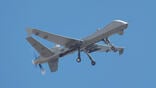
The concept behind the MMA represents a new approach in the category of medium-altitude long-endurance UAS that has been dominated in the U.S. inventory for two decades by the GA-ASI MQ-9A Reaper.
The MQ-9A represents an older paradigm than the MMA concept. Equipped with all of the sensors and weapons to complete a “kill chain” by itself, the Reaper patiently hunts for targets with radars, optical sensors and signals-intelligence receivers, then launches one of the missiles or rockets it is carrying.
The process also can involve receiving target data from other friendly military assets, but the MQ-9A is designed to complete the entire kill chain from target detection to elimination with no other military assets involved.
Although presented as an MQ-9A replacement, the MMA is expected to operate differently. It might be capable of performing some surveillance missions, but its job is long-range strike. Rather than using its own sensors to create a track for the target, it is expected to rely on offboard systems. Those systems instead direct the MMA to a launch point for the weapon it is carrying—a JASSM-ER or LRASM, for example—and release it.
The July solicitation by the Defense Innovation Unit gives contractors a five-year process to start fielding the MMA. That affords contractors time to build prototypes, complete flight testing and scale up a new manufacturing process.
Meanwhile, time could be running out on the existing inventory of MQ-9As. Iranian and Houthi air defense forces have scored dozens of Reaper kills over the last 2.5 years, reducing the Air Force fleet to less than 130.
Despite the heavy losses, Air Force leaders praised the MQ-9A’s performance. Gen. Kenneth Wilsbach, the chief of staff, called the Reaper the “most valuable” platform of Operation Epic Fury’s hunt for Iran’s mobile and disguised missile launchers.
But options to replace the lost Reapers with new MQ-9As are limited. Due to a lack of new orders, GA-ASI closed the production line for the 66-ft.-wingspan UAS at the end of 2024. Fewer than 10 unsold MQ-9As remained available for sale, and Italy recently ordered two of those.
GA-ASI initially offered the U.S. Air Force the 78-ft.-wingspan MQ-9B SkyGuardian, a heavier and longer-range variant. The U.S. Navy plans to lease a small number of MQ-9Bs, but the Air Force passed on the offer.
Instead of acquiring a straightforward successor to the MQ-9A, the Air Force chose to redefine its approach to the mission.
GA-ASI President Dave Alexander, who helped scale up the company’s original family of RQ-1 Predators more than 30 years ago, warns that it could take more time than the Air Force realizes for a new supplier to scale up production to the volumes that the Reaper family achieved over a period of decades.
“If you put some smart people together, you can build a prototype, right?” Alexander said. “To scale it into the kind of production that they’re talking about of, you know, 10-15 of these a month, that scalability, that’s, like, 10 times harder than that prototype.”