This article is published in Aerospace Daily & Defense Report part of Aviation Week Intelligence Network (AWIN), and is complimentary through Oct 20, 2026. For information on becoming an AWIN Member to access more content like this, click here.
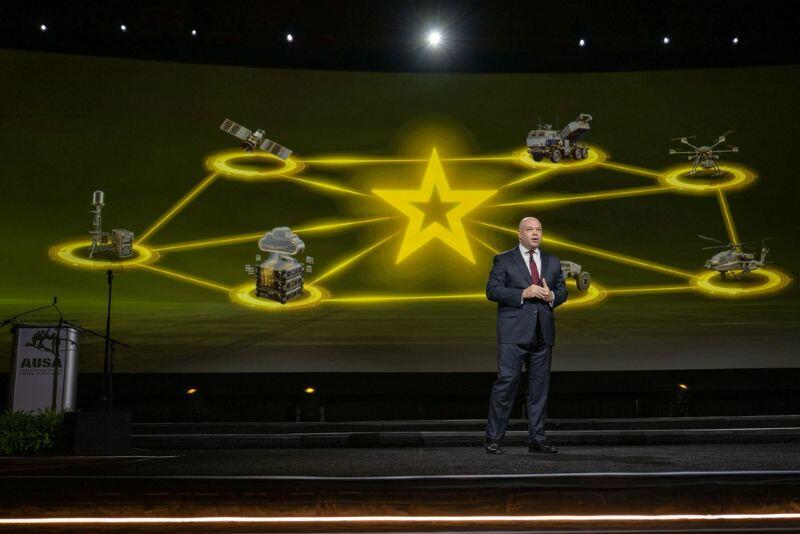
Acting Army Secretary Adam Telle speaks Oct. 12 at the Association for United States Army conference in Washington.
In his first major speech as Acting Secretary of the Army, Adam Telle used a line that has already been praised and repeated in the halls of the Association of the United States Army (AUSA) conference here.
“We’ve drowned ourselves and the public in buzzwords, strategies, slideshows, government acronyms and bureaucratic doublespeak,” Telle said Oct. 12. “Things that are advertised as revolutionary. But the Army’s value proposition is actually too fundamental for goofy corporate jargon.”
Focusing on the overuse of buzzwords is a welcome remark from the top of the Army’s bureaucracy, but even still it is hard to avoid the biggest buzzword that is everywhere both in the sprawling AUSA conference hall and in seemingly every new Pentagon memo and leader speech: Autonomy.
On the heels of Defense Secretary Pete Hegseth announcing last month the push to create a new four-star-led Autonomous Warfare Command, the Army is dutifully following suit. Acting Army Chief of Staff Gen. Christopher LaNeve on Oct. 13 formally announced the designation of Futures and Autonomous Systems Command (Fascom), previously Army Futures and Concepts Command.
LaNeve in his own remarks said the command is tasked with pioneering operational concepts for autonomous capabilities across the Army. The three-star-led command will consolidate existing work done by Combat Capabilities Development Command, Medical Research and Development Command, the 75th Innovation Command, Joint Modernization Command and the Transformation Decision Analysis Center.
The newly designated command will oversee new work by the Army’s five corps to test new equipment and make recommendations for acquisition, development and implementation. The 8th Army will oversee how crewed and uncrewed rotary wing aircraft will collaborate, with tests focusing on giving attack pilots direct control of UAS sensors for over-the-horizon targeting. The XVIII Airborne Corps will focus on autonomous aerial intelligence, surveillance and reconnaissance and lift. V Corps will create an autonomous breaching company, III Corps will have an autonomous armored reconnaissance company. and I Corps will have an autonomous fires battery and autonomous watercraft company.
“We’ve got to change our approach from bolting on technology to rethinking how we fight,” LaNeve said.
The general’s announcement follows an Oct. 1 memorandum from Telle further entrenching autonomy throughout the Army’s acquisition bureaucracy. In addition to Fascom, Telle ordered the Army’s G-3/5/7 Force Management Directorate to create force structure to put autonomous capability in formation.
The Army’s assistant secretary for acquisition, technology and logistics will stand up the Program Acquisition Executive for Autonomy and prioritize the acquisition of autonomous fires, combat vehicles, watercraft, supply, breaching and ISR systems “no later than” fiscal 2028. Additionally, the Army will expand the placement of the UAS specialist and robotic technician jobs “to all applicable Army units.”
Industry has taken notice of the Pentagon’s insatiable desire for autonomy, with the AUSA massive show floor—and open-air sites spreading into the nearby neighborhood—full of companies large and small touting autonomous systems. These include drones and counter UAS systems developed globally, including in Ukraine. Israel Aerospace Industries and Sig Sauer showcased a drone carrying a light machine gun. Robot dogs walk the show floor and showgoers fly and fight small quadcopters in a netted cage.
“The Department of War is committed to not only experimenting, testing and rapidly fielding advanced technologies, but to also proliferate proven technologies throughout our formations,” LaNeve said in remarks to industry representatives. “We are incorporating autonomous and unmanned systems at every single echelon across the formation.”

Related Content