This article is published in Aviation Week & Space Technology and is free to read until Aug 19, 2026. If you want to read more articles from this publication, please click the link to subscribe.
The Eurofighter Typhoon will be upgraded extensively to become a bridge to the GCAP platform and give export customers like Saudi Arabia and Turkey confidence in the Typhoon’s future.
An ambitious refresh of the UK’s Combat Air Strategy is set to reshape the Royal Air Force for a new era of warfare.
Eight years after the previous strategy led to the launch of the UK’s Future Combat Air System—and ultimately the trilateral Global Combat Air Program (GCAP)—the RAF’s Chief of the Air Staff, Air Chief Marshal Harv Smyth, is calling for the service to become Europe’s first sixth-generation air force (AW&ST July 30-Aug. 19, 2018, p. 38).
- New CCA program is planned to underpin the strategy
- Eurofighter investments aim to prevent capability gaps with GCAP introduction
- Combat Air Strategy explores optimum mix of F-35As and Bs
- Boom-equipped tanker now needed for GCAP aircraft, F-35 and other enablers
The recently published Defense Investment Plan (DIP) is providing a “clear pathway” for this modernized front-line fleet, Smyth told Aviation Week ahead of the Global Air and Space Chiefs Conference held here July 15-16.
The DIP has earmarked about £31 billion ($42 billion) for air and space programs (AW&ST July 13-26, p. 22). While GCAP secured the lion’s share alongside Eurofighter upgrades and acquisition of more Lockheed Martin F-35 Joint Strike Fighters, some £300 million has been set aside for the Storm Fighter, a collaborative combat aircraft (CCA) program that Smyth said underpins the strategy and the service’s modernization.
Although other European countries, including Germany and the Netherlands, are pressing industry to introduce CCA technology quickly, Smyth wants the RAF to lead the region in the field. His ambition is to fly a CCA concept demonstrator alongside a Eurofighter Typhoon during NATO’s Steadfast Defender exercise in 2027 and field an initial operational capability by the end of the decade.
RAF analysis suggests CCAs can transform crewed aircraft capabilities and make them “future-proof,” Smyth said.
They will “provide the sensor dispersion and weapons carriage that we urgently need in our air force today,” he later told the conference. CCAs would move the “economic calculus back in our favor, absorbing risk and enabling our crew platforms to more readily survive,” he added.
And combining a Typhoon with CCAs could help turn the fourth-generation fighter into a pseudo-fifth-generation air system, Smyth told Aviation Week.
Analysis prior to the DIP suggested that the RAF’s CCA developments could be delayed until the mid-2030s to align better with GCAP. However, Smyth said that lessons from Ukraine and advancements in artificial intelligence and autonomy confirm the need for the capability today—and that the technology exists to deliver it this decade.
The allocation of £300 million for a CCA program was a “big win,” he said, that will allow the RAF to begin working on it roughly a decade earlier than originally envisaged.
Smyth seeks a platform that could be delivered by UK industry—not just major primes, but small and medium-size companies, too. “If we can get our Royal Air Force ‘kitemark’ on it and prove it as a viable capability within the near term, there’s also a very real possibility we can export it and use it as an engine for growth for the UK’s brilliant aerospace industry, like we have achieved in the past with Hawk, Tornado and Typhoon,” he said.
Smyth noted that the RAF is willing to take risks to accelerate such programs, particularly if there is a time or operational imperative. “I’m going to want to spiral the [CCA] capability and keep going quickly and be happy to fail in some areas, but I want to adopt a fail-fast approach,” he said.
By the time the GCAP aircraft enters service in the late 2030s, Smyth wants the CCA program to have delivered several iterations and enhancements. “We are not looking for perfection in the first iteration,” he said. He intends to take an approach similar to the U.S. Air Force’s Century Series of fighters, from the F-100 Super Sabre to the F-106 Delta Dart.
Smyth said he is often frustrated to hear the RAF being “inappropriately” accused of being risk-averse. “Actually, in my experience, we are incredibly risk-aware, and we know how to manage risk against the imperative,” he said. “This is why we are being so successful on both operations and in capability development and delivery.”
Smyth pointed to the recent rapid integration of the BAE Systems APKWS II guided rocket system onto the Eurofighter in just 42 days from initial development to front-line service, despite being told that the process could take up to two years.
“If it was not for the fact that we were deployed and there was an immediate operational imperative, I think we may have struggled to meet those timelines,” he said. “The big lesson for defense is that we should not have to wait to be in a shooting war to be able to achieve these outcomes, we should be able make this business as usual.
“That’s my big push in the air force—to inject pace and get ahead of where the adversary is,” Smyth added.
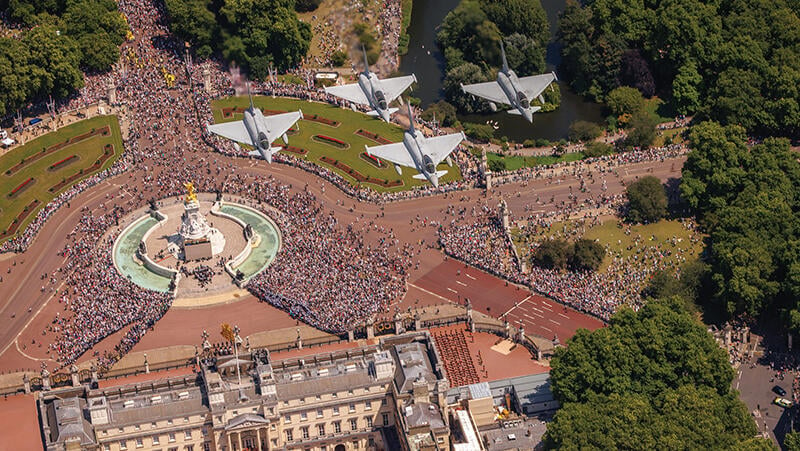
Beyond CCAs, the DIP enables key investments in front-line combat fleets. Although GCAP is intended to replace Eurofighter Typhoon eventually, the plan commits the RAF to upgrading the aircraft through the four-nation Long-Term Evolution program, including a midlife update.
Smyth said he needs a “proper overlap” and no “cliff edges” between the withdrawal of the Eurofighter and the initial operational capability of GCAP.” He added that continuing to develop the Eurofighter “allows me to bridge from that very solid combat air capability into the next.”
As for the F-35, Smyth said he is “not happy” about the slow pace of weapon integration. The RAF will have to utilize the RTX Small-Diameter Bomb II as an interim standoff weapon until MBDA’s Spear 3 miniature cruise missile is integrated (AW&ST Oct. 13-26, 2025, p. 28).
“We need to get better at developing and integrating weapons onto our platform,” Smyth said. “If Ukraine has taught us one thing, it is that pace of delivery to the front line is absolutely key.”
The RAF remains committed to introducing the conventional-takeoff-and-landing F-35A for the dual-capable aircraft substrategic nuclear mission as announced in June 2025 by then-Prime Minister Keir Starmer. The primary role of the F-35As will be training, as they are cheaper to operate than the short-takeoff-and-vertical-landing F-35B.
But as part of the Combat Air Strategy refresh, the RAF and Royal Navy plan to examine the optimum balance of F-35A and B aircraft, which could lead to the acquisition of more F-35As beyond the 12 announced last year. Additional F-35s would allow the service to use the deep-precision-strike capability before the GCAP fighter enters service, Smyth said. Plans to introduce CCAs onto Queen Elizabeth-class carriers as part of a hybrid air wing could reduce the need for large numbers of F-35Bs to be embarked.
The Storm Fighter joins a growing family of autonomous systems. The RAF already has the Storm Shroud, a Tekever AR5 uncrewed aircraft system fitted with an electronic warfare payload to confuse enemy air defenses. These have been joined by the Storm Chrome, a long-range electronic warfare drone, and the Storm Fire, a low-cost 1,000-mi.-range one-way effector likely derived from the Lanner foam-molded lifting body munition.
Beyond combat aircraft, Smyth wants to strengthen the RAF’s enabling capabilities. He is looking ahead to service entry of the delayed Boeing E-7 airborne early warning aircraft and expects the three Wedgetails to be flying operational missions by next summer. Acquiring additional aircraft to build out the fleet—a recommendation of the Strategic Defense Review—remains an aspiration for now, he said.
“We know that we need more than three if we are to appropriately defend UK airspace, particularly given the threat we see from Russia,” and procurement of more aircraft will be a “discussion for future spending and defense reviews,” Smyth said.
The RAF is also looking at space-based airborne moving target indicators as part of a layered approach to airspace surveillance.
In addition, the service wants to expand its aerial refueling capability by adopting boom-equipped tankers, Smyth said. After decades of relying on probe-and-drogue refueling alone, the RAF is exploring options with Airtanker, operator of the service’s Airbus A330 Multi-Role Tanker Transports, to install a boom. That would finally enable the service to refuel aircraft including the Boeing C-17, P-8 Poseidon, E-7 and RC-135 Rivet Joint as well as F-35As and GCAP aircraft.
“I am confident we will find a way through this discussion,” he said. “It is a capability we know we really need, especially as more of our fleet require a boom [versus] a drogue to conduct air refueling.”
The RAF also wants to grow its role in space. Smyth—who was named the service’s first director of space in 2020—said the RAF is “significantly pivoting” from space domain awareness to space control. The service has access to “very unique” and “niche” classified capabilities that have been used to great effect, he said, and these would be scaled further through the DIP. There will also be six new dedicated space squadrons, a component command and a space defense center from which space control missions can be operated.
Smyth said the RAF is adopting a new mindset for “transition to conflict” and testing and proving out new concepts including agile combat employment to achieve combat capability through dispersion.
For Smyth, all these initiatives form part of a broader ambition—to make the RAF Europe’s first sixth-generation air force. “It would be great if we could be the first to do that in Europe, because I think when you’re a first, others will follow,” he said. “The RAF has a very proud history of leading the way, and I am determined to continue in that vein.”