This article is published in Aviation Week & Space Technology and is free to read until Jul 03, 2026. If you want to read more articles from this publication, please click the link to subscribe.
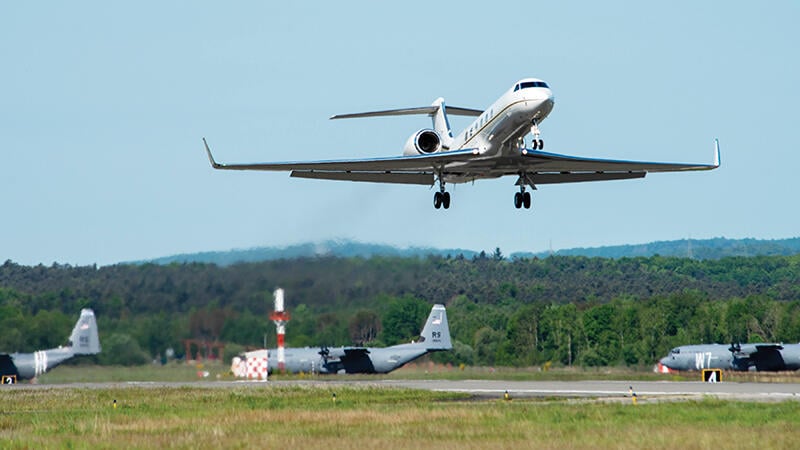
The U.S. Air Force has not specified what aircraft type will replace the C-37A/B beginning in 2027.
While much attention has gone to major changes to the Pentagon’s Air Force One plans under President Donald Trump, the administration’s directed major budget increase is allowing services to fund other VIP transport and support aircraft fleets that have received less priority.
The Pentagon’s fiscal 2027 budget request aims to reach $1.5 trillion through a combination of base spending plans and a reconciliation process. That plan includes refreshing the U.S. Air Force’s Boeing 737- and Gulfstream G550-based VIP fleet and expanding U.S. Marine Corps goals for its small fleet while outlining U.S. Army hopes for its aging yet in-demand support aircraft.
- The Air Force wants C-37 and C-40 replacements
- The Pentagon details Air Force One schedule
The Air Force’s shift is the biggest in the Pentagon’s new spending plan. The service expects to buy one C-37C in fiscal 2027 for $208 million, followed by three in 2028, four in 2029, four in 2030 and five in 2031. Collectively, the plan calls for $2.2 billion for 17 aircraft under the Common Small Executive Airlift Replacement Aircraft program.
The Air Force says it will modify an existing commercially derived aircraft with VIP interiors, along with a distinguished visitor compartment, mission communication and self-defense. Air Mobility Command describes a requirement of carrying five aircrew and 20 personnel for nonstop trips of up to 7,500 mi.
The current fleet is a mix of Gulfstream V-based C-37As and G550-based C-37Bs. Even though the G550 is out of production, it is still in demand as the Air Force grows its EA-37B Compass Call fleet based on the type. The service said in a statement that it would not comment on what aircraft the C-37C would be based on, pending an acquisition strategy, but keeping the same mission designation would require a similar aircraft like the Gulfstream G700. The U.S. Coast Guard recently procured two G700s for its own C-37s. Eight C-37As and C-37Bs are to be retired over the next five years.
The Air Force’s budget plan also calls for purchasing a used 737 to modify into a C-40C to augment its current fleet of the type. Last year, Congress called for $250 million to buy the aircraft after lawmakers had blocked a plan for the service to buy a 737 MAX to create a new C-40D. Four C-40Cs are to be retired in 2028.
Air Mobility Command has called for recapitalizing both the 737-based C-40s and the 757-based C-32s with one type, potentially downsizing to a business-jet-size aircraft. The service also flies the much smaller Learjet-based C-21, although the command says this fleet is viable until at least 2030.
The Air Force One plan has become clear within the past year, as the service has detailed a new schedule to retire the Boeing VC-25As in 2029, and the VC-25Bs are expected to be delivered in 2028. This summer, the Air Force anticipates delivery of a Boeing 747-8 donated by Qatar. The aircraft has been modified into what the service designates as the “VC-25B Bridge Aircraft” with a much smaller suite of upgrades.
The Marine Corps flies a smaller fleet of Beechcraft UC-12 and Cessna UC-35 VIP transports. The service is in the early stages of its own recapitalization to a one-type UC-12W fleet, and the Pentagon’s spending plan includes a major ramp-up in this procurement. The Marine Corps is to acquire 10 UC-12Ws in 2027, up from just one in 2026, followed by seven in 2028 for a total of 28, including previous buys.
The Army hopes to follow, although that spending has not been detailed yet. Col. Joe Minor, capability program executive for aviation within the service’s portfolio acquisition executive maneuver air office, tells Aviation Week that the service has been updating the C-12—a military version of the Beechcraft Super King Air and Beechcraft 1900—to a modern two-variant fleet.
The updated C-12V features a Collins Pro Line 21 integrated avionics system, a fresh interior and new paint. The C-12Y is modernized with a Garmin G1000 NXi integrated flight deck and a new autothrottle system to automate power management. Minor says the Army might acquire a standalone autothrottle system for the V variant.
The Army flies 13 Fairchild C-26 Metroliners that have sustainment and readiness challenges, and Minor says they should be recapitalized as spending allows.
Similar issues with aging and obsolescence face two jet transports. Minor says the Army is looking at replacing its UC-35 with something longer-range—such as an aircraft roughly the size of a Bombardier Challenger 3500, Cessna Citation Longitude or Gulfstream G280—that could operate in the Indo-Pacific region, where the current fleet is challenged in flying to places like Hawaii and Guam, he says. The Army also flies three C-37As older than the Air Force’s fleet that should be replaced as age-related issues persist, he says.

Related Content