This article is published in Aviation Week & Space Technology and is free to read until Feb 28, 2026. If you want to read more articles from this publication, please click the link to subscribe.

Royal Saudi Air Force Faces Modernization Crossroads

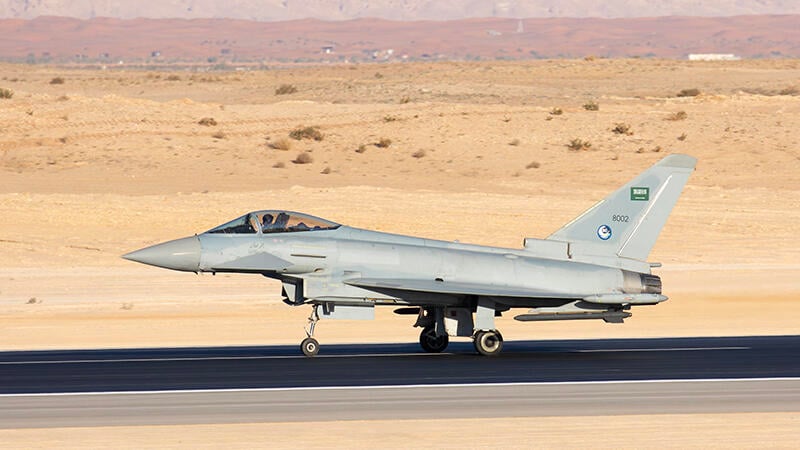
Royal Saudi Air Force's Eurofighter Typhoon

BAE Systems is proposing local assembly of a second Saudi batch of Eurofighters that could also enable involvement in the Global Combat Air Program.

Credit: Tony Osborne/AW&ST

Saudi Arabia’s air force is facing a series of critical modernization and restructuring decisions as the kingdom—the biggest defense spender in the Middle East—seeks greater self-reliance.

The Royal Saudi Air Force (RSAF) may soon need to confront capability gaps as it prepares to divest its oldest front-line types, including the Boeing F-15C/D Eagle, Panavia Tornado and an aging fleet of Lockheed C-130 Hercules airlifters.

  • Saudi Tornado and F-15C/D fleets are slated to be phased out in coming years
  • Airbus and Embraer are pushing hard for airlifter sales to replace Hercules
  • Riyadh continues to plan for merger of air arm and air defense forces

At the same time, the service is grappling with a long-discussed proposal to merge with the Royal Saudi Air Defense Forces to create a Royal Saudi Air and Space Force. First outlined in 2015, that plan has yet to advance.

Riyadh has several modernization paths available but has made no firm decisions. That caution may be partly driven by Vision 2030, a national strategy to diversify the economy and expand domestic defense industry capabilities. But large fighter purchases from overseas could be seen as politically and economically difficult unless accompanied by substantial local industrial participation.

Royal Saudi Air Force's Panavia Tornado IDS fighter jet
The RSAF’s Panavia Tornados are recognized as the service’s carrier for “strategic weapons” such as air-launched cruise missiles, although this task can be performed by the Eurofighter. Credit: Tony Osborne/AW&ST

Industry officials expect the RSAF’s Tornado fleet to leave service around 2030, in line with Germany and Italy. The F-15C/D fleet is already being phased out, with some aircraft “destined for museums,” a senior RSAF commander said here at the World Defense Show (WDS), held Feb. 8-12. Dedicated training units for the two aircraft types have been disbanded, and only a handful of the pilots being trained each year through the RSAF training pipeline are being streamed to the Tornado or the older Eagles. As for the C-130, the RSAF’s fleet is made up of more than 30 C-130Hs and two KC-130Js that are heavily utilized, particularly as the service performs more international deployments notably to Europe, Turkey and Pakistan, with which Saudi Arabia has agreed on a mutual defense pact.

BAE Systems continues to promote a second tranche of up to 54 Eurofighter Typhoons, eight years after a memorandum of understanding was signed between London and Riyadh. The UK offer includes what BAE describes as a substantial industrial package, building on local assembly of Hawk advanced jet trainers completed in Dhahran, Saudi Arabia, in 2022 (AW&ST March 26-April 8, 2018, p. 51). A Typhoon order could also strengthen Saudi aspirations to join the Global Combat Air Program (GCAP), a move that would be in line with the kingdom’s interest in having a seat at the table on a next-generation fighter program.

But Riyadh has also been distracted by another option recently, the Lockheed Martin F-35 Joint Strike Fighter. U.S. President Donald Trump declared in November, ahead of a visit by Saudi Crown Prince Mohammed bin Salman to Washington, that he would approve the sale of the low-observable fighter to Saudi Arabia. The F-35 featured prominently at WDS, including a full-scale mockup in RSAF markings. However, the status of any potential Foreign Military Sales deal remains uncertain, and delivery timelines would likely stretch well into the 2030s. Moreover, the F-35 offers limited scope for industrial participation aligned with Vision 2030.

Another option involves modernizing the RSAF’s most recent fighter purchases, the F-15SA/SR (Saudi Advanced) Eagle that is now arguably the backbone of the RSAF. Boeing has proposed potential upgrades of those aircraft to bring them up to the F-15EX standard, the version being acquired by the U.S. Air Force. Although development of the F-15SA lit the spark for Boeing’s development of the Advanced F-15 family that includes the F-15EX, Boeing officials say the F-15SA features technologies that now date back more than 15 years.

The F-15SA currently features a cockpit arrangement similar to the F-15E Strike Eagle, an older Raytheon APG-63v3 active, electronically scanned array (AESA) and BAE’s Digital Electronic Warfare System. An upgrade package would add the F-15EX’s wide-area cockpit display, the more capable APG-82 AESA radar and the Eagle Passive/Active Warning and Survivability System electronic warfare system.

“The F-15 is 52 years old, and the F-15EX is the latest and greatest [version] of that,” said Vince Logsdon, Boeing Defense’s vice president for international business development. “We are looking at potential upgrades to the SA aircraft and potential new buys as well.”

An SA-to-EX upgrade could be performed in-country by Saudi Arabian Military Industries’ AlSalam Aerospace, an organization that recently completed the F-15S-to-SR upgrade.

Saudi Arabia has also expressed interest in Turkish Aerospace Industries’ Kaan fighter, which first flew in 2024. Although a memorandum of understanding was anticipated at WDS, no agreement was signed. Turkish officials have indicated discussions remain active and could  advance in the coming months.

Turkish President Recep Tayyip Erdogan had hinted at a potential Kaan deal, stating that the two countries were nearing an agreement following his meetings with the crown prince in Riyadh shortly before the show.

In the airlift domain, Airbus and Embraer see potential opportunities despite the absence of a formal requirement. Embraer had proposed a C-390 final assembly line in Saudi Arabia but has since shifted plans toward a regional completion center in the United Arab Emirates. Airbus says the A400M—recently upgraded from a 37- to 40-metric-ton maximum payload—could meet Saudi tactical and strategic needs and has developed a roll-on/roll-off VIP interior with the kingdom in mind that was also revealed during WDS (AW&ST June 30-July 13, 2025, p. 27).

Airbus performed demonstration flights for officials from the Saudi defense ministry and the General Authority for Military Industries using a German Air Force A400M.

On top of these procurement decisions is the unresolved question of merging the RSAF and the air defense forces that form part of the kingdom’s 2015 National Defense Strategy drawn up by bin Salman, who served as defense minister in 2015-22.

Saudi Arabia has proposed a modernization of both the defense ministry and its armed forces, with some 300 initiatives being rolled out through 2028, but it is unclear whether the merger of air force and air defense forces will be achieved by then. Officials at WDS would not say when the merger could take place or whether the 2028 deadline remains.

Both organizations have worked closely to protect Saudi cities and critical infrastructure from drones as well as cruise and ballistic missile attacks launched by the Houthi militants in Yemen. Officials describe the merger of the two services as a means of “achieving operational integration” and “enhancing superiority in both the air and space domains.” A single service would reduce reaction times to aerial threats, and it would avoid overlaps in roles and responsibilities, “unifying decision-making and effort,” they say.

Tony Osborne

Based in London, Tony covers European defense programs. Prior to joining Aviation Week in November 2012, Tony was at Shephard Media Group where he was deputy editor for Rotorhub and Defence Helicopter magazines.