This article is published in Aerospace Daily & Defense Report part of Aviation Week Intelligence Network (AWIN), and is complimentary through Apr 27, 2026. For information on becoming an AWIN Member to access more content like this, click here.
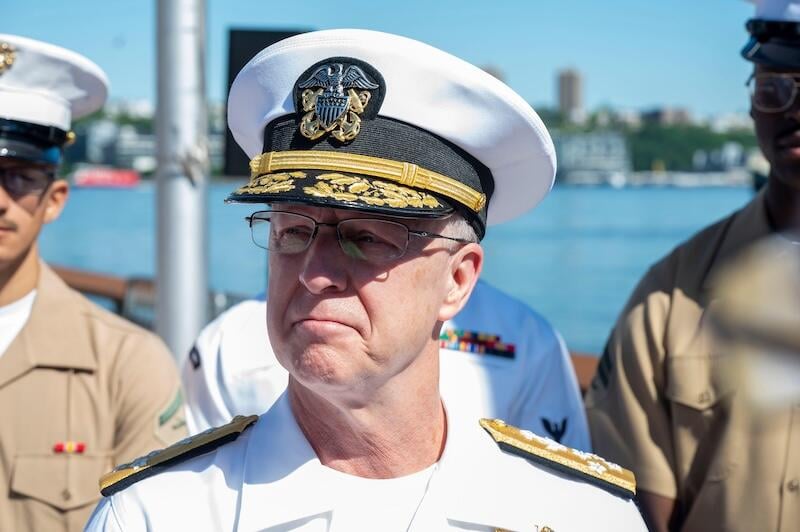
Chief of Naval Operations Adm. Daryl Caudle.
Credit: ZUMA Press Inc./Alamy
One of the two companies vying for the F/A-XX contract lacks the capacity to deliver the fighter on time, Chief of Naval Operations Adm. Daryl Caudle told reporters on April 20.
Caudle’s remarks, which came early on the first morning of the Navy League’s Sea Air Space convention, shed light on the reasons for a decision by the U.S. military’s civilian leaders last year to postpone a planned contract award for the next-generation carrier-based fighter.
“One of the contractors who would make this plane for us is in a place where they really can’t deliver in the timeframe we need it,” Caudle said. “So there was, just, you know, 'check twice, cut once' kind of mentality here on this decision.”
Caudle did not name which of the two remaining bidders for the F/A-XX program falls short of the required capacity. Boeing and Northrop Grumman executives have said they have the ability to meet the Navy’s schedule for the fighter. The Navy eliminated Lockheed Martin from the competition nearly two years ago.
Despite those concerns, the military’s civilian leadership agreed at the end of last year to proceed with the F/A-XX contract award in 2026. Caudle expects a decision near the end of the summer.
“I think you’re going to see a downselect on this in August,” Caudle said. “I think that’s the month that they have committed to making the decision on the program.”
The Navy plans to acquire a fleet of F/A-XX fighters to replace the Boeing F/A-18E/F Super Hornet and EA-18G Growlers on carrier decks starting in the mid to late 2030s.
Although civilian leaders grew concerned about the capacity within the industrial base to support the program, the Navy’s military leadership has not wavered in the requirement for a new carrier-based fighter.
“This is just having an aircraft that can operate with a level of certainty and with the acceptable level of risk, even by the time that plane fields against adversaries,” Caudle added.