This article is published in Aviation Week & Space Technology and is free to read until Dec 19, 2025. If you want to read more articles from this publication, please click the link to subscribe.

From Colombia To Ukraine To Saudi Arabia, Fighter Deals Are On
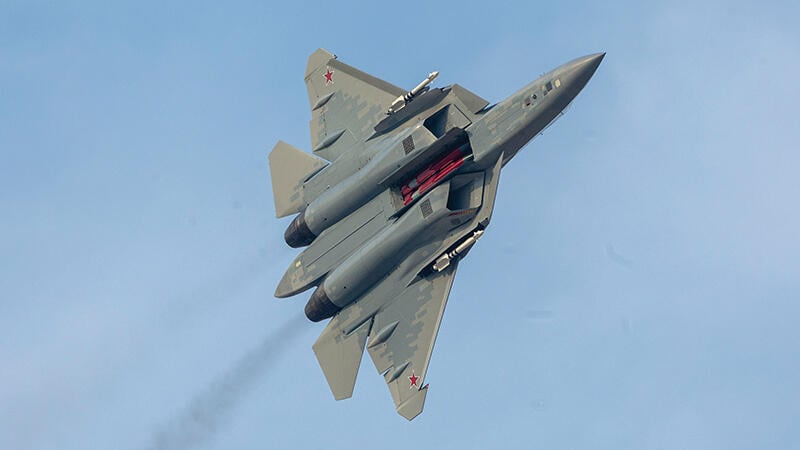
Sukhoi Su-57E flying against sky

After U.S. President Trump greenlit Lockheed Martin F-35 sales to Saudi Arabia, UAE President Mohammed bin Zayed Al Nahyan watched the Sukhoi Su-57 fly at the Dubai Airshow.

Credit: Billypix

When it comes to fighter procurement, this year could go down as one for the ages.

By mid-November, a number of landmark deals had been made: the Pentagon chose Boeing to build the F-47, Turkey bought 20 new Eurofighter Typhoons and Ukraine committed to 100 Saab Gripens. But in recent days, activity moved to another level. The White House greenlit the first Lockheed Martin F-35 export to a Gulf country, Ukraine and France shook hands on the sale of 100 Dassault Aviation Rafales, and the Gripen E/F secured a third foreign order, this one from Colombia.

U.S. President Donald Trump declared on Nov. 17 that he would approve the sale of F-35As to Saudi Arabia, adding that Riyadh has been a “great ally” and wants to buy the fifth-generation fighters. The statement, made in Washington on the eve of a visit by Saudi Crown Prince Mohammed Bin Salman on Nov. 18, was followed by an official White House declaration on selling the country a defense package including the F-35.

  • Ukraine eyes purchase of 100 Dassault Rafales
  • Saab finalizes Colombia Gripen order

That announcement reverberated at the Dubai Airshow. While Trump’s pledge did not lock in the region’s long-awaited F-35 order, it signaled closer ties between Washington and Riyadh—perhaps at the expense of other relationships.

The F-35 has reached this point before in the region. Five years ago, the first Trump administration approved a $10.4 billion deal to export 50 F-35As to the United Arab Emirates (UAE). The approval came after the UAE became the first Gulf state to agree to the U.S.-brokered Abraham Accords and normalize relations with Israel, a move that has been strained by Arab and global reaction to the two-year war in the Gaza Strip.

In September 2021, then-President Joe Biden suspended the F-35 export case for the UAE, citing the country’s growing links to the Chinese military. A sign of that relationship was in plain sight at the Dubai Airshow, as the UAE Air Force’s Fursan Al Emarat aerobatic display team made its first performance with the Hongdu L-15 after confirming the order at the previous gathering in 2023.

Once spurned by the U.S. government, UAE officials seemed to lose interest in acquiring the F-35As, even as the possibility of a second Trump administration grew last year. In September 2024, the UAE ruled out renewing talks to seal an order even if Trump won reelection.

Zelenskyy and Macron shaking hands
Ukrainian President Volodymyr Zelenskyy (left) and French President Emmanuel Macron shook hands near Paris on a deal for 100 Rafales and more. Credit: Elysee Palace

The UAE has historically balanced geopolitics and fighter acquisition by splitting orders between U.S. and French manufacturers, but the country has been expanding its hedging strategy.

Meanwhile, as Lockheed Martin awaits the completion of the U.S. government’s labyrinthine arms export approval process, company executives awkwardly avoided any temptation to gloat over the prospect of finally selling F-35s in the area between Israel and South Korea.

“All I can say is President Trump made the announcement,” Steve Sheehy, vice president of international business development for Lockheed’s Aeronautics business, told Aviation Week at the Dubai Airshow. “We appreciate, you know, his supporting of the F-35 program.”

The U.S. has not disclosed details of the Saudi F-35 deal, its value or what the weapons package would comprise.

The extent to which the potential deal—still awaiting congressional approval—would affect the prospects for others chasing fighter business in Saudi Arabia is also unclear. The Boeing F-15EX, Eurofighter Typhoon and Dassault Rafale have been competing for a blockbuster order from Riyadh. Saudi Arabia still has the option of further modernizing its air force with a mixed fleet.

The country also has signaled it wants to participate in one of the future fighter programs emerging in the U.S. and Europe. Given the level of classification around such programs in the U.S., Saudi interest could keep the door open for sales and industrial work on current European combat aircraft as a steppingstone.

Near Paris, another blockbuster fighter deal unfolded in parallel. Ukrainian President Volodymyr Zelenskyy and French President Emmanuel Macron signed a declaration of intent for Kyiv to buy 100 Rafale F4s. The acquisition, announced at Villacoublay air base on Nov. 17, could be worth more €12 billion ($13.9 billion) and would be the largest export contract for the Rafale in terms of aircraft numbers.

Zelenskyy’s office said the agreement covers possible technology transfer and local assembly of the Rafale in Ukraine. The deal would include weapons for the fighters, consisting of air-to-air missiles and guided bombs. Ukraine is already using the Safran Hammer guided bomb kit and would receive more under the new deal.

“This moment is something special and truly historic for both nations . . . new planes, new reinforcements, new steps to strengthen our army and our country,” Zelenskyy said.

Kyiv also would acquire Eurosam SAMP/T NG ground-based air defense systems and radars. Zelenskyy said the two countries will begin joint projects this year to produce low-cost interceptor drones and work on the “development of critical technologies and components that can be integrated into Ukrainian drones.”

With or without a peace agreement, Kyiv needs to acquire modern combat aircraft to address the Russian threat because its Soviet-era fighters—Su-khoi Su-24s, Su-25s and Su-27s and Mikoyan MiG-29s—are obsolete. Secondhand Lockheed Martin F-16s from Belgium, Denmark and the Netherlands, as well as Dassault Mirage 2000s from France, could be difficult to keep relevant against enhanced Russian combat aircraft in the future.

In late October, Ukraine signed a letter of intent with the Swedish government to acquire the single-engine Saab Gripen E. The deal covers up to 150 aircraft and potential surplus Gripen C/Ds from Swedish stocks to enable Ukraine to become familiar with the fighter. The first Gripen E delivery could happen in three years, officials said.

There are still big questions around funding for both fighter deals, given the size of the bill and Ukraine’s weak economic position. One option the governments are pursuing is the use of frozen Russian assets in European banks.

On the eve of the Dubai Airshow, Saab also finalized a roughly €3.1 billion agreement with Colombia for the purchase of 17 Gripen E/Fs—15 single-seat Gripen Es and a pair of two-seat Gripen Fs. The aircraft would replace an aging fleet of Israel Aerospace Industries Kfir fighters and would arrive in 2026-32.

The move caps an active year for Gripen orders that also included the Royal Thai Air Force’s finalization of a deal for four in August. Thailand also plans to buy more.

Saab CEO Micael Johansson has said the company needs to scale up Gripen output to keep pace and may need to add a third final assembly location to satisfy demand. Eurofighter and Dassault also are ramping up to address growing backlogs.

Embraer, which plans to assemble 15 Gripen Es as part of the Brazilian Air Force’s order of the fighter, will assemble a portion of the Colombian fleet at its defense manufacturing hub in Gaviao Peixoto, Brazil; the balance will be delivered from Saab’s plant in Linkoping, Sweden.

The Su-57’s outing to Dubai marked only its third event appearance outside Russia—and the first time it flashed its internal weapon bays. Rostec CEO Sergey Chemezov said the aircraft was in “huge demand” from potential export customers, without addressing whether Algeria, long suspected to be a buyer, is already a customer.

Four years after Rostec debuted a mockup of the single-engine Su-75, dubbed the Checkmate, at Dubai in 2021, the fighter is progressing toward first flight, Chemezov said.

—With Brian Everstine in Washington

Steve Trimble

Steve covers military aviation, missiles and space for the Aviation Week Network, based in Washington, DC.

Tony Osborne

Based in London, Tony covers European defense programs. Prior to joining Aviation Week in November 2012, Tony was at Shephard Media Group where he was deputy editor for Rotorhub and Defence Helicopter magazines.

Robert Wall

Robert Wall is Executive Editor for Defense and Space. Based in London, he directs a team of military and space journalists across the U.S., Europe and Asia-Pacific.