This article is published in Aerospace Daily & Defense Report part of Aviation Week Intelligence Network (AWIN), and is complimentary through Aug 24, 2026. For information on becoming an AWIN Member to access more content like this, click here.
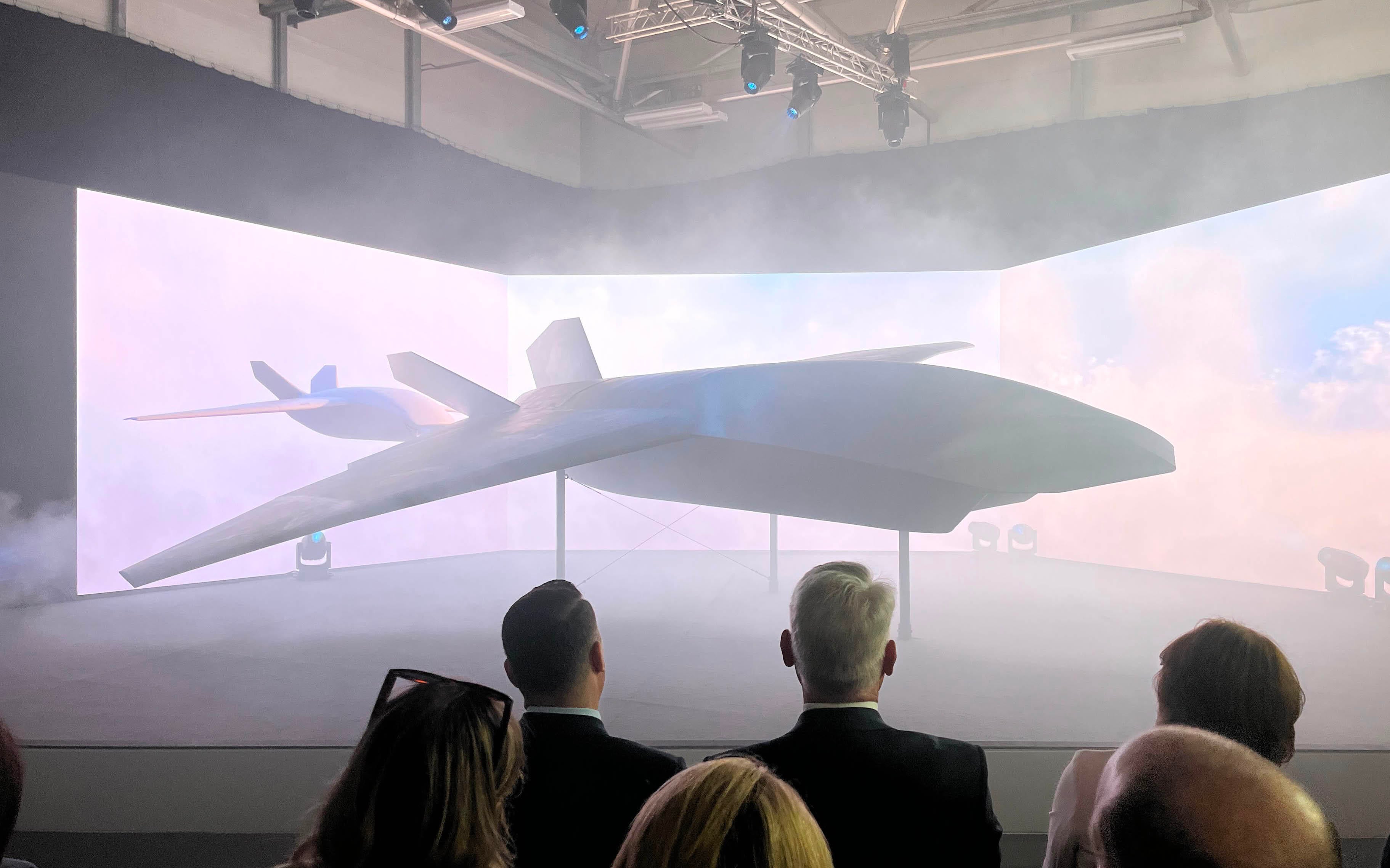
FARNBOROUGH, England—BAE Systems is to help the Royal Air Force (RAF) take its first steps in the collaborative combat aircraft (CCA) era and move the service toward its aim of being Europe’s first sixth-generation air force.
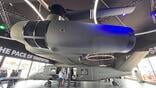
The company unveiled a model of its Brontanax CCA here at the Farnborough Airshow, a self-funded autonomous CCA platform it plans to begin test-flying next year and allow the RAF to achieve its aim of flying a CCA platform alongside a Eurofighter Typhoon before the end of 2027. Brontanax is an ancient Greek word for Thunder King.
While a number of U.S. developed CCAs have tried to grab the RAF’s attention at the Farnborough Airshow, BAE claims its delta-winged, low-observable platform—similar in size to a Hawk jet trainer—is entirely sovereign, leaning on a supply chain of more than 100 UK companies. Although it currently lacks a British engine in this initial iteration, BAE Systems and the RAF hope to be able to lean on an emerging family of powerplants developed by Rolls-Royce through a new Orpheus family of low-cost, rapidly developed turbofans in the future.
And although the new platform is seen as a demonstrator by the RAF, for BAE, the aircraft is a “pre-series, pre-production prototype” of an aircraft it wants to put into serial production and field with the UK or allies, Dave Holmes, the director of BAE’s FalconWorks aerospace research and development arm, told journalists ahead of the reveal.
FalconWorks has been leading the development of the CCA platform and has previously revealed details of its CCA concepts since 2022, but the company had become tight-lipped on the work over the last two years as it matured the plans toward a flying prototype. The first prototype has already been assembled by BAE Systems at its site in Warton, England, and will move into ground testing in early 2027 followed by flight testing in the UK by the second quarter of that year. Air Chief Marshal Harv Smyth, the RAF’s chief, told Aviation Week that he wants to be able to demonstrate the CCA capability at the 2027 Steadfast Defender NATO exercise. That demonstration will then pave the way for the launch of the RAF’s new Storm Fighter CCA program, backed by £300 million ($401 million) allocated in the Defense Investment Plan.
Speaking at Farnborough, Smyth said the unveiling marked a “meaningful pivot” toward sixth-generation air power, adding that it was a “deliberate stepping-stone pathway through this next decade, laying the groundwork for the Global Combat Air Program.”
At the heart of the aircraft is a BAE-developed vehicle management systems with software that leans on the Pyramid reusable and open avionics system reference architecture that is owned by the UK Defense Ministry.
'Sweet Spot'
“We're not starting from a clean sheet,” Holmes said. Company engineers leaned on its experience developing uncrewed systems such as Corax, Herti, Mantis and Taranis. The airframer is targeting what Holmes calls a “sweet spot” producing a platform capable of performing 70% to 80% of the Eurofighter’s missions, but at 20% to 25% of the cost.
Holmes’ view is that deviating from that sweet spot raises costs and can inadvertently invoke Augustine’s 16thlaw, which results in military aircraft costs growing exponentially.
Crucially, lessons have also been learned from the RAF’s previous attempt to develop a CCA demonstrator—Mosquito—development of which was halted in 2022 before assembly was completed. Among the lessons learned from Mosquito was not to over-engineer a platform that is expected to perform only a limited number of flight hours and may only ever fly for occasional training or in wartime.
RAF officials said the contemporary CCA work is a more “refined conversation” and that the level of funding more realistically matches the new ambitions of the service.
Beyond developing the air vehicle, Holmes said the company has also been considering how to deliver the platform and make sure that it can be enhanced in “calendar weeks” rather than the “calendar years” associated with the upgrade of current-generation crewed fighters. The company is exploring the potential of a production system that can not only be “fractionated and distributed to partner nations,” but one that is always on and “doesn’t care what it is making.” That would avoid what he described as the “astronomical cost of the engineering, the tooling, all of the infrastructure that goes with it to launch a big program.”
Exports are also a crucial element for both BAE and the RAF, so the future CCA platforms will adopt the government reference architecture developed by the U.S. so that it can become a “more accessible system” for export customers and one that is “as controllable as agnostically as possible,” RAF officials said.

Related Content