This article is published in Business Aviation & AAM Report part of Aviation Week Intelligence Network (AWIN), and is complimentary through Nov 07, 2026. For information on becoming an AWIN Member to access more content like this, click here.
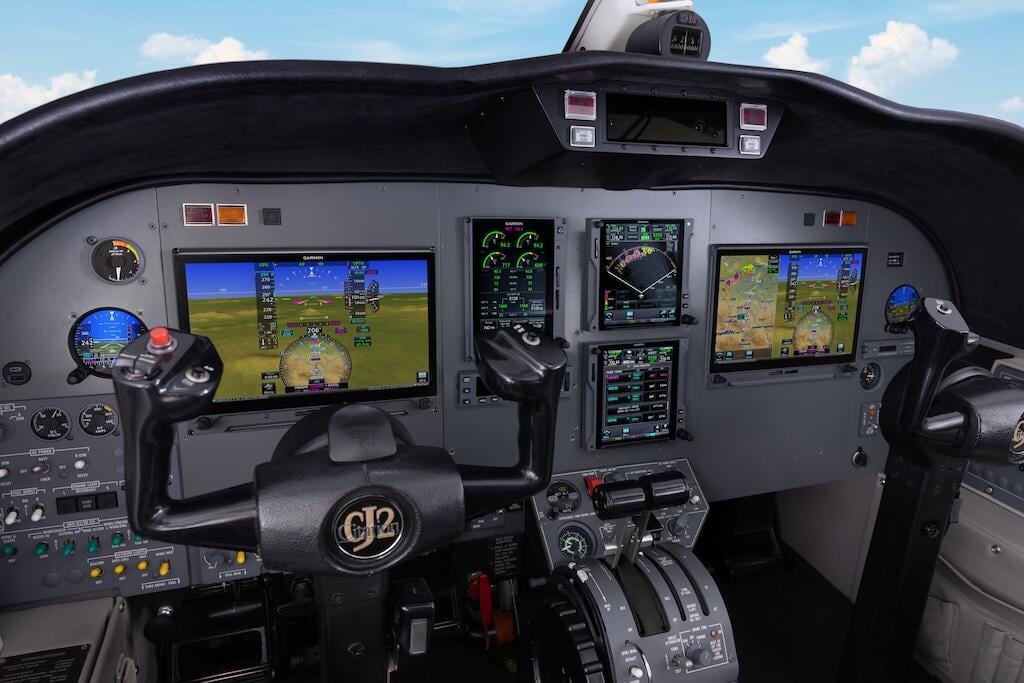
The CitationJet upgrade builds on Citation CJ1 and CJ2 retrofits.
Garmin will showcase new developments at NBAA-BACE spanning avionics retrofits, automated and autonomous systems, flight-planning software and database updates.
The avionics manufacturer announced on Sept. 22 that it has received FAA supplemental type certification (STC) approval for a flight deck modernization of the original Cessna Model 525 CitationJet, certified in 1992. The upgrade builds on proven retrofit programs for its successors—the Cessna Citation CJ1 and CJ2.
Included are two Garmin G600 TXi touchscreen flight displays, GTN Xi navigators, a GFC 600 digital autopilot, GWX 8000 StormOptix weather radar and optional upgrades designed to reduce pilot workload and add new capability and safety-enhancing technologies.
The autopilot provides new operational capabilities such as coupled vertical navigation (VNAV) descents and coupled go-around capability while executing a missed approach, allowing automation to assist during high-workload procedures, Garmin says. In the event of a loss of cabin pressurization, Emergency Descent Mode can automatically descend the aircraft to a preset altitude to help prevent hypoxia.
Cessna built a prototype and 359 original Model 525s, according to the Aviation Week Fleet Discovery database. Garmin expects around half of current operators will upgrade their CitationJets in the next 5-10 years.
“A large number of them have our GTNs already because we’ve had that ability for a long time,” says Dan Lind, Garmin senior director for aviation sales, marketing and support.
“We’ve had a great relationship with the Citation Jet Pilots Association, and working directly with those customers, they made it very clear that they were looking for an all-Garmin option throughout the CJ line," Lind adds.
“We laid it out over time what we were hoping to solve to address some of the obsolescence they were [experiencing],” he says. “At the same time, they wanted pretty much the same thing, with all-Garmin glass, the autopilot, weather radar and some of the other things. This was very influential for the timing and targeting those [CitationJets]. They have the volume as well in that airplane that helps justify prioritizing [the retrofit].”
Data Comm

One capability that didn’t exist in the 1990s but is available now for CitationJet operators is an air-to-ground data link that accesses the FAA’s Data Communications (Data Comm) system. Data Comm enables pilots to receive departure clearances at 60 airports as well as en-route clearances, frequency changes and other instructions from controllers by text message, supplementing voice communications.
“We’re seeing a lot of adoption,” Lind says of Data Comm. “The unique thing that Garmin did is we are offering just an FAA Data Comm option, whereas other solutions in the market would require, say, a full FANS [Future Air Navigation System], which is expensive, or an ACARS [Aircraft Communications Addressing and Reporting System] subscription, which can also be more expensive.
“With just our GTN Xi [touchscreen navigator] and our VHF Data Link Mode 2 radio—the GDR 66—and some software, we can enable Data Comm for customers,” Lind says. “We do it at a government subscription rate of $500 a year, whereas with other [communications service providers] you're going to pay a subscription of $5,000 to $6,000 a year. You think about the turbine drivers—it’s almost nothing for them.”
The full flight deck retrofit for the Cessna Citation CJ, CJ1 and CJ2 is available through Garmin’s authorized dealer network.
Autoland Milestone

Since the FAA certified Garmin Autoland on the Piper M600/SLS in May 2020, Garmin now counts 15 aircraft models and more than 2,500 aircraft flying with the autonomous emergency landing system. Nearly 250 of those aircraft were retrofitted with Autoland after delivery.
Activated by pressing a dedicated button, or automatically if the pilot does not respond to prompts, Autoland calculates a flight plan to the most suitable airport that avoids terrain and adverse weather, notifies air traffic control, initiates an approach to the runway, and extends the landing gear and flaps as the aircraft descends to land.
The Autoland-capable fleet ranges from piston singles to single- and twin-engine turboprops and light jets. In 2026, Garmin Autoland received certifications on the HondaJet Elite II, the Embraer Phenom 300EV and the Pilatus PC-12 Pro. Epic Aircraft announced FAA certification of Autoland on its E1000 AX single-engine turboprop fitted with Garmin’s G1000 NXi avionics suite on Sept. 30, 2026.
Garmin expects Autoland certifications on the Beechcraft Denali and the Cessna Citation M2 Gen3, CJ3 Gen3 and CJ4 Gen3 in 2027.
Services Portfolio
In the past year, Garmin has also introduced multiple updates and enhancements to its Garmin Pilot mobile app, among them expanding its database of Guided Visual Approaches, which numbered 64 approaches to 48 airports as of July.
Designed in collaboration with Hughes Aerospace, these “guided visuals” provide lateral and vertical guidance for pilots flying visual approaches to challenging airports, including those with complex terrain and obstacles. They can be purchased through flyGarmin.com and loaded directly into the app.
In May, Garmin added SmartCharts to its Garmin Pilot Web flight-planning website for desktop use. SmartCharts is a dynamic charting tool designed to simplify terminal procedures and evaluate weather impacts of a specific flight before leaving the ground. Flights planned on Garmin Pilot Web sync to mobile devices for seamless planning and flying.
Garmin’s GDL 60 datalink unit with PlaneSync service automatically updates avionics databases, logs flight and engine data, and supports remote monitoring of fuel and systems' status via 4G LTE cellular or Wi-Fi connectivity with smart devices.
“It has been a great year if you think of just Garmin’s Aviation Services portfolio,” Lind says. “As we look at the broader services portfolio—everything from pre-flight planning to integrating with the avionics while you’re flying and then the post-flight analysis, you’re going to continue to see us build around those three different areas. We’ve seen great demand, and we’re just going to continue to invest in those areas as much as we can,” he says.

Related Content