This article is published in Business Aviation & AAM Report part of Aviation Week Intelligence Network (AWIN), and is complimentary through Nov 07, 2026. For information on becoming an AWIN Member to access more content like this, click here.
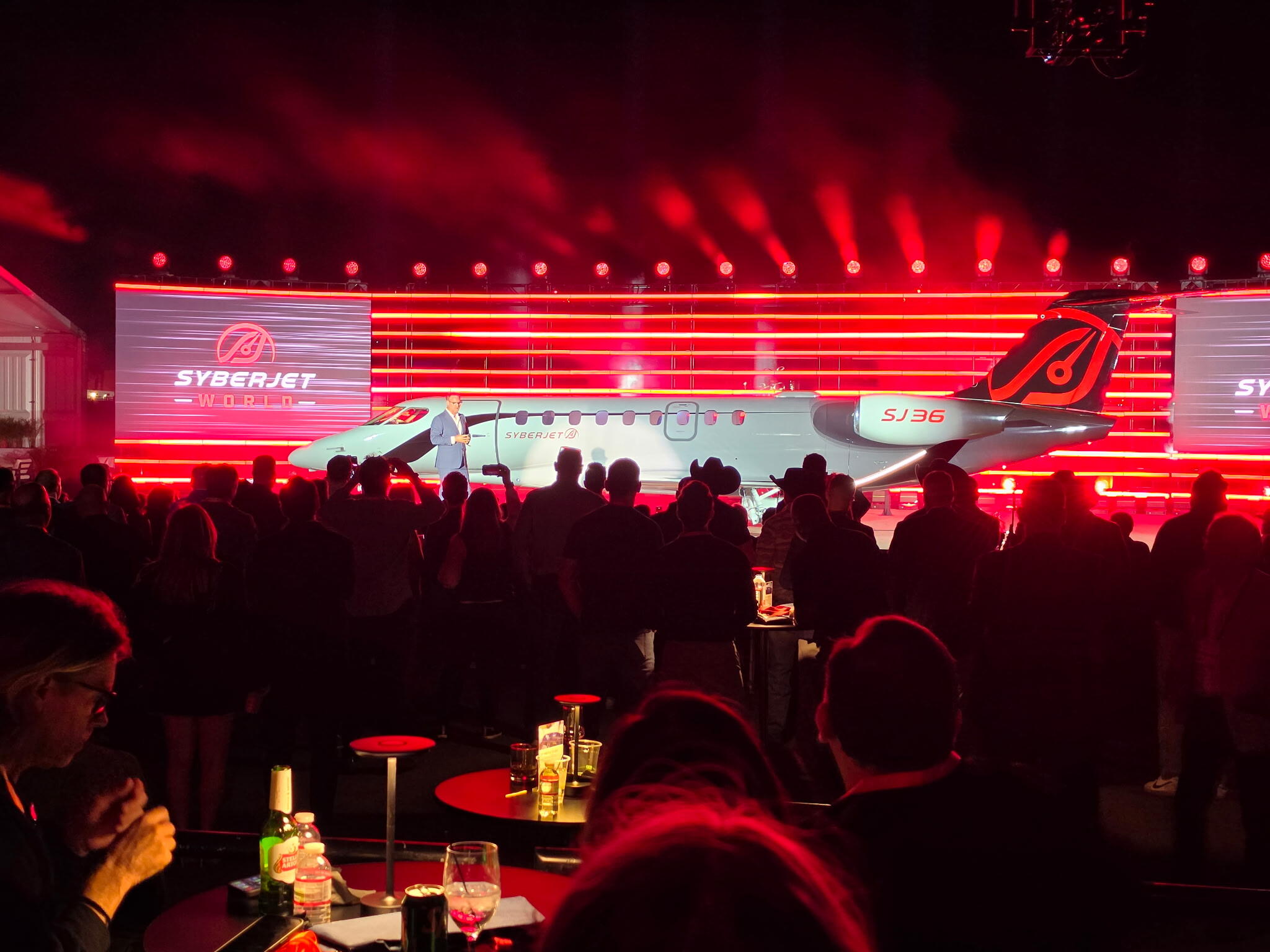
A model of the new SyberJet is unveiled on the eve of NBAA-BACE 2026.
LAS VEGAS—On the eve of NBAA-BACE, SyberJet Aircraft opened its order book as the company was scheduled to unveil its new SJ36 light jet, detailed the production timeline for the SJ30's successor, the SJ34, and introduced a proprietary new avionics system it says will redefine the category.
The stretched nine-seat SJ36, a derivative of the Sino Swearingen SJ30, is a single-pilot light jet designed to fly more than 3,000 nm, reach speeds of Mach 0.88, maintain sea-level cabin pressure up to 41,000 ft. and climb to 49,000 ft.
The mockup on display at Henderson Executive Airport during NBAA-BACE includes a complete interior, full seating, avionics displays, lighting, cabin systems and audio equipment, along with an exterior featuring the fuselage, tail, wings and landing gear. Deliveries are projected to begin in 2032.
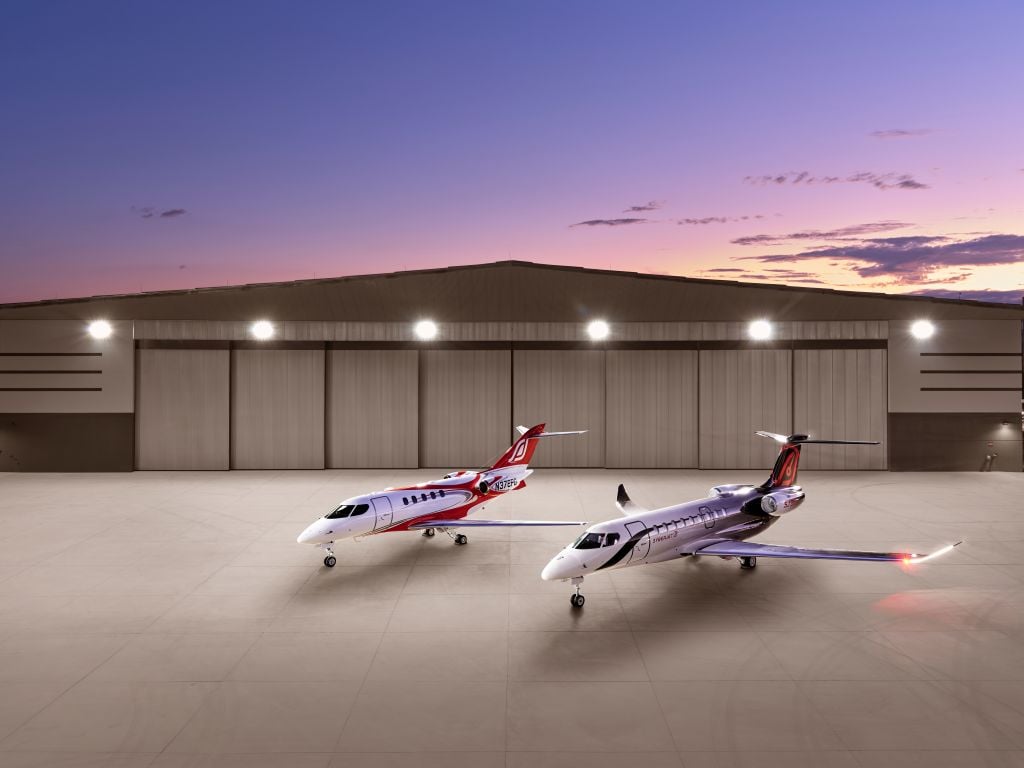
Officials also announced that the seven-seat SJ34 will replace the FAA-certified SJ30-2, a single-pilot jet. The SJ34 will be upgraded with SyberVision avionics, larger Williams FJ44-3 or FJ44-4 engines and a new interior matching the SJ36. It is expected to cruise at up to Mach 0.83 with a range of up to 2,500 nm. Deliveries are projected to begin in 2029.
The SJ30-2 has a fraught background in which nine were built and four delivered, including the final delivery in 2006, according to Aviation Week data, as production stalled through multiple ownership changes, including Sino Swearingen and Ernivest Aviation. SyberJet formed in 2011 when Metalcraft Technologies acquired the program's assets.
In 2024, SyberJet was acquired by a new investment group headed by Nikola founder Trevor Milton. SyberJet owns all but one of the aircraft.
Milton has withstood his own turbulence. The founder and former CEO of Nikola, a producer of electric and hydrogen-powered trucks, was found guilty in 2022 of securities and wire fraud and sentenced to four years in prison. Milton appealed, was pardoned by U.S. President Donald Trump, and in September 2025, the Securities and Exchange Commission dismissed the case. During that time, Milton turned to aviation, becoming rated in helicopter and fixed-wing aircraft.
Milton calls the SJ30-2 the most “amazing” light jet ever built but one that never made it.
There are doubters on its resurrection, but, “That's OK,” Milton says. “That's actually warranted. But the way you fix anything is to overdeliver. And when you overdeliver, people say, ‘Holy crap! They can do this and we now believe in them.’
“We will overdeliver beyond anyone's imagination . . . We're going to deliver the most amazing jets the world has ever seen.”
He also realizes how difficult the aviation industry is.
In the broad picture, “There is no guarantee,” Milton says. “Aviation is hard. Complicated. Is affected by market dynamics and other regulations. The likelihood of failure is higher than the likelihood of success.
“Many great men before me have failed, and there is a high chance we will fail. Not because of my past, but because aerospace is incredibly difficult, and starting a company is like self-torture,” he says.
However, there is a need for innovation, he says: “[Customers] want cool stuff; they want leading edge, and our goal is to push the whole industry toward the fact that they have to change.”
The centerpiece of the company's reveal is SyberJet's new in-house avionics system, breaking from industry norms of partnering with suppliers such as Garmin or Honeywell. The system features six 4K touchscreen displays, each fully redundant, so any single screen can assume the functions of another — a departure from competitor systems where displays are certified for specific functions only.
“You could have a failure on four of them, and you could still fly your plane with every feature known in our system,” Milton said.
The avionics demonstrator shown at NBAA runs on true production code rather than a demonstration build, representing tens of millions of lines of software the company says is nearing flight readiness, with an internal goal of flight testing within 12 months.
Among the system's most forward-looking features is “Syber Pilot,” an artificial intelligence (AI)-based pilot assistant integrated into the avionics, intended to eventually achieve full FAA type certification as an autonomous pilot capable of managing an entire flight — from clearance acquisition and taxi through departure, en route navigation, arrival, landing and shutdown.
Milton distinguished the technology from Garmin's Autoland, which is limited to emergency landing scenarios. "Autoland is maybe 5% of what this does," he said, noting Autoland does not manage clearances, taxiing or broader flight operations.
In its initial NBAA form, Syber Pilot analyzes live air traffic control (ATC) communications and Controller-Pilot Data Link Communications (CPDLC) data, interpreting instructions such as altitude restrictions, speed assignments and arrival procedures, loading them into the flight plan with a single button press. A similar capability extends to taxi instructions via a new smart taxi feature.
“Our goal is to be a leader in that,” Milton says. “The future will be the Uber of the skies. You just order a jet, and you want to go from Salt Lake City to Phoenix, Arizona. You show up and there is no pilot on board.
“You get the passengers in. You close the door, and the jet does everything. There's no longer a human involved . . . That's going to be the future of aviation, whether we like it or not.”
The SJ36 cabin, designed with Bond Design Group, run by Milton's wife, Chelsey, includes 38 speakers, two subwoofers, high-speed satellite internet and virtual reality (VR) capability for inflight entertainment. A reconfigured layout with a centrally located lavatory allows two oversized rear seats that convert into a near-full-size bed.
SyberJet touted a cruise fuel burn of roughly 112 gal./hr. (about 750 lb./hr.) — positioning the SJ36 as an efficiency-to-performance outlier in its category.
The company also unveiled “Passage One,” a membership program capped at 250 participants, offering special launch pricing of $10 million to $12 million for the SJ34; launch pricing of $14 million for the SJ36; 1,000 hr. or five years of tip-to-tail coverage for the entire aircraft; 1,000 hr. or five years of Williams TAP Blue, an hourly fee engine maintenance program; fuel for 1,000 flight hr. or five years, limited to 100,000 gal.; and two pilot type-rating training slots.
Milton calls the structure an industry first that will help the company compete for market share against established light jet competitors.
“Aviation has not seen a disruption in a long time,” Milton says. “We didn't just show up at NBAA . . . We came in with big dreams, and many people doubted our ability to deliver, but I think we did a good job.
"The full-scale SJ36 mockup represents what the production aircraft is expected to look like. The avionics are world class and may be better than any system on the market,” he says.
“With the SyberJet Passage One program, you could save millions of dollars over the competition and never worry about anything but factory support,” he adds.

Related Content