Aerial media company Heli-D has upped its game in the U.S. From its beginnings as an aerial advertising company using fabric banners as a medium, Heli-D earlier this year secured FAA authorization to deliver messages near the site of Super Bowl 2026 using a helicopter-borne, 400-ft.2 light emitting diode (LED) display.
This would have been the first time an aerial LED system of this scale was flown near a major stadium in a dense urban environment, says the company, a division of Australia’s Remarkable Media Group. Ultimately, Heli-D did not conduct flights “due to last-minute increased security measures that affected planned operations” at the Super Bowl, held Feb. 8 in Santa Clara, California.
Not a helicopter company itself, Heli-D subcontracts with helicopter operators to carry its double-sided flying LED as an external load under FAA Part 133 certification. It competes in the Digital Out-of-Home advertising industry, which is projected to grow into a $62 billion global market by 2030.
“We use the best pilots and helicopters in every market that we’re in,” says Heli-D co-founder and CEO Simon Powell. “But we’re an aerial media company—we control the screen, not the helicopters.”
The Australian company made waves in the U.S. before the Super Bowl. In October 2025, Heli-D helped Microsoft Xbox launch its new Ninja Gaiden 4 video game by broadcasting a match between two gamers flying in parallel with the aerial display, held aloft by a Livewire Aviation AS350 B3 Astar (Airbus H125). The campaign over coastal Florida using a 215-ft.2 LED billboard set a Guinness World Record for the largest video display flown from a helicopter.
“The audience to this extraordinary feat were passengers on departing cruise ships,” Guinness says.
The principals of Remarkable Media, then operating as Branding By Air, evolved from flying advertising banners to digitizing aerial media by projection.
In August 2016, they helped promote the MTV Video Music Awards at Madison Square Garden in New York City by flying two helicopters in synchronized fashion up and down the Hudson River. One towed a 250-ft.-wide banner, or “cinema screen.” The other, a Bell UH-1H Huey, carried a projector stack that locked imagery onto the screen using projection mapping technology. The feat earned the team a Guinness World Record for deploying the largest aerial projection screen.
The only other place in which Remarkable Media used projection was in Dubai to honor Sheikh Zayed bin Sultan Al Nahyan, founder of the United Arab Emirates.
“That’s kind of where the journey begins,” Powell relates. “We progressed to LED because the original projection system only worked during nighttime and involved two helicopters [flying] in close proximity. But it wasn’t a commercial product because it didn’t fly during the day and had limitations—we had a dust storm in Dubai. It wasn’t something that we could roll out globally.”
The slowdown in activity during the COVID-19 pandemic, when Australians were prohibited by their government from traveling overseas, allowed the company to refocus its efforts on digitizing aerial media through LED technology. It flew a prototype for Netflix in Sydney Harbor during the pandemic and launched the new LED system at the Melbourne Cup Carnival horse racing event in November 2024.
During the Melbourne event, Heli-D’s subcontracted AS350 flew over the racetrack with a huge, scannable QR code on the screen, enabling racegoers to connect directly to the betting app of TAB, a sports wagering brand.
Aerodynamic Features
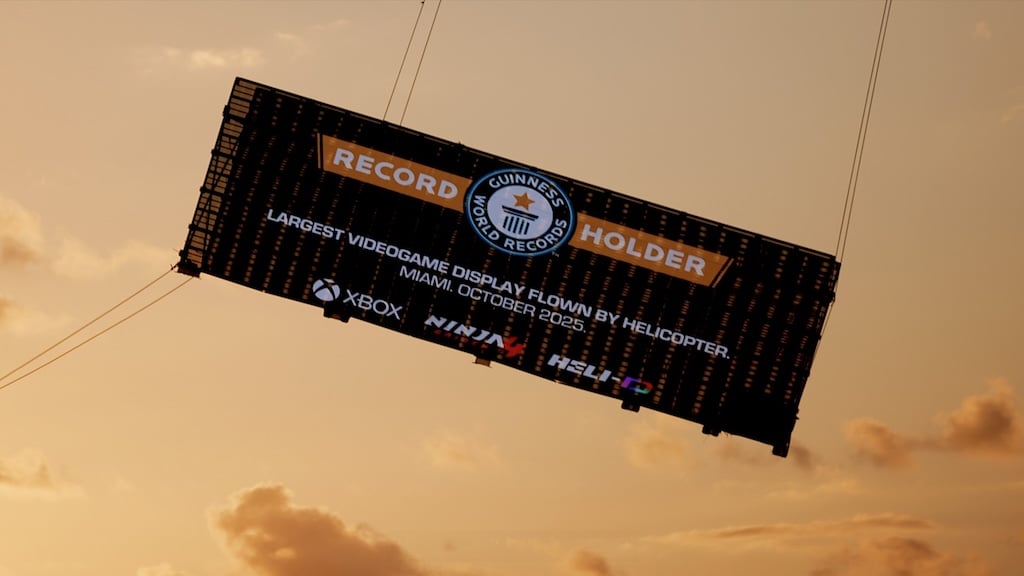
Ryan Osbourne, Heli-D co-founder and chief technology officer, says the company designed the LED system to fit within the existing FAA regulatory framework for external loads. A traditional jumbotron or billboard of the size used by Heli-D weighs about 5-7 tons, he explains.
“We obviously couldn’t fly that,” he adds. “We knew we needed to tear it down to its component parts and completely remake it. We started with an aluminum frame and we’re now using carbon composites. We weaved our own tubes and completely redesigned the airframe, or the chassis, that carries these displays. We’ve gone from just about 5.2 ton all the way down to 1,500 lb.”
Heli-D built the structure to fit within the equivalent of a 40-ft. shipping container so that it could be transported by road or sea. Its top must be folded down to fit, as it is taller than the container.
“But the main priority was to be aerodynamically stable,” Osbourne says. “I’m a fixed-wing pilot, so we applied some of those skills to the design. We took something with the aerodynamic performance of a brick and we made it aerodynamically stable by turning the two display sides into vertical stabilizers [with] porous panels so that they release any internal pressure from the inside out.
“We also applied a proprietary grid to both sides to have induced parasitic drag, so this thing just grips the air as we’re traveling,” he explains. “We’ve also got some very clever rigging going on that basically turns it into an aerial marionette.”
The company developed a proprietary power supply by adapting aircraft power takeoff systems to function as generators to run the dual LED screens, which consume 40 kW of power at 220 volts. “Everything we need to run the screen is onboard,” Osbourne says. “The power system is embedded in the frame.”
Heli-D says it has FAA approval to fly as close as 250 ft. from viewers if necessary. At the start of an operation, the helicopter lifts the screen from the ground using 150-ft.-long lines. The line length helps with noise abatement because the aircraft operates high above the structure, Osbourne says. Nevertheless, Heli-D’s plans for Super Bowl 2026 caused some controversy in the nearby community.
In advance of the championship game, Yahoo News reported: “A Reddit thread is erupting with anger over a proposal that could take intrusive advertising to a new level: giant LED billboards flown by helicopter—close enough to be, as the company behind them puts it, ‘unignorable.’”
Though security measures prevented the company from conducting flights during the Super Bowl, Heli-D is focused on growing its business in the U.S., which is considered the world’s most mature aerial advertising market. “This is now a repeatable, certifiable system, not a stunt, proven through FAA-supervised activations for Netflix, Microsoft, Xbox and others,” the company says.
Heli-D is eyeing major upcoming events as advertising venues, including the FIFA World Cup scheduled across multiple cities from mid-June through mid-July. It also sees an opportunity for paid political messaging before the U.S. midterm elections in November.
“We’ve applied a lot of learnings over the last 10-plus years into this,” Osbourne relates. The new LED screen is “designed really to grab people’s attention. You can advertise anything you want, but if people aren’t looking, you’ve lost the battle.” BCA

Related Content