This article is published in Business Aviation & AAM Report part of Aviation Week Intelligence Network (AWIN), and is complimentary through Nov 13, 2026. For information on becoming an AWIN Member to access more content like this, click here.
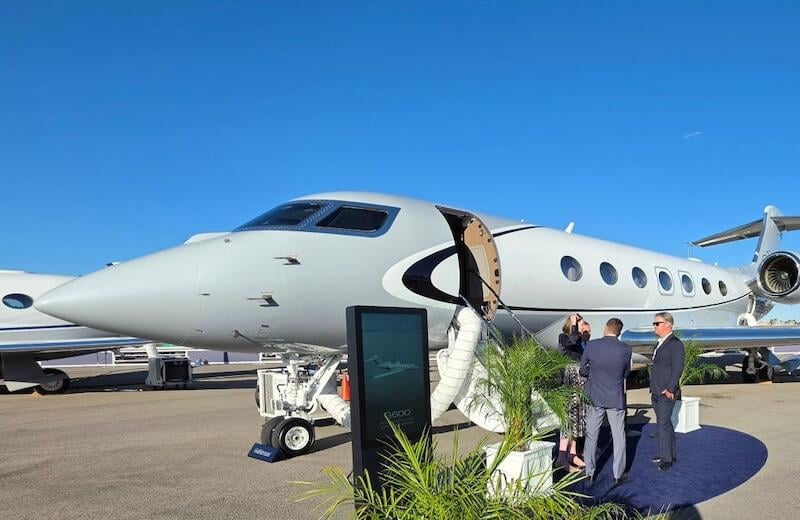
Gulfstream exhibited its G600 at NBAA-BACE 2026 as part of its full lineup of products on display.
Gulfstream is riding a sustained wave of demand for its business jets, with new aircraft orders up 30% during the first nine months of 2026 compared with a year ago, as the manufacturer pushes toward a goal of delivering roughly 200 aircraft annually by 2030.
Gulfstream delivered 40 business jets in the third quarter of 2026, including 35 large-cabin and nine midsize-cabin aircraft, up from 39 a year ago, the company reports. For the first nine months of the year, Gulfstream delivered 119 aircraft, up from 113 during the same period a year ago.
General Dynamics’ Aerospace division, which includes Gulfstream Aerospace and Jet Aviation, recorded third-quarter 2026 revenue of $3.54 billion, up 9% from the same quarter a year ago, and operating earnings of $513 million, up 19% from a year ago.
Gulfstream is working to increase new aircraft deliveries to about 200 in 2030. Analysts predict Gulfstream will deliver an estimated 160 aircraft during 2026.
At the same time, Gulfstream is seeing efficiency gains in manufacturing and completions, particularly on the G700 and G800, Danny Deep, president of General Dynamics, Gulfstream’s parent company, told analysts on a financial call about third-quarter results. At the same time, volume is up at its maintenance centers, at Jet Aviation and at its U.S. FBOs.
Deep will transition to CEO of General Dynamics on Jan. 1, 2027, succeeding Phebe Novakovic, who will transition from chair and CEO to executive chair of the board. He will inherit leadership during a growth period and large order backlogs.
Interest in Gulfstream aircraft has been active across all models in the U.S., Western Europe and Southeast Asia, with “some cautious concern from customers in the Middle East,” Novakovic said. “They are, however, still active in the pipeline but slow to provide orders,” she said. “This is not surprising given the current geopolitical environment there.”
Gulfstream’s book-to-bill ratio, or orders compared with deliveries, on a trailing 12-month basis, was 1:4. Rising fuel prices have not had any discernible effect on demand, Deep said.
To reach 200 deliveries in 2030, Gulfstream must produce more than 200 in 2029, Deep said. “We have the production and the workforce and the facilities to produce 200 aircraft,” he said. “On that path, we expect and are certainly hopeful that our suppliers will be able to keep up.”
Producing more than 200 will require investments in additional facilities and equipment, which the company is prepared to make as demand dictates, Deep said.
A portfolio of new clean-sheet aircraft has been positive for Gulfstream, Novakovic said. That success reinforces the company’s commitment to continue investing in and developing its product lineup and support network. “We’re going to stay on this path,” Deep said.
The company will phase out G280 deliveries sometime in mid-2027 as it replaces the aircraft with the G300, expected to be certified toward the end of the year. In the meantime, there will be a gap between the two models, Deep said. Even so, it will not preclude Gulfstream from “having a better 2027 than 2026,” he said.
The upcycle in the business jet market continues, Vertical Research Partners said in a note to investors, “with Gulfstream seeing a good response to its new bizjet products that should support steady growth in coming years. Our impression is that the whole industry has embraced a more conservative approach to volumes and pricing, and that should support future profitability.”

Related Content