This article is published in Business Aviation & AAM Report part of Aviation Week Intelligence Network (AWIN), and is complimentary through Oct 26, 2026. For information on becoming an AWIN Member to access more content like this, click here.
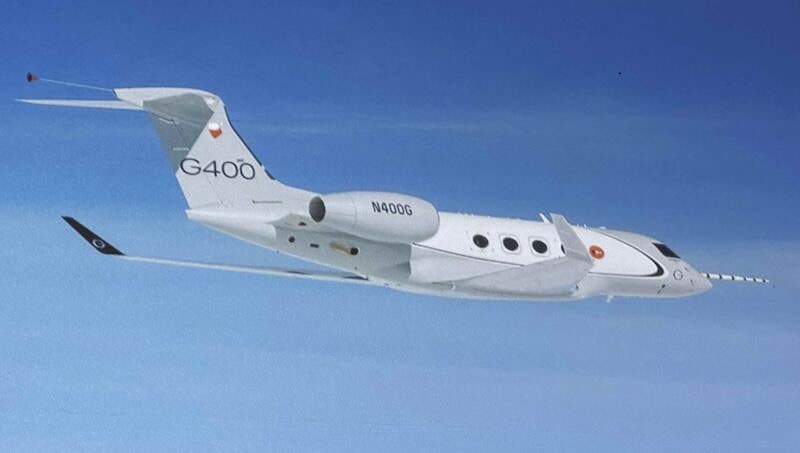
LAS VEGAS—While stopping short of forecasting certification timelines for the in-development super-midsize G300 and large-cabin G400, Gulfstream says flight-test efforts for both programs are accelerating, with more aircraft joining the parallel test campaigns.
Updating progress at the National Business Aviation Association-Business Aviation Convention & Exposition (NBAA-BACE) business aircraft convention here, Gulfstream President Mark Burns says the first G400 fitted with a full interior has joined the test fleet after completing its initial flight from Dallas Love Field Airport, Texas. Assembly of the third G300 test aircraft is underway by licensee Israel Aerospace Industries in Tel Aviv, Israel
“We're in the throes of flying that airplane now. It flew recently about 3.5 hr. at about 48,000 ft., so we'll continue to expand that envelope as well," says Burns, who adds the G400 is the fourth and final aircraft to join the test fleet.
The G400, which is intended to complete the company's new-generation large-cabin family, first flew in August 2024 and was originally due for deliveries this year. But, as with other recent FAA and European Union Aviation Safety Agency (EASA) certification programs, the G400 timetable has become more protracted due to more stringent regulatory requirements, particularly on software validation.
“We don't have a prediction on when [it will be certificated]. Unfortunately, I don't make that call,” says Burns.
But Gulfstream believes the G400 will benefit from lessons learned during the certification campaign for the preceding long-range G700 and G800 programs. The G700 was launched in 2019 but did not receive certification until March 2024, roughly two years later than originally expected. The G800, which first flew in 2022, was certified just 34 months later, in April 2025.
“I was probably the most vocal person on the planet during the G700 about my dissatisfaction with the certification process,” says Burns. “I told [the regulators] at the time we need to modernize this to take advantage of the tools that are available to us today, and I think we did that on the G800 more than ever before, and I think the 400 will benefit from that,” he adds.
“We're trying to build the safest airplanes in the world, but we think, based on the tools we have available to us today, we can do it faster without compromising safety. I think the world is going to change here in the next few years. I think the current group in the FAA and [Department of] Transportation are listening to our thoughts on modernization, and I expect we're going to get the opportunity to use our tools a little bit better in the future,” says Burns.
One of the initial G400 test aircraft also established a new city-pair speed record from Miami on its way to be exhibited at NBAA, completing the flight in 4 hr. 8 min. at an average speed of Mach 0.89.
Of the G300, Burns says: “The airplane continues to fly well, and the second airplane will fly here very soon.” The first aircraft flew in December and is provisionally due for initial deliveries starting in 2028.

Related Content