Singapore’s First National SAF Procurement Pilot Nabs Nine Companies
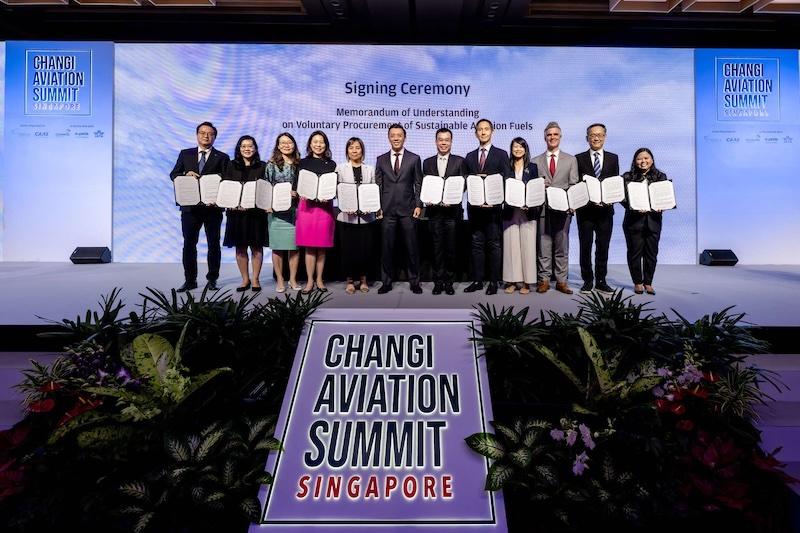
Executives at the signing ceremony.
SINGAPORE—Nine companies, together with the Civil Aviation Authority of Singapore (CAAS) and its Sustainable Aviation Fuel Company (SAFCo), have signed a memorandum of understanding (MOU) to participate in Singapore’s first government-led, national-level sustainable aviation fuel (SAF) procurement initiative.
The signatories are Boston Consulting Group, Changi Airport Group, DBS Bank, GenZero, Google, OCBC Bank, Temasek, Singapore Airlines and Scoot. The MOU was signed at the Changi Aviation Summit, held ahead of the Singapore Airshow.
As the inaugural SAF purchase under the centralized procurement framework, the exercise will serve as a live trial for SAFCo to test the end-to-end operational, commercial and accounting processes required for a national SAF procurement and environmental attribute allocation system. This comes ahead of the implementation of Singapore’s SAF levy on Oct. 1, 2026.
The pilot will also allow participating companies to achieve emissions reductions either through physical SAF use or the allocation of associated environmental attributes, while gaining practical experience with centralized procurement and benefiting from greater price certainty.
Following the signing, SAFCo will issue a tender for the acquisition of CORSIA-eligible SAF, after which pricing will be determined based on supplier responses.
SAFCo was established in October 2025 to centrally procure SAF for all flights departing Singapore Changi Airport. Under the framework, passengers will pay a fixed SAF levy depending on flight distance and cabin class, with the volume of SAF procured tied to funds collected through the levy. Singapore has set a target of a 1% SAF uplift in 2026, rising to 3%–5% by 2030.
“We are encouraged by the strong commercial interest,” CAAS Director-General Han Kok Juan said in a statement. “With greater awareness, we hope more companies will join. By aggregating regulated and voluntary SAF demand, we aim to grow a robust and efficient SAF ecosystem to support a more resilient and affordable fuel supply for our aviation sector.”

Related Content