ICAO Urges Shift From Seeing Developing States As SAF Feedstock Source
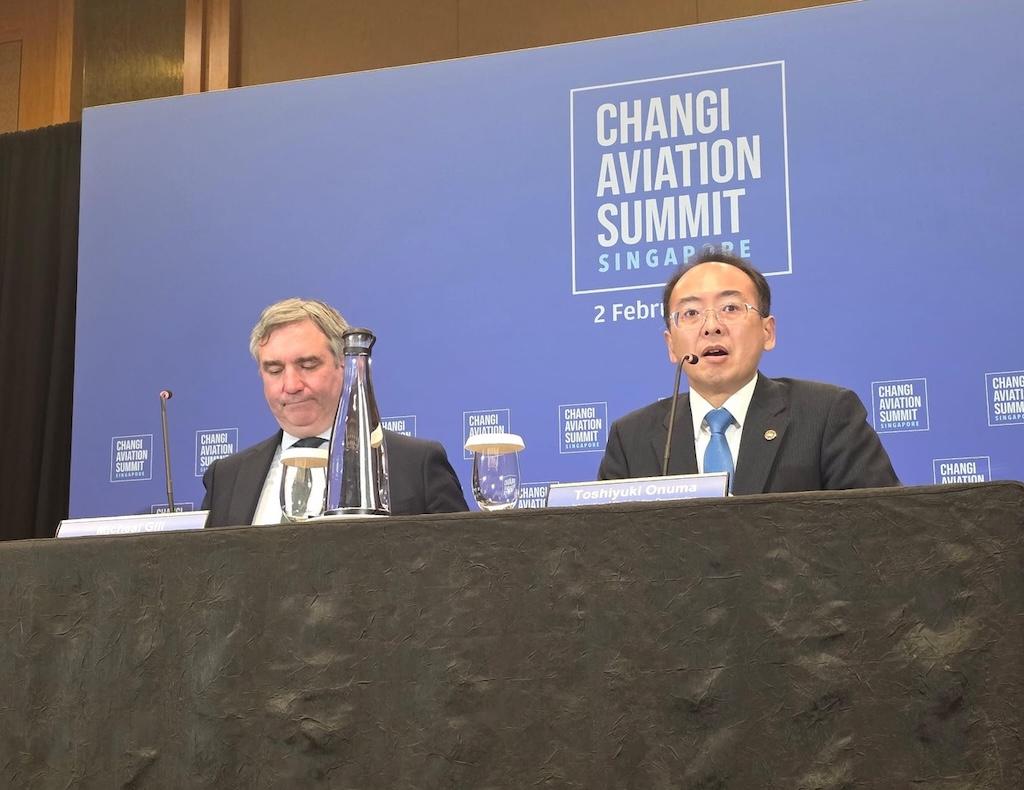
ICAO Council President Toshiyuki Onuma (right) at the Changi Aviation Summit.
Achieving the global aviation industry’s goal of net-zero emissions by 2050 will require a fundamental shift in how developing countries are viewed, ICAO Council President Toshiyuki Onuma said, arguing they should no longer be seen merely as sources of sustainable aviation fuel (SAF) feedstock.
“(To achieve net zero) there is a need to change mindset,” Onuma said in his first media interview since assuming the ICAO presidency on Jan. 1.
“There is a tendency to see developing countries simply as sources of feedstock. If you look at developing countries in that way, it becomes very difficult to materialize this aspirational goal—especially in terms of cooperation and sharing.”
Onuma stressed that enabling SAF production within developing countries themselves is central to ICAO’s mission, aligning with the organization’s long-standing principle of leaving no country behind.
“How to encourage production in developing countries is a very important mission of ICAO,” he said. “The vision of ‘no country left behind’ should not remain a slogan—it must be materialized through equal ability to achieve this very important goal.”
Multiple studies have identified significant SAF feedstock potential in regions such as Southeast Asia, particularly from agricultural waste. Some analysts suggest the region could generate sufficient feedstock to meet its own SAF demand, with surplus capacity for export.
Before joining ICAO, Onuma served as senior deputy director general of the Japan Civil Aviation Bureau (JCAB), where he oversaw the development and implementation of several sustainability-related policies. He told ATW On Location that he intends to bring what he calls the “3C” approach—communication, cooperation and collaboration—to ICAO, a framework he said proved effective in Japan.
“I am quite confident that these principles can be understood by all member states,” Onuma said. “Ultimately, they can help deliver real progress toward net-zero carbon emissions.”
Onuma acknowledged ongoing challenges with the availability of CORSIA-eligible carbon credits, despite a mandate from 2027 requiring international flights to be subject to carbon offsetting. He said ICAO continues to engage with member states to encourage the development of CORSIA-certified projects and expressed optimism that supply constraints would ease over time.

Related Content