This article is published in Aviation Daily part of Aviation Week Intelligence Network (AWIN), and is complimentary through Mar 09, 2026. For information on becoming an AWIN Member to access more content like this, click here.

Airlines Resume Some UAE Flights Amid Ongoing Iran War Disruption
Aircraft
Credit: Patrick T. Fallon/AFP/Getty Images

A small number of flights took off from Abu Dhabi on March 2, and more were planned from Dubai, in the first signs that airlines were attempting to resume some flight operations after the Feb. 28 U.S and Israeli attack on Iran spurred retaliatory strikes on the greater Middle East region, which have led to significant disruption, airspace closures, thousands of flight cancellations and damage to airports.

As the war stretched into a third day March 2, with signs the conflict was extending to Lebanon, Middle Eastern carriers and global carriers that rely on Middle Eastern hubs for connecting flights between North America, Europe and Asia faced ongoing major disruption and the imminent challenge of repositioning stranded aircraft once restrictions ease.

The airspace of many countries in the region remained closed or restricted over security concerns with military operations underway, and an increase in GPS spoofing and jamming in the region. The European Union Aviation Safety Agency (EASA) has extended the validity of its existing advice warning airlines to avoid the region until March 6.

However, a small number of flights were starting to operate from Abu Dhabi and Dubai airports on March 2.

Repositioning Flights

A Dubai Airports spokesperson confirmed that a limited resumption of operations would begin March 2 “with a small number of flights permitted to operate from Dubai International (DXB) and Dubai World Central–Al Maktoum International (DWC).”

“Travelers are advised not to proceed to DXB or DWC unless they have been contacted directly by their airline with a confirmed departure time, as schedules remain subject to change,” the spokesperson said.

Etihad Airways said on March 2 that all flights to and from Abu Dhabi were suspended until 2:00 p.m. UAE time on Tuesday March 3. However, the Flightradar24 flight tracking website indicated that several Etihad flights had taken off March 2.

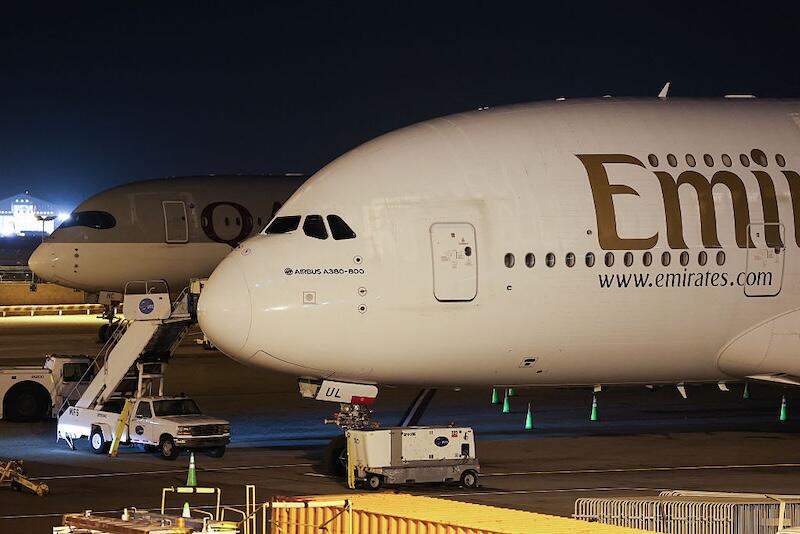
One of those, Etihad flight EY67, an Airbus A380, took off from Abu Dhabi at 2:39 p.m. local time March 2, heading for London Heathrow.

“All scheduled commercial flights to and from Abu Dhabi remain cancelled,” an Etihad spokesperson said. “Some repositioning, cargo and repatriation flights may operate in coordination with UAE authorities and subject to strict operational and safety approvals.”

The spokesperson added that flights would only operate once all safety criteria were met.

Flightradar24 indicated that Etihad flights to Amsterdam, Delhi, Islamabad, Karachi, Moscow, Mumbai and Paris had also been able to take off March 2.

A Lufthansa spokesperson also confirmed that a Lufthansa A380, flight number LH9851, took off on a repositioning flight from Abu Dhabi heading for Munich at 1:21 p.m. local time on March 2.

“Lufthansa’s Airbus A380 D-AIMK has completed necessary maintenance in Abu Dhabi and will return to Munich on Monday morning (March 2) as a special flight LH 9851,” the spokesperson said. “Passenger transport has been reviewed, but unfortunately it is not possible. Only two pilots are on board for the technical transfer flight. A cabin crew of at least 17 people, which is essential for the safety and care of passengers, is not available and cannot be flown in due to the current massive restrictions on air traffic in the United Arab Emirates. Without flight attendants, passenger transport is legally and safety-wise impossible.”

The spokesperson added that the accessibility of Abu Dhabi Airport for potential passengers was unclear and would be difficult to organize, including reliable planning of check-in, security checks, and boarding.

Austrian Airlines confirmed that it had operated a special flight from Vienna to Muscat, Oman, returning on March 1.

“On board were crew members and other employees from various Lufthansa Group (LHG) airlines who had previously been in the crisis region,” an Austrian Airlines spokeswoman told Aviation Week March 2.

Austrian Airlines did not outline how many passengers were on board, but a source told Aviation Week that that flight was almost full, including crew members of Eurowings, Lufthansa Cargo and other Lufthansa Group employees. They had been transferred from Dubai to Muscat by ground transportation.

Austrian flight OS1005 from Vienna to Muscat was operated nonstop with an A320neo. The return flight, OS1006, made a brief stop in Hurghada, Egypt, landing in Vienna early in the morning on March 2.

The spokesperson said no further special flights were currently planned, adding, “Austrian Airlines is currently exploring options to offer its passengers alternative flight connections. However, concrete planning is proving to be a significant challenge in this exceptional situation.”

Airspace Closures

In its latest airspace update, Jordanian authorities announced March 2 that the country’s airspace would close at night because of the developments in the region.

Jordan is the latest in a long list of countries in the region to close or restrict their airspace for varying periods, including Bahrain, Iran, Iraq, Israel, Kuwait, Qatar, Syria, UAE and parts of Saudi Arabia. The French foreign ministry also listed Lebanon’s airspace as closed in a March 2 briefing document.

Royal Jordanian Airlines said that its flight schedule would continue as normal, as long as Jordanian airspace remained open.

Emirates, Etihad Hubs Under Fire

Over the Feb. 28-March 1 weekend, Iran fired ballistic missiles and drones in response to the U.S. and Israeli air strikes, hitting airports in Bahrain, Dubai and Kuwait, causing damage. In Abu Dhabi, debris from an intercepted drone targeting Zayed International Airport killed one person and injured others.

The Abu Dhabi airport said March 2: “Due to the temporary closure of UAE airspace, passengers scheduled to travel today should check directly with their airline before heading to the airport.” The airport added that it was working closely with airlines and relevant authorities to manage the situation and minimize disruption where possible.

Dubai International, the world’s busiest airport for international traffic, was among those hit, causing what the airport authority said Feb. 28 was minor damage. “Emergency response teams were immediately deployed and are managing the situation in coordination with the relevant authorities,” Dubai Airports said, noting four staff sustained injuries and received medical attention.

Emirates Airline said it plans to begin operating a limited number of flights commencing the evening of March 2.

“The situation remains dynamic and is assessed continuously,” the airline added, urging passengers to check before traveling to the airport.

In a March 2 update, Qatar Airways said flight operations remained temporarily suspended due to the closure of Qatari airspace. “Qatar Airways will resume operations once the Qatar Civil Aviation Authority announces the safe reopening of Qatari airspace,” it said, promising a further update March 3.

Euro Carriers Affected

European airlines, already cut off from Russian airspace because of that country’s war on Ukraine, have canceled flights to the Middle East. Lufthansa Group suspended its airlines’ flights to Beirut; Amman, Jordan; Erbil, Iraq; Tehran; and Tel Aviv until March 7 and said it would avoid airspace of Iran, Iraq, Israel, Jordan, Lebanon, Qatar and the UAE.

The conflict is also affecting European airlines which do not fly to Middle Eastern destinations such as easyJet, which canceled three flights to Cyprus scheduled for March 2.

“Due to the events overnight affecting the RAF base in Akrotiri in Cyprus, as a precaution, three return flights between Paphos and Larnaca and the UK today will not be operating,” an easyJet spokesperson said. “Flights from March 3 are currently operating as planned but we would advise customers due to travel to and from Cyprus over the coming days to check our flight tracker for the latest information.”

Air France prolonged the suspension of its flights and from Beirut; Dubai; Riyadh, Saudi Arabia; and Tel Aviv to March 3.

British Airways said it had canceled a number of flights to the Middle East.

Oil Price Spike

While airlines are experiencing major disruption in the short term, they could also face further pressure in the longer term if a short-term spike of around 10% in oil prices turns into a lasting increase. Carriers that have been forced to hold onto older, less fuel-efficient aircraft because of supply chain difficulties and delivery delays, or those with insufficient fuel hedging, could be faced with intensifying cost pressure.

“There is a greater risk premium in the oil market—around 10 dollars was already factored in before the conflict—as prices had gone to $70/b and since the outbreak prices have headed higher,” said Paul Hickin, chief economist and editor-in-chief of Petroleum Economist. “The market is reluctant to rush to buy too much crude in advance as there are a lot of barrels on water and China has a lot of barrels in storage along with OECD countries. But should the situation continue to escalate, and more oil infrastructure is targeted, there will be a greater rush to manage that risk by buying up more crude.”

EASA has a Conflict Zone Information Bulletin (CZIB) in place advising airlines to not operate in the airspace of Bahrain, Iran, Iraq, Israel, Jordan, Kuwait, Lebanon, Oman, Qatar, the UAE and Saudi Arabia citing a “high risk” to commercial aviation.

On March 2, EASA extended the CZIB to March 6. It had previously been valid until March 2.

“Given the ongoing military intervention, retaliatory actions against U.S. and Israeli assets in the region are likely to occur, introducing additional high risks not only to the airspace of Iran but also to that of neighboring states hosting U.S. military bases or otherwise affected by the hostilities and associated military activities, including interceptions,” EASA stated Feb. 28 when it issued the CZIB

Saudi Arabian flag carrier Saudia on March 2 said the cancellation of its flights to and from Abu Dhabi, Amman, Dubai, Kuwait, Moscow and Peshawar, Pakistan, has been extended through March 4.

Helen Massy-Beresford

Based in Paris, Helen Massy-Beresford covers European and Middle Eastern airlines, the European Commission’s air transport policy and the air cargo industry for Aviation Week & Space Technology and Aviation Daily.

Ella Nethersole

Ella Nethersole is Deputy Editor of Aviation Week Network publications Arabian Aerospace and African Aerospace.

Kurt Hofmann

Kurt Hofmann has been writing on the airline industry for 25 years. He appears frequently on Austrian, Swiss and German television and broadcasting…