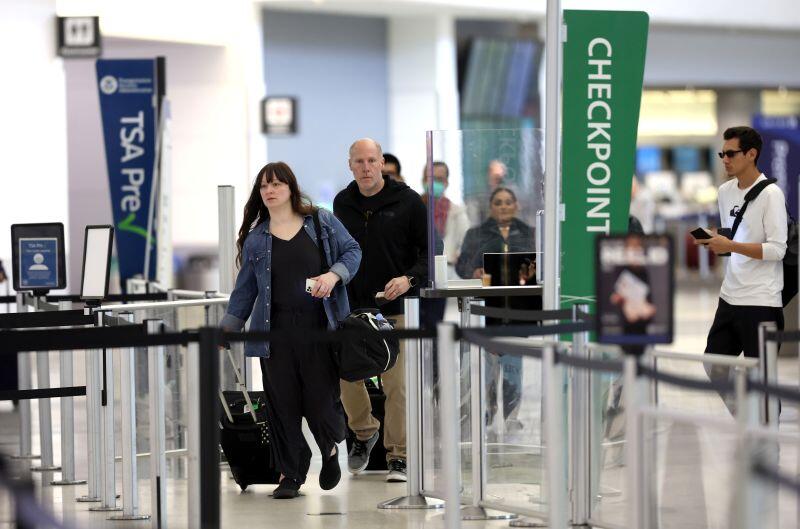
The Transportation Security Administration (TSA) is encouraging U.S. airports to opt in to privatized airport security as part of a new “TSA Gold Plus” initiative the agency said will enable efficient, high-tech checkpoints unencumbered by “lengthy federal budget cycles.”
Following the Feb. 14-April 30 Department of Homeland Security (DHS) partial shutdown that led to hours-long lines at checkpoints—as high percentages of unpaid TSA screeners refused to report to work—the Trump administration is aggressively pursuing a model in which private firms under contract with the federal government would manage checkpoints at an increasing number of airports. TSA would continue to provide “robust” regulatory oversight of airport security, the agency said.
TSA said the Gold Plus program will be a “public-private partnership” in which an expanded Screening Partnership Program (SPP)—under which a small number of airports have been allowed to opt out of federalized screening—will be paired with “TSA’s innovation authorities” to enable “cutting-edge aviation security solutions.”
The program will launch with four yet-to-be named airports, TSA Deputy Administrator Adam Stahl said at GAD Americas in Charleston, S.C., on May 27. Existing, traditional SPP sites will continue.
“We have 20 airports that have stayed in that [SPP] program,” Stahl said, describing it as “stagnant for the past 15 years or so.”
Gold Plus will model a “reconceptualization of a checkpoint,” the deputy administrator said, driving toward a more tech-oriented approach to enhance efficiency and safety. For the traveler, a Gold Plus experience might involve something like an E-Gate instead of an officer checking for an ID, or the use of “image on alarm only” tech—AI-enabled software to clear non-threatening bags and enhance throughput, Stahl said.
“Over time, the hope is that we’re going to continue to drive innovation and open up the aperture to really accelerate development,” he said.
The Gold Plus initiative comes as airports across the U.S. show interest in a privatized security option in the aftermath of the checkpoint chaos that ensued earlier this year. The Atlanta City Council, by an 11-1 vote, this month approved a resolution to explore the feasibility of Hartsfield-Jackson Atlanta International Airport (ATL) joining SPP. ATL, which is owned by the city of Atlanta, was hit particularly hard by extensive checkpoint wait times during the DHS shutdown.
“During the [DHS] federal funding lapse ... approximately 34-36% of TSA officers assigned to [ATL] did not report to work, resulting in multi-hour wait times, canceled flights, and substantial economic harm to the traveling public and regional economy,” the council’s resolution said. “Whereas SPP-participating airports, including San Francisco International Airport (SFO), did not experience similar disruptions because private contractor payrolls are funded under pre-existing federal contract obligations rather than direct annual appropriations.”
SFO was one of five airports allowed to join SPP in 2001 after TSA was created to federalize airport security following the 9/11 terrorist attacks. SFO notably has never had federal screeners, but SPP has expanded to only 20 mostly smaller airports over the past 25 years.
In its 2027 federal budget proposal submitted to Congress in April, the Trump administration said it would begin “the privatization of TSA airport screeners by requiring small airports to enroll in SPP.” The rollout of the Gold Plus initiative appears to push larger airports to voluntarily join the program. TSA can approve airports opting out to join SPP.
TSA said it “will continue to set the standards for aviation security using outcome-based measures that both drive performance and security,” adding that contracts with private firms “will redirect funds into the investable partnerships where leading industry operators can manage both technology and screening workforce ... Robust TSA oversight and outcome-based metrics ensure top-tier security and accountability.”
TSA said the Gold Plus program “empowers airports to opt in [to privatized security] and actively participate in designing and informing requirements, ensuring solutions are tailored to local operational needs and security priorities.”
The system in which private firms are contracted by TSA will replace “lengthy technology procurement refresh cycles with an agile, results-driven model to rapidly deploy new technologies and curb-to-gate solutions.”
TSA said airports opting in to SPP will work with the agency and “prospective vendors to develop and deploy solutions that leverage private-sector investment, cutting-edge technology and human capital. This approach ensures airports meet robust federal security standards while driving operational excellence and responding to consumer needs.”
TSA added that airports joining SPP will “receive staffing, technology, and maintenance at no additional cost to airports.”
Recognizing that security is a “no fail mission,” TSA is focused on quality, not quantity, Stahl said at GAD Americas, believing that Gold Plus will “augment security, long term.” The agency plans to announce the first four participating airports in the coming weeks. “It’s not going to be the only option; We want optionality for airports,” Stahl noted. While the first 4-5 Gold Plus locations are focused primarily on the checkpoint, he did not rule out future applications in other areas of the airport.
“For us, it’s all about flexibility, and we recognize every airport is unique, and demand is unique,” Stahl said. “We welcome any discussions for collaboration and innovation through the Gold Plus framework.”
—With Christine Boynton in Charleston, S.C.

Related Content