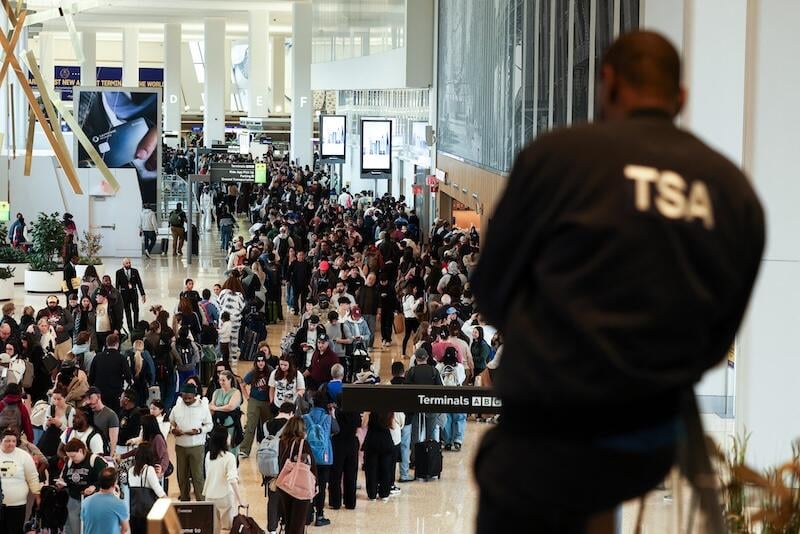
Passengers queue up for security at LaGuardia Airport on March 22, 2026.
The head of the U.S. Transportation Security Administration (TSA) says the partial shutdown of the Homeland Security Department (DHS), which has now reached 40 days, “significantly undermines the security of the U.S. transportation system” and has left many unpaid TSA officers facing desperate financial hardship.
Funding for DHS lapsed on Feb. 14, and more than 47,000 transportation security officers (TSO) who staff checkpoints at airports across the U.S. have gone unpaid since. Testifying before Congress on March 25, TSA Acting Administrator Ha Nguyen McNeill noted wait times at airport checkpoints are the longest in the 25-year history of TSA. “This is a dire situation,” she said.
Around 480 TSOs have left TSA since Feb. 14 and “major airports are experiencing days where 40% to 50% of their [TSO] staff are calling out because they simply cannot afford to report to work,” McNeill says. “We are being forced to consolidate lanes and may have to close smaller airports if we do not have enough officers. It is a fluid, challenging and unpredictable situation.”
McNeill says the “aviation sector has always been a target of interest for terrorists. That has been so since the days of 9/11 and continues to be so. Our vigilance is really critical, especially during this heightened threat environment” with the U.S. at war with Iran.
She says many TSOs are at the financial breaking point, noting she is “hearing from our workforce that what's happening to them is nothing short of cruel.”
McNeill adds: “Many in our workforce have missed bill payments, received eviction notices, had their cars repossessed and utilities shut off, lost their child care, defaulted on loans, damaged their credit line and drained their retirement savings. Some are sleeping in their cars, selling their blood and plasma and taking on second jobs to make ends meet, all while being expected to perform at the highest level when in uniform to protect the traveling public.”
Efforts in Congress to reach a compromise to end the DHS shutdown appear to have stalled. During the House of Representatives hearing at which McNeill testified, Republicans and Democrats angrily blamed each other for refusing to agree to a deal.
The dispute is largely over controversial immigration enforcement tactics used by DHS agency Immigration and Customs Enforcement (ICE) in recent months. Democrats are demanding changes in ICE policy before providing enough votes in the Senate to clear the 60-vote filibuster-proof threshold needed to pass legislation to fund DHS. A number of Democrats have said they would be willing to vote to fund TSA and other DHS agencies with the exception of ICE and Customs and Border Protection, but back-and-forth proposals to partially fund DHS have not led to a deal.
At President Donald Trump’s direction, ICE agents were deployed to major U.S. airports this week in an effort to help ease the bottlenecks at checkpoints. McNeill says ICE agents are “doing non-specialized screening functions” in support of TSA.
“We've been spending time training them the last few days, and we're seeing signs of early relief at the long lines,” she says.
Despite the DHS funding lapse, ICE agents continue to be paid because Congress directed massive amounts of money to immigration enforcement last year.
McNeill testified before Congress in February just prior to the start of the DHS shutdown, warning lawmakers that a lapse in funding would lead “to increased unscheduled [TSO] absences as a shutdown progresses” that would cause flight delays and cancellations.
McNeill noted in February that TSOs went unpaid for 43 days during a government-wide shutdown in October and November 2025. While TSOs received back pay when that shutdown ended, she said that many incurred financial penalties for missed bills or took on debt, and were not in a position to endure another lapse in pay.
She said on March 25 that TSA has missed nearly $1 billion in payments to TSOs since the start of the federal government’s fiscal year on Oct. 1, 2025. “As the shutdown drags on, we fear we will continue to lose talented and experienced employees to jobs that can provide a steady paycheck,” McNeill says. “Not only is the shutdown decreasing the number of interested candidates, but for those we are able to hire, they are required to complete four to six months of training before they are certified to work at checkpoints.”
That means TSA will likely be understaffed, perhaps significantly so, when 6 million-10 million visitors come to the U.S. for the FIFA World Cup in June, she says.
With summer already the busiest travel season, “we are in a perfect storm of severe staffing shortages and an influx of millions of passengers at our airports for the World Cup games in less than 80 days,” McNeill says. “At a certain point, this is a numbers game. If you don't have enough head count, you can't cover your operations.”

Related Content