Credit: EJ Rojas/Alamy
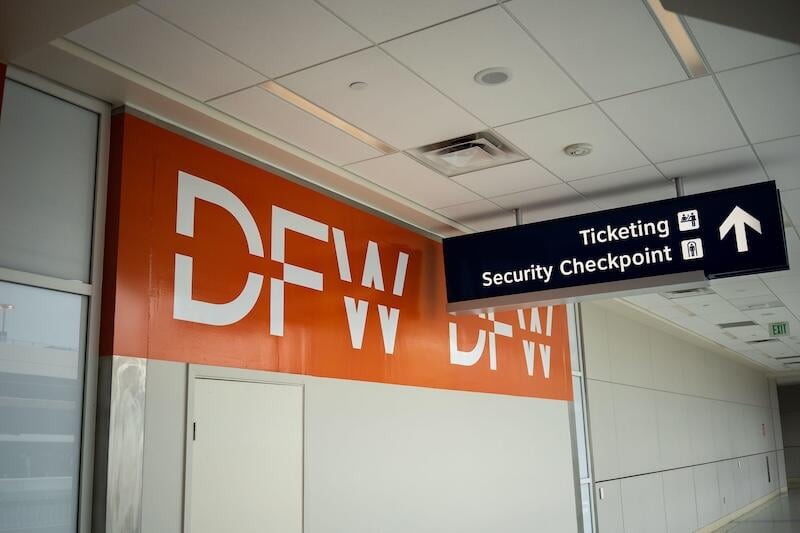
Dallas/Fort Worth International Airport (DFW) CEO Chris McLaughlin said the One-Stop Security (OSS) pilot program, which allows connecting international passengers to bypass security re-screening, has proven to be successful at DFW, expediting passenger processing.
The U.S. Transportation Security Administration (TSA), in conjunction with U.S. Customs and Border Protection (CBP) and the UK government, in July 2025 launched the OSS pilot program, which allows passengers traveling from London Heathrow Airport (LHR) on select flights to DFW and Hartsfield-Jackson Atlanta International Airport (ATL) to bypass re-screening at TSA checkpoints before connecting to another flight.
Passengers flying on American Airlines service between LHR and DFW and on Delta Air Lines flights between LHR and ATL are eligible.
In general, international connecting passengers traveling to U.S. airports are required to be re-screened at a TSA checkpoint after clearing customs. Their checked baggage also needs to be reclaimed, rechecked and re-screened before being placed on the connecting flight.
But passengers on the American and Delta OSS flights from LHR are able to move directly to the post-security area of the airport after clearing CBP. Checked baggage is transferred directly to the connecting flight as happens on domestic connections.
“Inbound connecting passengers [onboard American’s flights from LHR to DFW] can quickly process through CBP without reclaiming their bag and then progress immediately into the sterile area,” McLaughlin said during a Feb. 19 luncheon address to the International Aviation Club (IAC) of Washington, D.C. “The first person off the airplane is getting into the sterile area in 7 min. For the last person off the airplane, it's about 35 min. So while that experience is different for the first person than the last person, it is significantly better than every passenger that doesn't get to [go through OSS]. We're excited about it. We hope to see that program grow in the coming months and years.”
Before taking executive roles at Denver International and DFW airports, McLaughlin headed the TSA’s Office of Security Operations in the early part of the last decade when the PreCheck trusted traveler program was first implemented. Answering questions from Aviation Week following his speech, he said OSS and other TSA initiatives—including biometric facial recognition and advanced computed tomography carry-on baggage scanners—are beneficial both for passenger processing and security.
“As an old security guy, what I'll tell you is that when you achieve efficiency gains and an improved customer experience, you're also, by the way, improving security because it makes it easier to identify the threats that we care the most about,” McLaughlin said.
Faster security and customs clearance increase airport capacity, he noted. “The efficiencies are great, and what that can mean for us is that we have to build less brick and mortar because we can get more people through our existing structure,” he said.
TSA has said “foreign airports must meet certain standards deemed commensurate to TSA standards” to participate in OSS. LHR is currently the only foreign airport in the pilot program.
American COO David Seymour has called OSS a “game-changing program.” He said it “delivers a level of convenience and time savings that’s never been available before to [passengers] connecting from international flights.”
According to American, OSS can reduce connection times by more than half.
CBP is also piloting an International Remote Baggage Screening program that enables checked bags on select flights from Sydney Airport to be transferred to connecting flights without being rechecked and re-screened. But passengers on those flights still have to go through a TSA checkpoint.

Related Content