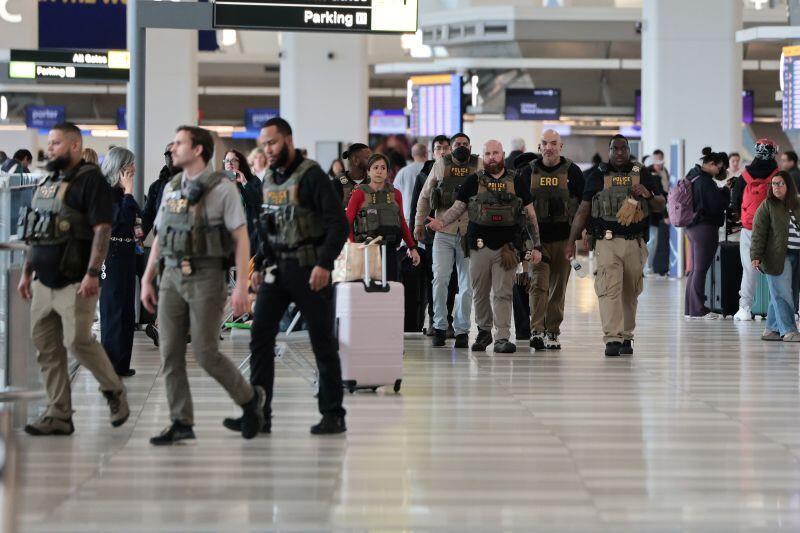
Immigration and Customs Enforcement (ICE) agents patrol Terminal B at LaGuardia Airport on March 23, 2026.
Immigration and Customs Enforcement (ICE) agents began deploying to U.S. airports at the direction of President Donald Trump as extensive lines at Transportation Security Administration (TSA) checkpoints continue to disrupt airport operations, with increasing numbers of unpaid TSA officers not reporting to work.
ICE agents were seen at major airports throughout the U.S. on the morning of March 23, though their role is unclear, and widely posted videos do not show them directly engaged at checkpoints. Appearing on Fox News, TSA Acting Deputy Administrator Adam Stahl said the ICE agents will serve as “a force multiplier to help provide non-specialized security functions that will allow for TSA officers to focus on baggage review and x-ray operations.”
Before boarding Air Force One at Palm Beach International Airport, Trump told reporters that if the deployment of ICE at airports is “not enough” to alleviate the long lines at checkpoints, “I’ll bring in the National Guard.”
ICE and TSA are both part of the Homeland Security Department (DHS), which saw its funding lapse on Feb. 14, leading to the suspension of pay for around 47,000 transportation security officers (TSOs) who staff airport checkpoints across the U.S. Understaffing resulting from increasing levels of call outs by TSOs have forced TSA to close checkpoint lanes at airports, causing long security lines and flight delays and cancellations.
While TSOs are going without pay, ICE agents are being paid though massive funds directed to the agency via legislation passed by Congress last year to bolster immigration enforcement. The impasse in Congress over DHS funding is largely related to controversial immigration enforcement tactics used by ICE and Customs and Border Protection in recent months.
Hartsfield-Jackson Atlanta International (ATL), the world’s busiest airport, has been hard hit by TSO callouts, including 41.5% not showing up for work on March 22, according to DHS. Nine major U.S. airports had TSO call out rates of at least 20% on March 22, with Minneapolis-St. Paul International Airport reporting the highest rate at 42.3%, DHS said.
ATL usually has a website page detailing wait times at its checkpoints. But the page on March 23 only showed a statement advising passengers “to allow at least 4 hr. or more for domestic and international screenings.”
Trump directed ICE agents at airports not to wear masks concealing their faces, though they will continue to do so when patrolling U.S. cities. One of Democrats’ demands during negotiations to end the DHS shutdown is that ICE agents no longer wear masks.
Atlanta Mayor Andre Dickens said “federal officials have indicated that this [ICE] deployment [at airports] is not intended to conduct immigration enforcement activities.”
Everett Kelley, the president of the American Federation of Government Employees (AFGE), the union representing TSA workers, said ICE agents are ill-suited to perform airport security duties.
“ICE agents are not trained or certified in aviation security,” Kelley said in a statement. “TSA officers spend months learning to detect explosives, weapons, and threats specifically designed to evade detection at checkpoints—skills that require specialized instruction, hands-on practice, and ongoing recertification. You cannot improvise that. Putting untrained personnel at security checkpoints does not fill a gap. It creates one.”
With Congress set to go on a two-week recess on March 27, pressure is mounting to find a resolution to end the DHS shutdown.
In a March 22 appearance on News Nation, TSA’s Stahl reiterated his warning made last week that some smaller airports may have to suspend operations if the DHS shutdown continues. “Small airports may be particularly impacted because they have fewer [checkpoint] lanes and they have fewer [TSOs], and so if three or four out of 10 employees call out, we may [have to] ensure we’re not degrading security. We may have to temporarily suspend operations at those airports,” he said. “I can emphatically tell you, as the days and the weeks continue, the likelihood of that happening will continue to increase.”

Related Content