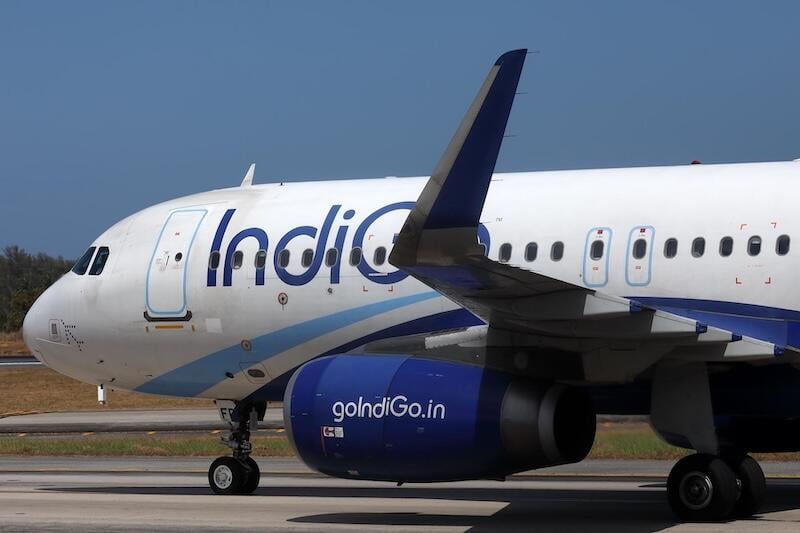
IndiGo plans to return most of its damp-leased fleet and reduce the use of older-generation aircraft as high fuel prices and airspace disruptions prompt India’s largest airline to take a more measured approach to capacity growth.
Speaking during the carrier’s full-year 2026 earnings call, CFO Gaurav Negi said the LCC is readjusting parts of its network and fleet deployment. “As part of this selective recalibration, calibration of certain routes is warranted to protect margin,” Negi said. “This optimization will involve reducing the usage of older-generation aircraft and returning certain narrowbody damp-leased aircraft that are naturally more expensive.”
Negi said the carrier’s “immediate attempt is to first phase out the damp leases,” which he described as more expensive to operate. The airline is also evaluating the future role of its 31-aircraft Airbus A320ceo fleet as it seeks to improve efficiency.
IndiGo currently operates a damp-leased fleet comprising five A320ceos, four A321neos and five Boeing 737s, alongside six 787-9s leased from Norse Atlantic Airways that are being used on long-haul services to Amsterdam, London and Manchester.
Beyond the planned return of damp-leased narrowbodies, IndiGo is also in talks with Norse about optimizing long-haul operations. “We are in discussion with our widebody ACMI partner to optimize our long-term long-haul operations due to ongoing airspace restrictions and elevated fuel cost,” Negi said. However, he emphasized that no changes are currently planned to the airline’s widebody delivery schedule. IndiGo has orders for 60 A350-900s.
IndiGo took delivery of its first 787-9 from Norse in March 2025 as part of its push into long-haul markets ahead of the arrival of its A350 fleet. The leased aircraft have since been deployed on routes to Amsterdam, London, Manchester and Copenhagen. However, the operation has faced challenges from the closure of Pakistani airspace to Indian carriers, disruption caused by the Middle East crisis and elevated fuel prices. The Copenhagen service was suspended in February.
Aviation Week has approached IndiGo for further details on the planned return of the damp-leased aircraft, including the expected timeline and any potential impact on the airline’s existing long-haul operations.
Negi’s comments come after a period of significant disruption to IndiGo’s international network during the Middle East crisis. “We had close to 160 daily frequencies that we were running into the Middle East as well as into Europe,” he said. “Once the crisis happened, large parts of this had to be canceled.” The airline has since restored a substantial portion of that flying and expects to return to full capacity by the end of June.
Negi said domestic markets are absorbing much of the capacity redeployed from international routes, particularly leisure destinations and new airports including Navi Mumbai International Airport and Noida International Airport, which is scheduled to open on June 15.
However, the disruption, combined with higher fuel prices, has led IndiGo to moderate growth expectations. The airline expects capacity growth of approximately 3% to 4% in the first quarter of fiscal 2027 compared with the same period a year earlier.
Unit passenger revenue is expected to improve by the mid-teens in the first quarter, aided by fuel surcharges and comparisons with a weaker period last year. Managing Director Rahul Bhatia said demand has remained resilient despite higher fares.
“For us, it is very clear that we need to take fares up to protect ourselves against these additional costs that are showing up,” Bhatia said. “For the moment, what we are discovering is that the fares are sticking, the demand is there.”
The results were the first since former CEO Pieter Elbers stepped down in March. IndiGo has appointed IATA Director General Willie Walsh as its next CEO, with Walsh expected to assume the role by early August. Bhatia said Walsh’s “proven leadership positions IndiGo well for its next stage of evolution” as the airline enters “its next phase of growth, scale and global expansion.”
Overall, IndiGo reported a net loss of INR23.9 billion ($252 million) for the fiscal year ended March 31, 2026, compared with a profit of INR72.6 billion a year earlier. Fourth-quarter results also swung to a loss of INR25.4 billion from a profit of INR30.7 billion in the same quarter of fiscal 2025.
For the full year, capacity increased 9.5% to 172.4 billion ASKs, while passenger numbers rose 4% to 123.4 million. Total income increased 6.4% year over year to INR895.1 billion.
IndiGo attributed the loss primarily to foreign-exchange movements, labor-code-related provisions and costs associated with the carrier’s December 2025 operational disruption when thousands of flights were canceled amid a scheduling crisis. Excluding foreign-exchange impacts and exceptional items, IndiGo reported an underlying profit of INR75 billion for fiscal 2026.
IndiGo also said its board has approved the partial prepayment of up to $450 million of finance lease obligations to InterGlobe Aviation Financial Services IFSC. The subsidiary will use the proceeds to acquire aircraft, engines and aircraft parts as the airline continues efforts to increase aircraft ownership and strengthen its balance sheet.

Related Content