This article is published in Air Transport World part of Aviation Week Intelligence Network (AWIN), and is complimentary through Oct 17, 2026. For information on becoming an AWIN Member to access more content like this, click here.
How Australia’s Aviation Sector Perseveres
Australia’s aviation market is proving more resilient than the increasingly difficult operating environment might suggest. However, the message emerging from this year’s CAPA Airline Leader Summit–Australia Pacific was not one of complacent recovery. It was of a market entering a more demanding phase, where demand remains fundamentally sound but the cost of delivering connectivity is rising faster than many parts of the industry can comfortably absorb.
In simple terms, Australia is not facing a demand crisis. The country is facing a profitability and connectivity challenge. On the positive side, competition conditions in Australian aviation have significantly improved. Several structural changes have improved conditions for airline competition, including slot reforms at Sydney Airport (SYD), Western Sydney International Airport (WSI) providing new capacity, liberal foreign ownership rules, and a growing market that can potentially support more competitors than in previous decades.
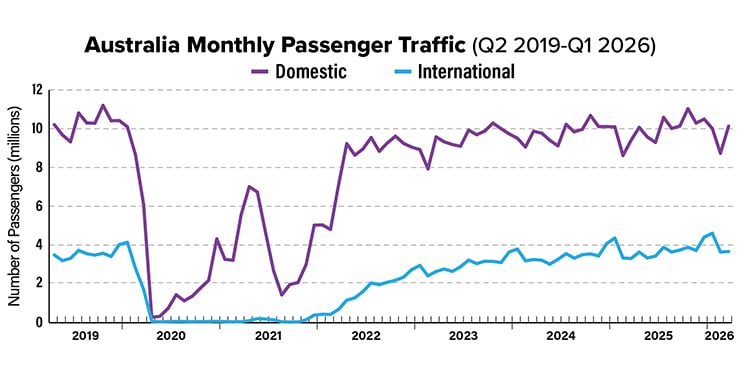
International aviation has become the principal engine of growth with demand into Australia remaining remarkably robust. Australia is also targeting further incremental tourism growth from its four major source markets—New Zealand, the UK, the US and Greater China—while additional capacity continues to enter the market.
Domestic travel, meanwhile, is broadly back at pre-COVID levels, but the recovery is becoming less uniform. Stronger markets are supporting growth while marginal routes and regional services are increasingly exposed to fuel volatility, regulatory costs and infrastructure charges. That divergence matters because airlines can redeploy scarce capacity toward stronger international opportunities where yields justify the additional complexity. Regional domestic markets do not necessarily offer the same flexibility.
The immediate pressure point is not simply jet fuel. It is the cumulative cost structure confronting airlines. Fuel volatility is interacting with sustainability requirements, regulatory obligations, labor costs, airport charges and operational complexity. Each individual increase may be manageable. Collectively, they can transform the economics of marginal routes. This is already being seen across parts of the South Pacific, where services and frequencies have been reduced or withdrawn as airlines reassess the economics of operating in higher-cost conditions.
Regional aviation provides perhaps the clearest indication of where these cost pressures could eventually lead. Lower passenger volumes, lower frequencies, smaller aircraft and higher operating costs mean relatively modest increases in fuel, regulation or infrastructure expenditure can have disproportionate effects on route viability.
There is a case for more targeted policy intervention around strategically important connectivity. This could include better-designed support mechanisms, greater coordination between federal and state governments, and infrastructure models appropriate to regional operations. The objective should not be to protect every existing route indefinitely. It should be to identify which connections generate sufficient economic and social value to warrant intervention when purely commercial economics become unsustainable.
More than AU$40 billion ($29 billion) of direct capital investment is expected across Australia’s airport system over the next decade, encompassing major gateways, capital city airports and larger regional facilities. There is an obvious need for investment. Passenger demand is growing, international capacity is expanding and infrastructure must evolve to improve capacity, resilience and the passenger experience.
However, investment creates a paradox. Airports need confidence that major projects will generate appropriate returns. Airlines, meanwhile, increasingly need to control every component of their cost base. If infrastructure expenditure translates into significantly higher airport charges, the resulting increase in the cost of operating services can undermine the connectivity the investment is intended to facilitate.
The strategic question should therefore move beyond whether Australia needs more airport infrastructure. The country clearly does in many locations. The more important questions are what is required, when is it required and who should bear its cost? There is also little value in building additional capacity if the wider aviation system cannot operate it efficiently. Concerns about staffing at air traffic control towers demonstrate that infrastructure capacity and operational capacity are not the same thing.
THE BIGGER PICTURE
The strongest message from the CAPA summit was that Australia’s aviation challenges can no longer be addressed in isolation.
Airlines alone cannot determine the cost of connectivity. Airports cannot make infrastructure decisions without considering airline economics. Governments cannot design regulatory and sustainability frameworks without understanding their cumulative impact on service viability.
For airlines, the priority should be sharper network discipline: identify routes with genuine strategic value, improve fleet flexibility, strengthen fuel and capacity resilience and develop greater pricing sophistication.
For airports, investment decisions should be more closely aligned with airline economics. Projects should demonstrate not simply passenger benefits but a credible pathway to improving capacity and resilience without unnecessarily weakening the economics of the services they support.
For governments, the priority should be reducing avoidable regulatory and infrastructure costs while targeting support toward connectivity that delivers demonstrable national and regional value.
And for the industry collectively, there is a strong case for more transparent dialogue around the cumulative cost of regulation. Sustainability, safety and consumer protection are not optional. However, their implementation needs to recognize the economics of aviation and avoid layering multiple individual requirements into an unsustainable overall cost burden.
Australia’s geography makes aviation indispensable, international tourism opportunities remain significant, and demand has demonstrated remarkable resilience. Resilience should not be mistaken for immunity, however. The next phase of Australian aviation will be defined less by whether people want to fly than by whether the industry can continue providing connectivity at a price passengers will accept and operators can afford.
Related Content