This article is published in Air Transport World part of Aviation Week Intelligence Network (AWIN), and is complimentary through Aug 24, 2026. For information on becoming an AWIN Member to access more content like this, click here.

Dubai Airports CEO Sees Long-Term Mid-East Aviation Growth Continuing

Dubai Airports CEO Paul Griffiths.

Dubai Airports CEO Paul Griffiths.

Credit: Dubai Airports

FARNBOROUGH—Dubai Airports CEO Paul Griffiths believes the geopolitical crisis in the Middle East has done little to alter the long-term trajectory of air travel demand.

Speaking at the Farnborough Airshow, Griffiths said the war in Iran that is affecting parts of the Middle East should be viewed as another temporary shock rather than a structural threat to growth in the region.

"The recent events have given us a very clear reminder of how quickly disruption can affect aviation," Griffiths said. "However, despite the events of the last few months, the long-term aviation expansion of Dubai remains very, very firmly on track."

His comments came as airlines continue rebuilding schedules after US, Israeli and Iran strikes disrupted airspace across much of the region earlier this year. A subsequent ceasefire fell apart, and strikes have resumed in recent days.

Although capacity has recovered substantially since the outset of the conflict, airlines are still operating fewer flights than before the crisis began. OAG Schedules Analyser data show about 22.9 million departing seats are scheduled from and within the Middle East during July, about 7.5% below pre-conflict levels and 6.9% lower than July 2025.

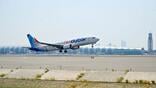
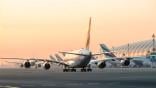
The UAE has experienced one of the region's largest absolute capacity reductions. July schedules show daily departing capacity recovering to about 222,200 seats, but that remains around 15% below pre-strike levels and almost 13% below July 2025. Emirates' regional capacity is down about 10% year-on-year, while flydubai remains almost 18% lower.

Griffiths nevertheless argued that aviation's history suggests such setbacks were temporary. "Our industry is not known for being a completely stable environment," he said. "It's repeatedly absorbed shocks at every level. It's adapted at massive speed and continued to grow and recover very strongly."

He said the demand fundamentals justify continued investment in Dubai World Central, the emirate's planned future hub, despite recent market uncertainty. "We're building this not on confidence alone or hubris, but it's actually being built on the certainty that we know the aviation market will continue to grow," Griffiths said. "It's backed by data."

Dubai International Airport (DXB) handled about 3 million passengers during the first half of July, with demand balanced across both O&D and transfer traffic. Griffiths said that about 55 airlines are operating at DXB and discussions are underway to restore service levels toward the over 90 carriers that served the airport before the latest regional disruption.

Looking beyond the current recovery, Griffiths argued that long-term demand forecasts remain intact. Citing projections from ACI and ICAO, he said global passenger traffic was expected to rise from about 9.9 billion passengers in 2025 to roughly 17.7 billion by the early 2040s, while Airbus and Boeing continue to forecast annual growth of between 3.6% and 3.8%.

"The long-term trend continues to be up," Griffiths said. "Despite every shock, global passenger traffic has returned to its growth trajectory every single time."

David Casey

David Casey is Editor in Chief of Routes, the global route development community's trusted source for news and information.