This article is published in Aviation Daily part of Aviation Week Intelligence Network (AWIN), and is complimentary through Dec 24, 2025. For information on becoming an AWIN Member to access more content like this, click here.

OneDXB Leads Charge For Sustainable Aviation At Dubai

Dubai showcase
Credit: Billypix

DUBAI—Sustainability is in the spotlight at this year’s Dubai Airshow where Dubai Airports is unveiling its OneDXB Sustainability Showcase, which it says shows how one of the world’s busiest aviation hubs is steering the industry toward a greener future. 

From cutting-edge energy initiatives and electrified ground operations to carbon-reduction strategies, the showcase underlines how efficiency and environmental responsibility go hand in hand.

The OneDXB Sustainability Alliance, which launched in September 2024, brings together seven founding partners—Dubai Airports, Emirates, flydubai, dnata, Dubai Duty Free, Emirates Flight Catering and Dubai Air Navigation Services. The goal is simple yet ambitious: to accelerate collective decarbonization efforts and set new sustainability benchmarks for the region and wider global aviation ecosystem.

“At DXB, we work with hundreds of partners, but the idea behind OneDXB is to create a focused alliance that collaborates on how we decarbonize in the short term and how we plan for future sustainable aviation strategies,” says Sven Deckers, Dubai Airports' head of sustainability.

With Dubai Airports in the midst of master-planning the next-generation mega-hub at Al Maktoum International (DWC), sustainability is being built into the project from the ground up. “As much as we need to look at how we decarbonize today, we must also think across the whole aviation ecosystem—10, 20 or 30 years ahead,” Deckers adds.

Integrated Sustainability in Action

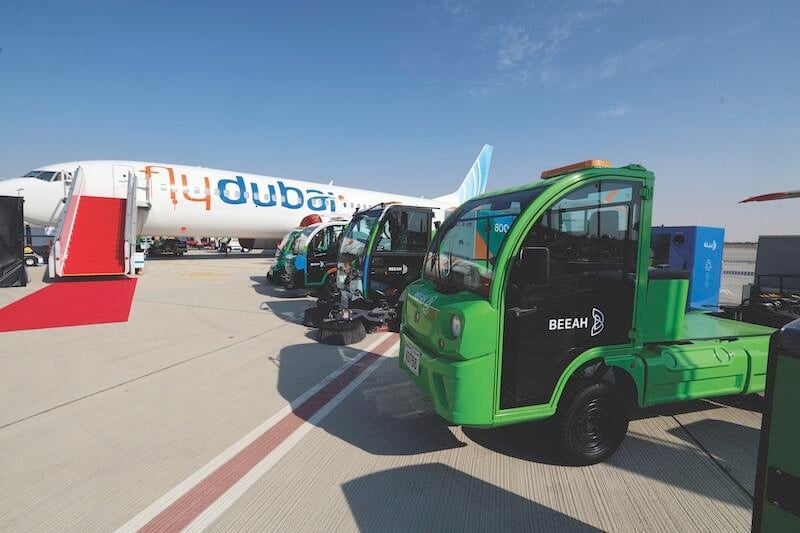
OneDXB’s Sustainable Turnaround Showcase offers visitors a unique, integrated experience that brings together around 35 partners and 45 pieces of equipment in a compact, 20-min. walkthrough. “Rather than visiting 30 or 40 separate stands, delegates can see the full picture of sustainable aviation, from the airport operator to airlines, ground handlers, and service providers, all in one place,” Deckers says.

The showcase includes a flydubai aircraft positioned on site to demonstrate a fully electrified turnaround, illustrating how ground operations can dramatically cut emissions. From electric fire trucks and autonomous vehicles to solar-powered systems and dry-washing technology, the display reflects real-world progress as well as what’s coming next.

“It’s not about showing off,” Deckers says. “It’s about showing what can be done—and inviting others to join the conversation. So, we encourage visitors to come to our stand and see for themselves. This is the start of something big.”

Among the technologies being showcased are multiple alternative-fuel solutions, including biofuels and hydrogen. Dubai Airports is already deploying biofuel in its operations, while also exploring hydrogen-powered ground transport—including a fully licensed hydrogen bus here at the show. Thanks to the Dubai Airports’ partnership with Airbus, visitors can also see a physical model of a hydrogen powerplant cell, part of the manufacturer’s research into zero-emission flight.

“There’s no single solution to aviation’s net-zero goal,” Deckers says. “It’s about a combination of many actions—electrification, biofuels, hydrogen and new operational efficiencies—each one moving the needle further.”

The UAE’s potential to produce sustainable aviation fuel (SAF) is another focus area. A truck on display demonstrates how used cooking oil collected across the UAE can be converted into SAF and biofuel. Meanwhile, research into power-to-liquid (PtL) fuels highlights how the region’s abundance of solar energy and desalination capacity could make it a future global hub for synthetic fuel production.

For Dubai Airports, the road to net zero involves a three-pillar approach: decarbonizing DXB through proven technologies such as solar panels, LED lighting
and HVAC optimization; trialing future solutions at DWC, which serves as an innovation testbed; and embedding sustainability into the design and operations of the upcoming DWC mega-hub.

“Unlike other major airports, the Dubai Airports setup gives us the unique opportunity to test in a live environment at DWC and design the airport of the future from scratch,” Deckers says.

“The future will be more sustainable, and we’re working today to define what that looks like.”

Chloe Greenbank

Chloe Greenbank wrote her first airline magazine article two decades ago and has been immersed in aviation magazines ever since.