This article is published in Air Transport World part of Aviation Week Intelligence Network (AWIN), and is complimentary through Nov 05, 2026. For information on becoming an AWIN Member to access more content like this, click here.
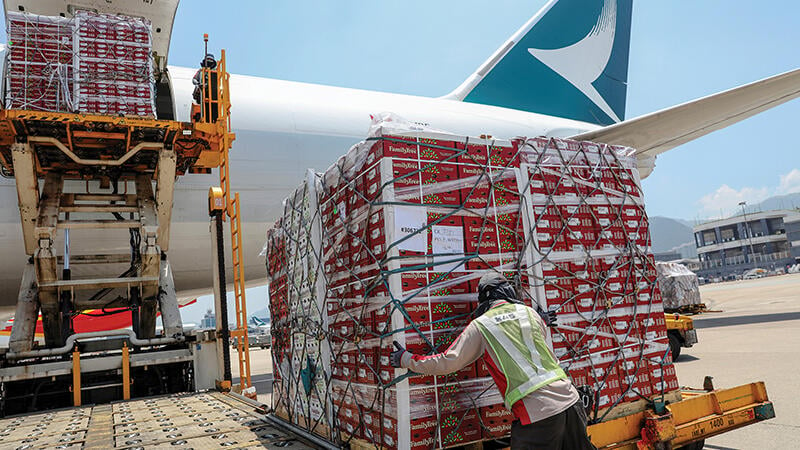
Cathay cargo operations.
As global air travel continues to grow, airports and airlines are increasingly looking beyond the terminal to improve the passenger journey and cargo supply chain. The focus has shifted to the “last mile,” creating seamless links between airports and surrounding cities through integrated road, rail and sea transportation. Beyond convenience, intermodal connectivity is emerging as a strategic tool that enables airlines to expand their catchment areas, relieve infrastructure constraints and improve cargo efficiency without adding runway capacity.
Few airports illustrate this strategy more comprehensively than Hong Kong International Airport (HKG). Under Beijing’s Greater Bay Area (GBA) initiative—first outlined in 2015—the airport has positioned itself as the international aviation gateway for an economic region encompassing Hong Kong, Macau and nine Guangdong cities, serving a population of around 86 million.
Rather than relying solely on passengers traveling directly to Hong Kong, HKG has invested heavily in cross-boundary transport links that effectively extend the airport into neighboring Chinese cities, including Dongguan, Guangzhou, Macau, Shenzhen and Zhuhai.
Cargo has become one of the strongest demonstrations of this model.
In 2023, Cathay Pacific opened the Cathay Cargo Terminal Dongguan, allowing export cargo to be accepted, security screened and built into aircraft pallets in Dongguan before being transported by bonded barge directly to HKG’s restricted airside area for loading onto aircraft. The service operates two or three sailings daily, with each journey taking approximately 7 hr.
In 2024, the concept expanded to support import cargo moving in the opposite direction, creating a two-way intermodal logistics corridor between southern China’s manufacturing hub and Hong Kong’s global cargo gateway.
Since launch, Cathay Cargo Terminal has processed more than 70,800 metric tons of bonded cargo through its intermodal network, combining air-sea barge services with bonded trucking in both directions.
COMMERCIAL BENEFITS
The approach has also demonstrated tangible commercial benefits. Cathay said transport times for Chilean cherries moving from Hong Kong into Guangzhou have been reduced to 10 hr., providing sufficient confidence to extend the model to other temperature-sensitive perishables, including live seafood.
The same philosophy extends to passengers. Cathay Pacific, together with HKG’s SkyPier Terminal, offers Direct Air+Sea and Direct Air+Land services linking the airport with Dongguan, Guangzhou, Macau, Shenzhen, Zhongshan and Zhuhai. The opening of the Hong Kong–Zhuhai–Macau Bridge in 2018 significantly strengthened those land connections, making the airport more accessible from across the GBA.
In November 2025, HKG introduced its Park & Fly initiative, allowing passengers from the GBA to drive across the bridge to an automated parking facility located within the airport’s restricted area before transferring by bonded bus to SkyPier for their departing flights.
Airport Authority Hong Kong said 2.8 million passengers used HKG’s cross-boundary land and sea transport services during fiscal 2025-26, including SkyPier ferry connections as well as cross-boundary coach and limousine services.
JAPANESE INITIATIVES
While Hong Kong’s intermodal strategy focuses on expanding its passenger and cargo catchment area, Japan is pursuing a different objective: addressing a growing shortage of truck drivers.
The country’s logistics industry has been under pressure since 2024 regulations limited the number of hours truck drivers can spend on the road, prompting transport providers to explore alternative distribution methods.
Japan Airlines (JAL) regional subsidiary J-Air, together with logistics company Lufi, introduced the J-Air Direct Fresh Service, enabling customers to move small cargo shipments across the airline’s domestic network through a single booking platform.
Despite the obvious speed advantage, changing long-established shipping habits has proven difficult. A J-Air Business Development Group spokesperson said road transport remains deeply embedded in Japanese business practices, making it challenging to establish small-lot air freight as a mainstream logistics option.
“While our primary advantage is exceptional transport speed, the current inflationary environment makes market sensitivity to price very high,” the spokesperson said. “As a result, shippers often opt for lower-cost road transport, even for slight price differences.”
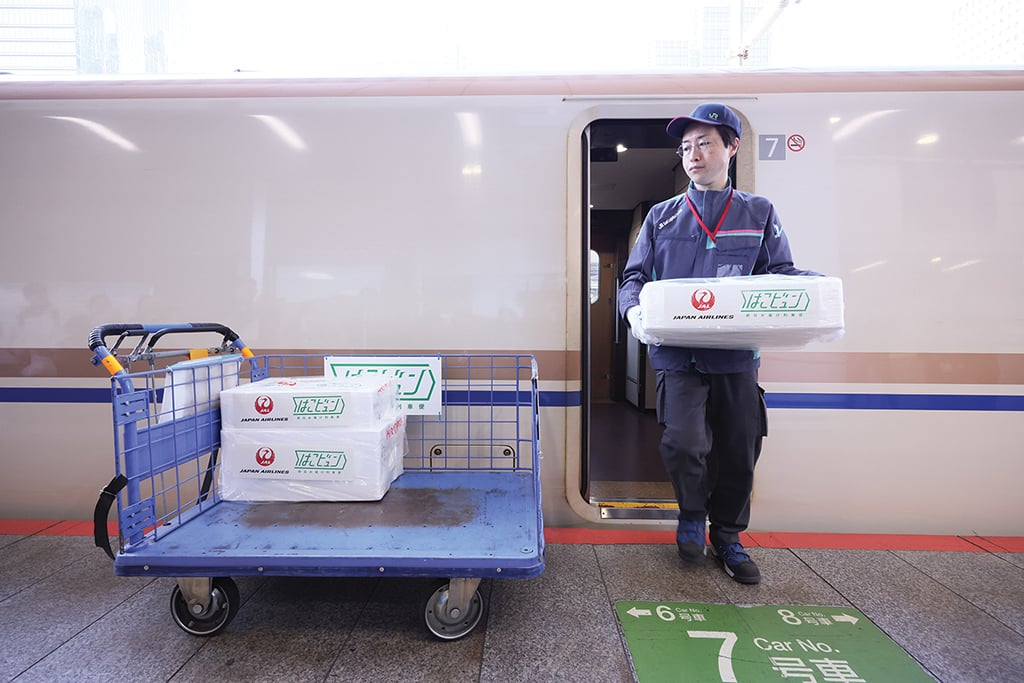
JAL is integrating Japan’s renowned Shinkansen high-speed rail network into its international cargo operations under the JAL de Hako-byun initiative.
Seafood, fresh produce and live koi fish from seven regional cities are transported by bullet train to Tokyo Narita and Haneda airports before being flown to destinations including Singapore and Taipei.
Although volumes remain modest—eight shipments totaling 58 packages weighing 560 kg—the airline views the initiative as a proof of concept. JAL plans to expand beyond its initial markets of Hong Kong, Malaysia, Singapore and Taiwan to include Europe, India, North America, Thailand and Vietnam, while broadening the product mix to encompass higher-value cargo such as semiconductors and pharmaceuticals.
The airline acknowledges that integrating rail and air transport presents operational challenges. Coordinating train schedules with flight departures while accommodating customs clearance and quarantine procedures requires close planning and remains a learning process as services expand.

Related Content