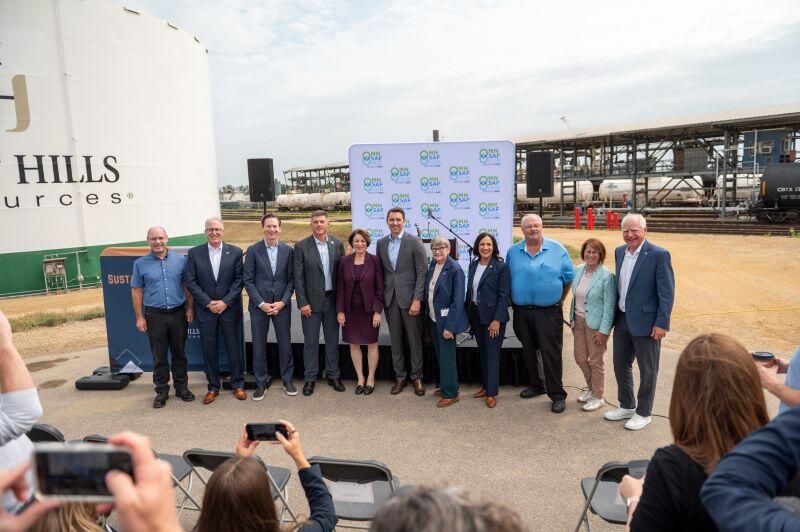
Delta Air Lines joined Minnesota SAF Hub partners, along with federal and state policymakers, to celebrate the completion of a new sustainable aviation fuel (SAF) blending facility at Flint Hills Resources' Pine Bend Refinery near Minneapolis-St. Paul International Airport (MSP).
Delta Air Lines will receive sustainable aviation fuel (SAF) at Minneapolis-St. Paul International Airport (MSP) via a new blending facility opened at a nearby oil refinery.
Located at Flint Hills Resources’ Pine Bend Refinery in Rosemount, Minnesota, the facility has the capacity to handle 30 million gal. of neat SAF annually, although Delta is expected to receive much less than the capacity level at least for several years. Shell Aviation will provide the neat SAF to the facility, where it will be blended with conventional jet fuel and then delivered through an existing 10-mi. pipeline directly to MSP.
Delta recently signed a five-year contract with Shell for the provision of SAF at multiple airports, including MSP. Shell will deliver at least 15 million gal. of SAF to the airline across multiple airports in 2026, and the carrier can scale to larger amounts in following years.
The new Minnesota blending facility will help “create the infrastructure needed to scale SAF use at one of Delta’s largest operations,” the airline said.
“With this [blending facility] in place, SAF can now be supplied, blended and uplifted at MSP in commercial volumes,” according to the Greater MSP Partnership (GMP), a coalition of businesses, universities, cities, counties and philanthropic organizations in Minnesota.
The blending facility is supported by the Pine Bend Refinery’s rail unloading systems, large-volume storage tanks, laboratory, underground pipelines and filtration systems.
Delta uses approximately 250 million gal. of jet fuel per year at MSP, where it has a hub. The airline has a target of using SAF for 10% of its aircraft fuel needs across its network by 2030.
Flint Hills will test and certify the SAF blends before shipment to MSP. GMP noted that neat SAF “must be blended, tested and certified before it can enter the airport fuel supply and be used in today’s aircraft. As the industry continues to increase the number of flights and miles powered by SAF, blending remains a core requirement for safe, certified use in existing aircraft and airport fueling systems.”

Related Content