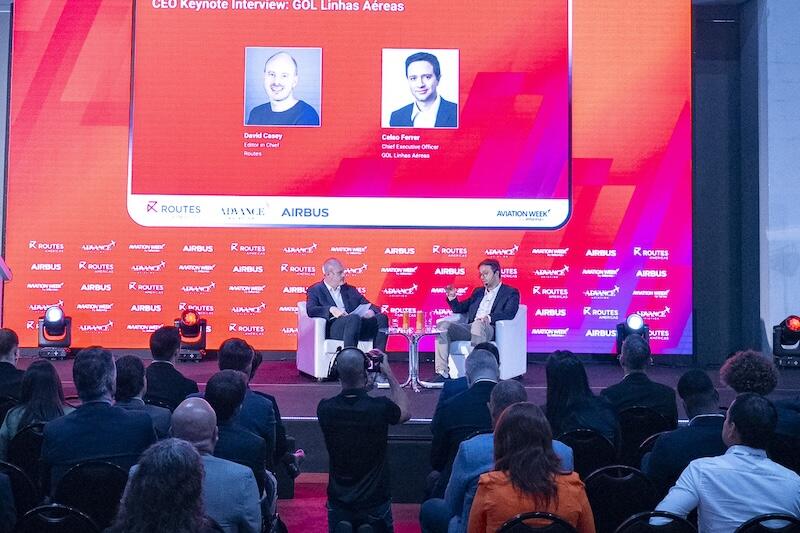
GOL CEO Celso Ferrer (right) on stage at Routes Americas 2026.
GOL Linhas Aéreas aims to maintain its core LCC business model and value-airline brand identity even as the Brazilian carrier navigates through a series of major changes.
GOL went through a Chapter 11 bankruptcy restructuring, is now part of the Abra Group rather than being independent and has confirmed it will take on a second fleet type and operate long-haul flights.
But through it all, CEO Celso Ferrer wants customers to see GOL as an efficient operator with reasonable ticket prices—not too differently than he believes the airline was perceived before it restructured.
“A lot of Latin American carriers took the opportunity [through Chapter 11] to rebuild their business model, to optimize fleet, to launch different products,” he told the Routes Americas 2026 conference in Rio de Janeiro. “In our case, we were having meetings with our board [during the Chapter 11 process] saying, ‘There are no big things to change. We believe in GOL. We like the model. We believe the market is going to be there for us.’ And so from the customer’s perspective, the company is still the same.”
Through the bankruptcy restructuring, the carrier maintained its all-Boeing 737 fleet of more than 140 aircraft (including over 130 currently active), rebuilt a network that had significantly shrunk and stuck with its public-facing brand as an LCC.
More News And Analysis From Routes Americas 2026
The airline has focused on domestic and near-international flying with its narrowbody fleet. But it became part of the broader Abra Group in 2022, an integration that was solidified when GOL emerged from Chapter 11 in June 2025 with Abra owning an 80% stake in the carrier. Abra also includes Colombia’s Avianca and Spain’s Wamos.
GOL confirmed on March 8 that it will take on a second fleet type—up to five Airbus A330s that Abra has on order—and operate long-haul flights.
Ferrer has said taking on A330s will be relatively low risk, because “if it doesn't work, we probably have another 10 options to deploy that fleet inside the [Abra] group.”
Prior to the A330 confirmation, Ferrer was asked at Routes Americas whether the airline can still retain its identity with a second aircraft type added and long-haul flying in the mix.
“I think that's a real challenge,” he conceded, adding: “We are saying, ‘OK, what is part of our culture that brought us here that we can never leave?’ First above everything is the safety culture. And in the case of GOL, the efficiency and simplicity of the decision-making process. So what we are trying to do is preserve the day by day, a lot of the way we operate, and take the strategic decisions [about the fleet] to another level [with Abra] … We are trying to not affect [Abra] with the day by day and they are trying to not affect the GOL team with the tough decisions [about overall group strategy] they are making at this moment.”
Ferrer said: “There's no magic way to solve this. It's a lot of dialogue, a lot of communicating, but the way Abra operates is to preserve the best of each of the companies that are part of the Abra Group. They are encouraging us to keep, as much as we can, doing the good things we do, and of course, on capital structure and [overall group] strategy, we will [make decisions] together.”

Related Content