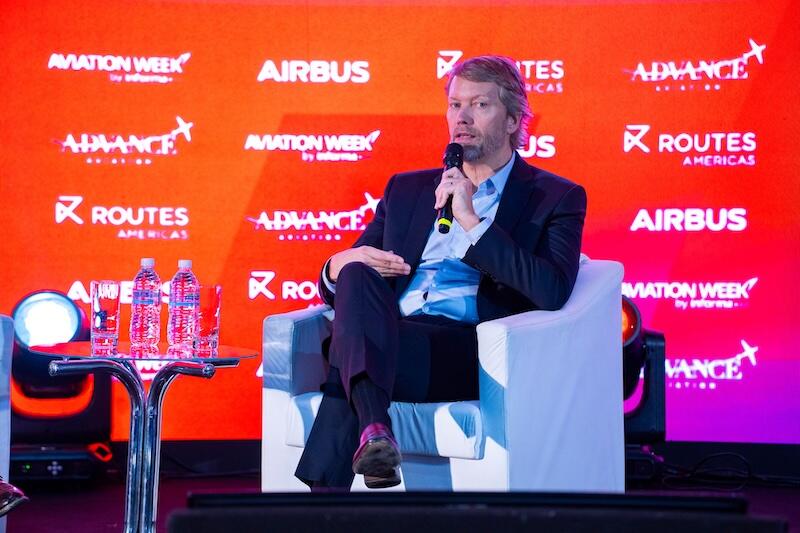
Jerome Cadier on stage at Routes Americas 2026.
LATAM Airlines Brazil’s CEO believes Brazil could become one of the world’s most competitive producers of sustainable aviation fuel (SAF), but high production costs remain a major barrier to large-scale adoption.
Speaking at Routes Americas 2026 in Rio de Janeiro, Jerome Cadier said Brazil's agricultural resources and energy sector give the country a potential long-term advantage in SAF production.
“I absolutely believe that SAF is a long-term solution,” Cadier said. “And I also believe that, given all the research that we’ve done with MIT and with Airbus, Brazil is a big part of the solution in the long term for the world.”
Brazil has the potential to produce SAF at a lower cost than many other regions, he said. However, Cadier cautioned that adoption will depend heavily on economics. Current supply remains limited, and prices are significantly higher than conventional jet fuel.
“The issue is the price,” he said. “SAF prices that we’ve seen in the very small amounts available are between three to five times more expensive than fossil fuel.
“Fuel typically represents about 30% of airline operating costs, meaning a rapid shift to SAF at current prices would significantly increase ticket prices. At the current price level, if you force airlines to introduce SAF, this would mean we’re looking at [an] 80% to 100% price increase in the ticket.”
More News And Analysis From Routes Americas 2026
Instead of mandates requiring airlines to purchase SAF, Cadier said policy-makers should focus on creating incentives that encourage production and bring prices closer to conventional fuel. “It’s not about forcing airlines to introduce SAF,” he said. “It’s about how we make the three to five times higher price be similar to fossil fuel.”
If SAF costs fall closer to parity with traditional jet fuel, airlines would adopt it rapidly, Cadier added. “If it’s 5% to 10% more expensive than fossil fuel, of course there’s going to be a huge market for it,” he said.
In the meantime, airlines are exploring other sustainability initiatives while the SAF supply chain develops. Cadier said LATAM has focused on reducing waste and improving operational efficiency as part of its environmental strategy.
“One example is the use of plastic,” he said. “Over the last three years we have eliminated basically 98% of the plastic we use in our operation.”
LATAM is also evaluating carbon offset programs as a near-term measure while the industry works to scale SAF production globally. “We need to talk about compensation in the short term,” Cadier said, referring to carbon offset initiatives.
Despite current challenges, Cadier said Brazil’s natural resources and industrial base could position the country as a major player in the future SAF market if supportive policies are put in place. “The industry will adopt SAF,” he said. “It just needs to be available at the right price.”

Related Content