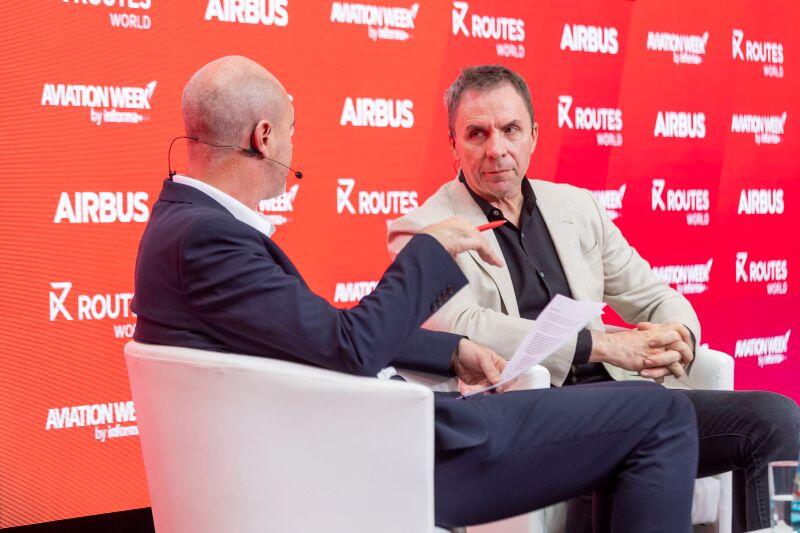
Wizz Air CEO József Váradi at Routes World in Frankfurt.
Wizz Air CEO József Váradi is predicting that the pace of aviation technology innovation will “dramatically slow down,” and is urging aircraft and engine manufacturers to prioritize durability and reliability.
“There are no new aircraft coming anytime soon. There is no new engine technology coming anytime soon,” Váradi told delegates at Routes World in Frankfurt. “Decarbonized engines, hydrogen, all that kind of stuff. That’s all been pushed back considerably. Everyone believed that by early 2030 there will be something out there in the market. I’m thinking there is not going to be anything.”
He also noted the shift in relationships between OEMs and regulators, following Boeing’s challenges. “Maybe an innovation took two years to get regulatory approval. That two years will become four years, five years in the future. So I think that because of supply chain and because of regulatory scrutiny, things will slow down.”
Váradi acknowledges that all the major engine manufacturers have faced technology maturity challenges. Wizz itself had 44 A320neo family aircraft grounded at the height of the Pratt & Whitney Canada geared turbofan (GTF) powder metal issues, representing 20% of the fleet. This has since reduced to 27 aircraft and is expected to drop to zero by the end of 2027, after four years of disruption.
“The GTF issue was the single biggest challenge in our 22-year history because of the scale of exposure and the length and depth of the issues,” Váradi said. “It’s been a very painful and very damaging process.” Wizz is one of the world’s largest GTF operators, and the powder metal issues gave CFM-powered A320neo family operators a “huge competitive advantage,” Váradi added.
Despite all this, Váradi is standing by his GTF selection as the best option for the next 10-15 years. “I’m still a believer, personally, that the GTF is just a lot better technology than CFM,” he said. “I have a commercial agreement with Pratt & Whitney that effectively underwrites the performance of the engine.”
Pratt & Whitney Canada declined to comment. CFM acknowledged its right of reply but had not shared a response at the time of publication.
“Innovation is great, but we also know that the changeover from one technology to another is damaging. It’s painful, and the operational risk—as the GTF demonstrated—can be really big,” Váradi said. “When we have a new technology, let’s make sure that it is properly executed, properly delivered, it’s reliable, it’s durable before you start thinking about the next thing and disrupting the market again with another change.”

Related Content