This article is published in Air Transport World part of Aviation Week Intelligence Network (AWIN), and is complimentary through Aug 13, 2026. For information on becoming an AWIN Member to access more content like this, click here.

IATA's Willie Walsh Delivers Broadside On Fuel, Fleet And SAF

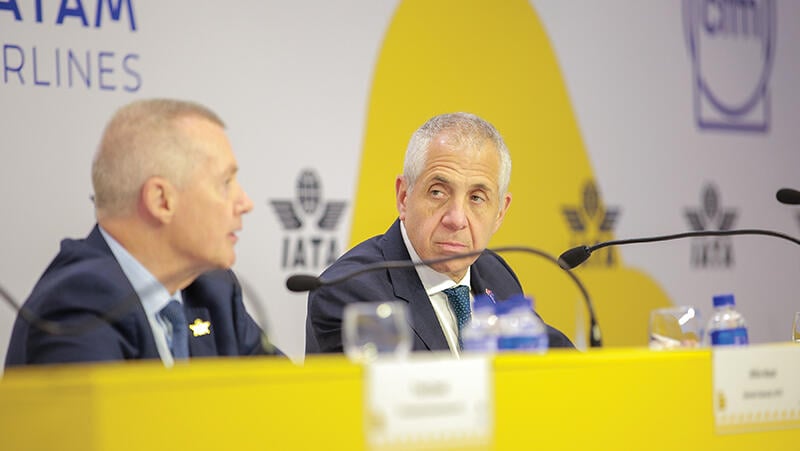
Willie Walsh (left) and Roberto Alvo

IATA director general Willie Walsh (left) and IATA chair and LATAM CEO Roberto Alvo at the AGM.

Credit: IATA

IATA director general Willie Walsh opened the association’s AGM with what was likely his last major speech in that role, and he did it with his signature style—verbally jabbing hard at those he sees as standing in the way of airline success and profitability.

Walsh addressed several current-issue themes in his speech at the AGM’s venue in Rio de Janeiro in June: the Iran war, sky high jet fuel prices, the lack of sustainable aviation fuel (SAF), the ongoing supply chain mess, aviation taxation and regulation, and more. But he saved his most pointed remarks for the oil industry that has essentially walked away from its SAF production promises, the aircraft and engine manufacturers that have failed to deliver and air traffic management organizations.

“Airlines face higher fuel costs with fleets that are less efficient than planned. Why? Because the aerospace supply chain continues its failure to deliver aircraft and engines as promised,” Walsh said in his opening address.

“The aircraft order backlog is over 18,000. And the average fleet age has reached a record 15.2 years. Moreover, being short by over 5,000 more fuel-efficient replacement aircraft that we had counted on means missed efficiency gains, not to mention higher lease rates and increased maintenance costs. In total, supply chain failures cost airlines at least $11 billion in 2025. Today’s higher fuel prices will only make that worse.”

Walsh pointed out that failure to deliver aircraft and engines had not prevented most manufacturers to post far higher margins than airlines see, even in good times.

“My message to the engine OEMs is simple: Stop gouging us and get back to making great engines that work and that last. Allowing these failures to extend into the next decade is totally unacceptable to the customers,” Walsh said.

It’s worth pointing out that many OEMs were also among top AGM sponsors, so IATA airlines saw a little of those profits returned to the coffers, at least indirectly.

But there were other targets, including European and US air traffic management systems. “Europe’s fragmented inefficiency continues. Decades of under-investment in the US system have left it best described as nostalgic—certainly not modern. More airspace is becoming entangled in conflicts which we manage safely, but with sub-optimal rigid route systems. And, overall, nationalistic thinking blocks progress on smarter and more flexible solutions. The high cost of fuel makes these frustrations insufferable. That’s before we even consider the hypocrisy of governments talking a good game on sustainability and competitiveness while dragging their feet on meaningful ATM reform,” Walsh said.

Other themes of the conference, not surprisingly, included the woeful lack of SAF, which was seen as a key bridge to meeting the industry’s 2050 net zero emissions goal that looked tough but achievable when it was announced in 2021, but now seems more of a pipedream. And, of course, there was much talk about the impact of the war in Iran on airlines in terms of regional airspace and airport closures and more broadly on jet fuel prices that skyrocketed way beyond last year’s forecasts.  Average jet fuel prices will be 70% higher year-on-year, adding $100 billion to world airlines’ collective fuel bill this year, Walsh said. While air travel demand remains strong, IATA therefore has reduced its airline profitability expectations for 2026 by half. Net profits are forecast to fall from $45 billion last year to $23 billion in 2026, with net margins dropping from 4.2% to 2.0%.

“The big unknown is how long travelers and shippers can tolerate the higher costs of connectivity,” Walsh said.

Regarding SAF, IATA estimates shared at the AGM show global production will reach around 2.4 million tonnes in 2026, a fraction of what is needed. That will mean SAF will represent just 0.8% of total commercial aviation use at a cost of $4.3 billion to airlines.

“The path to meeting 65% of our needs in 2050 is growing more difficult with each year of ineffectively sequenced government policies and oil companies’ manifest lack of interest,” Walsh said.

But another hallmark of Walsh is his optimism.  “While the forces of conflict and division seem to make our world more dangerous day by day, aviation makes the world a better place by bringing people together. We offer hope and enable freedom,” he said.

He will need that optimism in his next job, as CEO at Indian airline IndiGo, an airline with its own significant challenges in a country still stymied by red tape.

The 83rd IATA AGM will be held in Xiamen, China, hosted by Xiamin Airlines on May 30-June 1, 2027. It will be the third AGM to be held in China. Previous hosts were Shanghai in 2002 and Beijing in 2012 (Shanghai should also have hosted the 2022 AGM but relinquished the role after the fatal crash of a China Eastern Airlines Boeing 737; Qatar Airways stepped in as host).

IATA also announced that Pegasus Airlines Chair Mehmet Tevfik Nane will succeed LATAM Airlines Group CEO Roberto Alvo as IATA chair from June 2027.

“As we navigate a more complex environment, our industry must continue working together to strengthen safety, improve efficiency, advance sustainability, and unlock the benefits of connectivity for more people and communities,” Alvo said.

Karen Walker

Karen Walker is Air Transport World Editor-in-Chief and Aviation Week Group Air Transport Editor-in-Chief. She joined ATW in 2011 and oversees the editorial content and direction of ATW, Routes and Aviation Week Group air transport content.