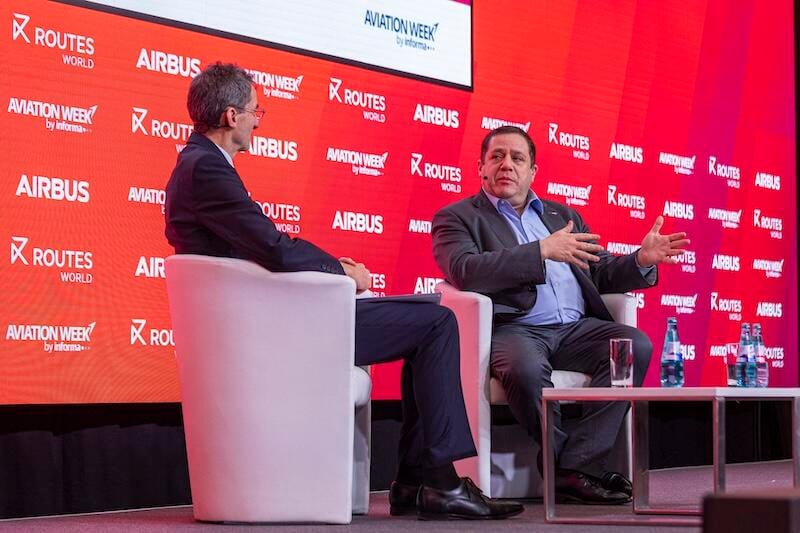
British Airways' Neil Chernoff (right) speaks onstage at Routes World 2026 in Frankfurt.
FRANKFURT—British Airways (BA) is moving more quickly to adjust its network when geopolitical events disrupt operations, drawing on lessons learned during the COVID-19 pandemic.
That approach guided the airline’s response to the Middle East conflict, which prevented BA from operating 12-14 daily frequencies—about 5% of its schedule—and suddenly left aircraft available for deployment elsewhere.
“The speed of reacting—and reacting quickly—is more valuable than being too slow to do anything,” Neil Chernoff, BA's chief planning and strategy officer, said during an interview at Routes World 2026 in Frankfurt.
Chernoff said the pandemic demonstrated the problems caused by repeatedly pushing back the planned resumption of flights. The uncertainty disrupted passengers and made aircraft and crew planning more difficult.
When the Middle East conflict began, BA initially concentrated on bringing stranded passengers home. The airline operated eight or nine rescue flights from Muscat, Oman, despite not serving the city regularly, and added flights to Bangkok and Singapore. It later used some of the capacity released by the disruption to increase service to Bengaluru and Nairobi.
However, Chernoff said redeploying aircraft is not immediate. BA typically needs about two months to establish replacement flying, partly to allow time to sell seats, but also because crew planning and rostering are completed 45-60 days before departure.
More News And Analysis From Routes World 2026
“You need the selling cycle and two months is not a lot of time,” he said. “The other issue is crew planning. We do all our crew planning and crew rostering about 45 to 60 days in advance.”
The same thinking influenced BA’s winter 2026-27 schedule. When the airline was making its plans, it had little visibility over how long the conflict would continue or how quickly demand for Middle East travel might recover. It therefore placed aircraft in markets where the outlook appeared more certain.
“I would rather temporarily miss the market or add capacity later than commit aircraft that cannot be deployed and end up sitting on the ground,” Chernoff said.
BA retains some flexibility for summer 2027, particularly until three or four months before departure. But much of the available capacity has already been reassigned, meaning that restoring more Middle East flying could require reductions elsewhere.
Meanwhile, the wider network continues to expand. BA is launching service from London Gatwick to Colombo, Sri Lanka, on Oct. 23, with flights from London Heathrow to Melbourne, Australia, scheduled for Jan. 9, 2027. Cincinnati and St. Louis will see increased frequencies in 2027 as well, while Bangkok, which began as a winter-only route, has also been extended into the summer season after stronger-than-expected demand.

Related Content