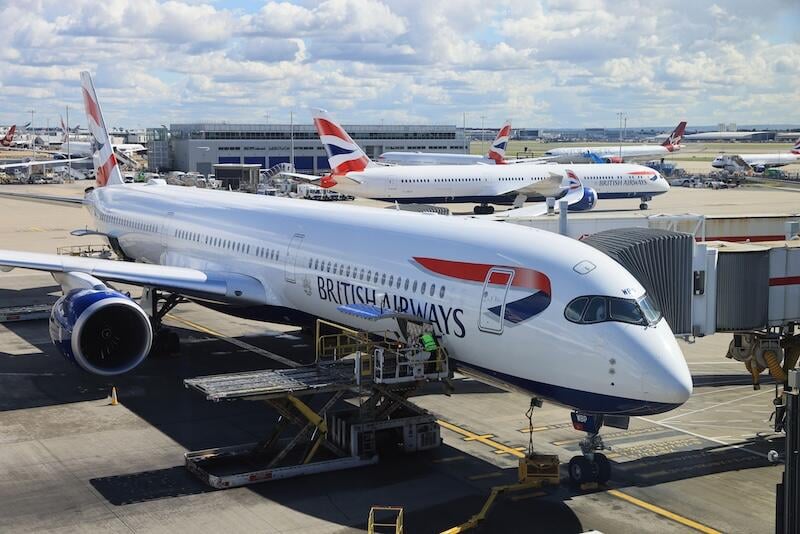
British Airways' main hub is London Heathrow.
British Airways is increasing its focus on Asia-Pacific service for the winter 2026-27 season, launching new routes to Melbourne, Australia, and Colombo, Sri Lanka, as it seeks to capture demand traditionally routed through Middle Eastern hubs.
The expansion comes as British Airways scales back parts of its Middle East network following the escalation of conflict involving Iran, Israel and U.S.-aligned states in the Gulf, which has led to airspace restrictions, airport disruption and a sharp drop in demand.
The Oneworld alliance member says its long-haul network will grow by around 9% year-on-year over the winter, combining the two new routes with frequency increases to established markets such as Tokyo Haneda and New Delhi, as well as Cape Town, South Africa, and several U.S. and Caribbean destinations.
At the same time, British Airways has been forced to curtail operations in the Middle East. Services to Bahrain, Dubai, Tel Aviv, and Jordanian capital Amman have been canceled through at least May 31, while Doha, Qatar, remains suspended until April 30 and Abu Dhabi until the start of the winter season.
“We know there is short-term demand as a result of the situation in the Middle East,” says Neil Chernoff, the airline’s chief planning and strategy officer. “To support customers with alternative routes from popular destinations, we have already launched additional flights, and we will continue to monitor customer demand and add flights to our schedule if we’re able to do so.”
In response, British Airways has moved quickly to redeploy capacity eastward. The airline added seven additional return services to Bangkok and Singapore in March, targeting displaced demand that would typically have routed through Gulf hubs.
The most eye-catching development next winter is British Airways’ return to Melbourne after more than two decades, becoming its second Australian destination. Daily Heathrow flights will begin on Jan. 9, 2027, operating via Kuala Lumpur.
“London is one of the world’s great global cities and a critical hub for business, tourism and education, while Melbourne was last week voted Time Out’s ‘best city in the world’ as well as being home to the largest British expat community in Australia, so there will be no shortage of two-way demand,” Melbourne Airport CEO Lorie Argus says. “The average daily international service injects around A$190 million ($135 million) into the Victorian economy each year, which is why it’s so important that we continue to attract and support more services such as this to Melbourne.”
Historically, a significant share of UK-Australia passengers has connected via Middle Eastern hubs. Sabre Market Intelligence data shows that in 2025 about 25% of the 407,000 two-way passengers traveling between the UK and Melbourne connected via Dubai, with Doha and Abu Dhabi also among the largest transfer points.
British Airways last served Melbourne in March 2006 and will now compete with a growing number of carriers targeting the Australia-Europe market via Asia. Turkish Airlines launched Melbourne service via Singapore in 2024, while Finnair is set to begin flights to Helsinki via Bangkok in October.
In South Asia, British Airways will also reenter the Colombo market with 3X-weekly winter-season flights from London Gatwick starting Oct. 23. The airline last served Sri Lanka in 2015. The move comes as traffic between the UK and Sri Lanka remains sizable, with about 452,000 two-way passengers recorded in 2025 and much of that demand traveling via Middle Eastern hubs.
The carrier’s broader network expansion includes increased frequencies to high-demand leisure markets. Cape Town will receive a third daily flight, while Tokyo Haneda will operate double daily throughout the winter season. Capacity to the Caribbean is also being expanded, with additional services to Barbados, St. Lucia, Jamaica and Punta Cana, Dominican Republic. In the U.S., Houston and Baltimore will also see increased frequencies.
British Airways says demand for alternative leisure destinations has strengthened amid ongoing geopolitical uncertainty. According to British Airways Holidays, searches for Caribbean destinations such as Antigua and Barbados have increased significantly year-over-year, while demand for Indian Ocean markets including the Maldives and Mauritius has also risen.

Related Content