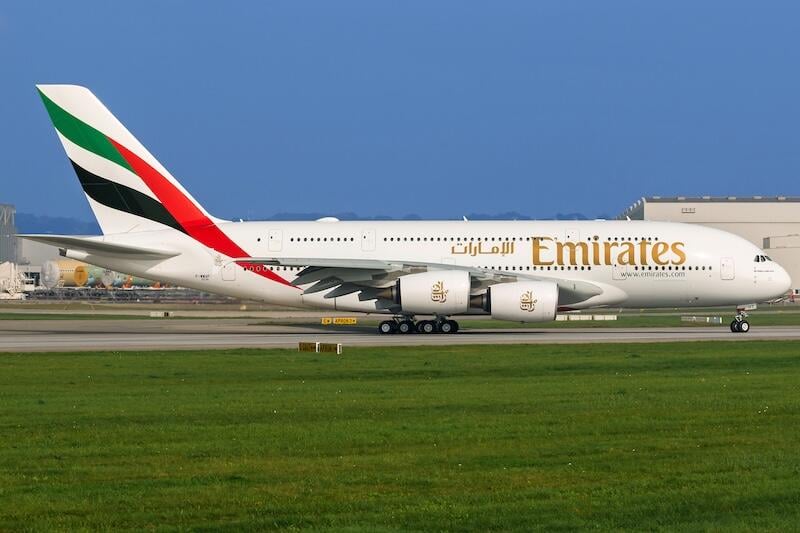
Engine-overhaul times for Emirates’ Airbus A380 fleet have increased from a contracted 85 days to more than 350 days, delaying the return of grounded aircraft and limiting the airline’s ability to add capacity, according to President Tim Clark.
The Aviation Week Fleet Discovery database shows Emirates has 84 A380s in service, 24 either parked or parked reserved, and seven stored. Roughly two-thirds of the overall fleet is powered by GP7200s made by Engine Alliance, the GE Aerospace and Pratt & Whitney joint venture, with the remainder equipped with Rolls-Royce Trent 900s. Clark said the airline has no firm timetable for bringing the unavailable aircraft back into service.
“No, no, I do not know,” he said when asked during an interview for Aviation Week’s Window Seat Podcast when the aircraft would return. “It’s driven by the turnaround time, contracted at 85 days—coming at over 350 days.”
The delays are significant because the A380 remains one of Emirates’ most valuable commercial assets. Clark said the aircraft generated more profit than any other type in the airline’s fleet during its record 2025-26 financial year.
“Last year, the A380 was the most profitable asset in our fleet, and that was the most profitable year we’ve ever had,” he said. “It tells you how successful, how popular that airplane is.”
Emirates has invested heavily in keeping the A380 commercially competitive, refurbishing cabins to add premium economy and update its first-, business- and economy-class products.
The aircraft allows Emirates to concentrate large amounts of capacity on high-demand routes, particularly at airports where slots are scarce. That also makes a grounded A380 difficult to replace with smaller widebodies.
Speaking at Routes World 2026 in Frankfurt, Clark said infrastructure limitations and aircraft availability leave little room to expand the A380 network.
“One is constraint of Code F capability. Two is the slots available,” he said. “I guess the A380 is spoken for in just about every city that we can fly it to.”
Emirates plans to keep its A380s in service until 2041, extending some aircraft beyond their original 20-year design assumptions where certification and airframe condition allow.
The airline has few options offering comparable capacity. Emirates expects to begin receiving Boeing 777-9s in 2027, but the aircraft will accommodate about 150 fewer passengers than an A380 in the carrier’s configuration.


Related Content