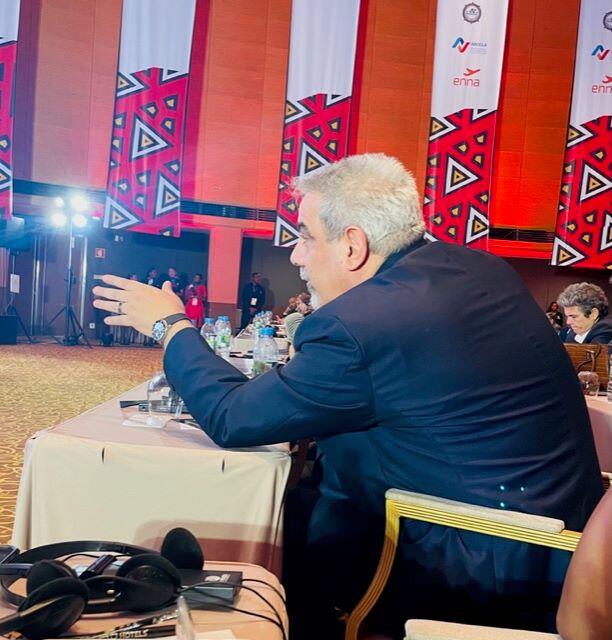
Kamil Al-Awadhi, IATA Regional Vice President for Africa and Middle East
Faced with taxes and charges across Africa that are already “15% higher than the rest of the planet” and continually rising and multiplying, IATA, the Airlines Association of Southern Africa (AASA) and the Airlines Association of Africa (AFRAA) resolved to work together to tackle the issue at AFRAA’s Annual General Meeting in Angola in early December.
“I recommend that the three associations, including AACO [Arab Air Carrier Organization] because it involves Morocco, Algeria, Tunisia, Egypt and Libya, have quarterly meetings to discuss what the associations need to do to tackle as a unified task force the level of safety and cost associated on the African continent,” Kamil Al-Awadhi, Regional VP for Africa and Middle East of IATA, told AFRAA delegates. “We need to hammer out a plan.”
Al-Awadhi said that in his five years in his role, the associations have failed to make enough impact on the issue of charges, describing the “great burden” on financial performance when African airlines only make a profit of $1.2 per seat, compared to a global average of $7.7 per seat.
“What chance of growth is there when you’re paying all sorts of charges, taxes, levies, fees, and costs that are just continuously rising?” he said.
Al-Awadhi’s message was amplified and supported by Lemma Yadecha Gudeta, group chief commercial officer at Ethiopian Airlines. “Taxes are a killer in Africa,” he said. “We must convince governments that air transport is an enabler in economic growth and connectivity. It should not be considered as a source of income.”
Lemma also pointed to concerns about ground handling monopolies at African airports giving airlines no choice of provider and a lack of negotiating leverage.
One of the latest charges appearing on IATA’s radar in Africa is countries imposing taxes to pay for Advanced Passenger Information Systems (APIS) that collect and share traveler data with other countries for international flights.
“We are seeing a big new wave of these APIS charges,” says Somas Appavou, IATA Regional Director External Affairs & Sustainability, Africa.
While airlines and IATA understand this requirement, IATA has seen proposals that bear little relation to the cost of developing this system. For instance, IATA helped negotiate Nigeria’s proposed APIS charge down from $50 per passenger to $11.5, a fee that came into effect on Dec. 1.
Al-Awadhi’s ambition for the unified efforts of the African associations extends to safety. “Africa’s rate of 10.59 accidents per million flights is not acceptable,” he said, referring to IATA’s 2024 Annual Safety Report. This compares to a global average of 1.13 accidents per million flights.
“Airlines, civil aviation authorities, airports, ANSPs [air navigation service providers], regulators, and associations should see this as a red flag as something significantly serious,” Al-Awadhi said.
At IATA’s forthcoming Focus Africa event in Ethiopia in April 2026, Al-Awadhi said the association will launch two major initiatives to tackle airline, airport and civil aviation safety standards. These have taken IATA two years to develop, “and we plan to implement them with about 16 states to start off with.”

Related Content