This article is published in Aviation Daily part of Aviation Week Intelligence Network (AWIN), and is complimentary through Jul 09, 2026. For information on becoming an AWIN Member to access more content like this, click here.

Airline CEOs See AI Reshaping Customer Interaction, Operations

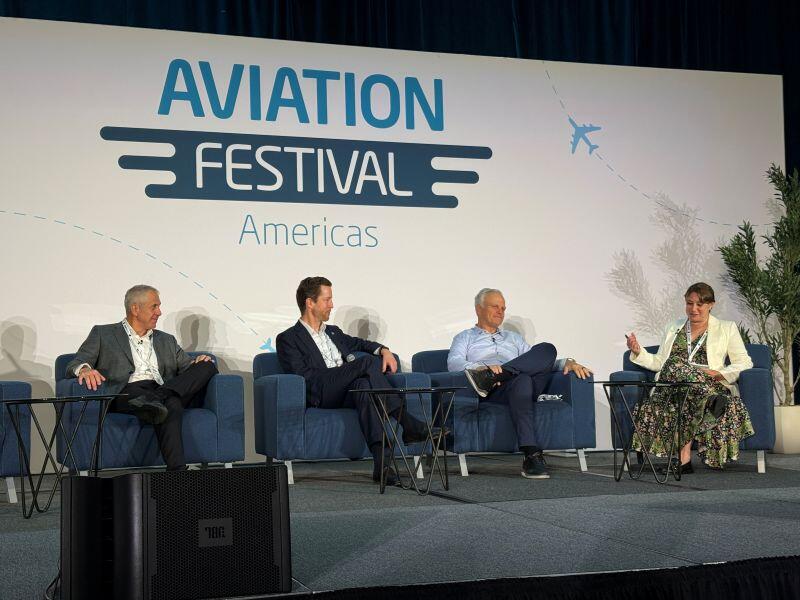
From Left: LATAM Airlines Group CEO Roberto Alvo, WestJet CEO Alexis von Hoensbroech and Breeze Airways CEO David Neeleman.

From Left: LATAM Airlines Group CEO Roberto Alvo, WestJet CEO Alexis von Hoensbroech and Breeze Airways CEO David Neeleman.

Credit: Chris Sloan

MIAMI—Airline CEOs believe artificial intelligence (AI) may allow them to reduce travel friction, rewrite how airlines sell tickets, communicate with passengers and manage operations behind the scenes.

Speaking during a CEO panel at the Aviation Festival Americas conference in Miami this week, executives described a future in which customers may no longer visit airline websites, contact centers shrink dramatically and many routine operational decisions happen almost instantly through AI-driven systems. But despite the excitement surrounding the technology, several airline leaders cautioned that aviation’s biggest operational headaches, particularly around aircraft reliability and maintenance, will still require traditional engineering and human oversight.

LATAM Airlines Group CEO Roberto Alvo argued execution would become more important than technology access. “Technology in itself is going to be off the shelf,” he said, arguing the real differentiator would be “how the airline has to organize itself and work in order to extract the full potential of the technology.”

The LATAM chief predicted customer behavior could evolve rapidly as “agentic ecommerce” platforms mature, potentially reducing the importance of traditional airline websites and apps within the next several years. “In five years, it’ll be hard to go to a web page or to an app again,” he predicted. “You’re just going to interact with the problem somehow, probably vocally.”

Even so, Alvo cautioned that customer preferences would remain mixed. While some travelers will continue to value speaking with people during disruptions or complex itineraries, others may eventually find human interaction slower and less efficient than automated systems.

WestJet CEO Alexis von Hoensbroech described AI as potentially the biggest operational and commercial transformation airlines have experienced since the rise of the internet economy. “This will probably be the most fundamental revolution in the way businesses are being performed that we have seen in decades,” he said, suggesting the impact could exceed that of the dot com era because of AI’s ability to replace large amounts of highly skilled work.

Much of that transformation, the executives suggested, will happen gradually through customer communication channels, contact centers and operational workflows rather than flashy consumer products alone. Von Hoensbroech acknowledged staffing inside airline contact centers would likely decline over time as automated systems handle larger volumes of customer interaction, though he stressed airlines would still need human interaction in many situations because “the relationship piece matters a lot in aviation.”

Breeze Airways founder and CEO David Neeleman pointed out airlines have been moving steadily toward automation for decades. Today, Breeze largely operates without traditional call centers, relying instead on messaging-based customer support layered with automated AI systems and remote agents capable of simultaneously handling multiple customer conversations. “Now we have the AI layer on top of that that tries to answer 80% of the questions, and we have the human behind that,” he said.

Neeleman argued customers ultimately care less about the underlying technology than reducing friction throughout the travel experience. He envisioned more automated airport and disruption management processes where passengers can move through airports, baggage drop and reaccommodation with minimal human intervention. “You just want frictionless stuff,” he said.

Operationally, predictive maintenance emerged as one of the most immediate opportunities. Airlines are already collecting enormous amounts of aircraft performance data, and executives believe AI tools could dramatically accelerate maintenance troubleshooting, parts forecasting and operational decision making.

Neeleman cited one recent example where engineers loaded Breeze’s Minimum Equipment List manual into an AI model, reducing the time required to determine whether a maintenance issue could be deferred from roughly 20 minutes to seconds. “That AI is mindboggling on what one person can do in a short period of time,” he said.

Alvo also pointed to predictive maintenance as an area where AI could meaningfully improve airline operations through faster processing of complex operational data. “I’m sure that with parallel processing, we’ll find a way of doing that much better than today,” he said.

Chris Sloan

Chris Sloan is a contributing editor covering air transport for Aviation Week Network.