This article is published in Air Transport World part of Aviation Week Intelligence Network (AWIN), and is complimentary through Oct 16, 2026. For information on becoming an AWIN Member to access more content like this, click here.
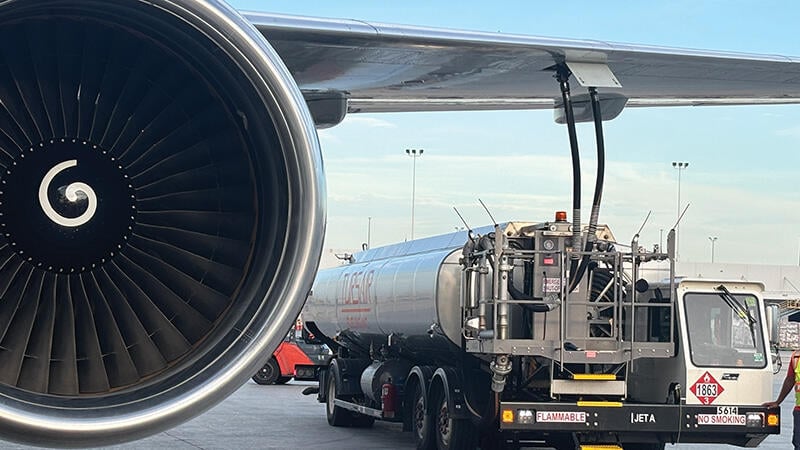
The war with Iran has led to much higher oil prices than were anticipated in 2025. Perhaps even more concerning for airlines is long-term uncertainty about jet fuel price volatility and availability. The question is: How should airlines best address that uncertainty?
ATW spoke with Chris Russo, a Houston-based associate director for energy in North America at Publicis Sapient, who pointed out that even if the war with Iran ended tomorrow and the Strait of Hormuz fully reopened, two factors would ensure jet fuel prices remain high for months to come.
“Whatever normal looked like in the past is going to be completely different now with how the Strait is going to be managed. Now it is open season for countries to insert and interject and otherwise potentially interfere moving forward,” Russo told ATW. “We have now crossed that threshold. So, moving forward, whatever happens in the Strait, even in times of peace in the future, it could open itself up for more issues at a later point, for numerous different geopolitical reasons. There are two issues at play right now. There is a current-state problem and a future longer-tail problem that will rear its ugly head at a later point that will affect these jet fuel prices.
“The current-state problem today is that refineries that take the crude and turn it into the products that we use like gasoline and diesel and jet fuel are at capacity. They cannot produce any more of the refined product. The global refinery output has actually decreased. So even if we’re flush with crude, there’s only so much that they can produce right now and the demand for it is still so high that we are in a problem today with those prices,” Russo said.
“The longer-tail problem that we have not properly equated for yet is that there is going to be a crude inventory shortage. There already is one—we just haven’t cooked it and baked it into our books yet—because China and the US have been pulling from their strategic reserves this entire time. There will come a point where the piper has to be paid.”
Russo pointed to a statement by Shell CEO Wael Sawan that the world was facing a nearly 1-billion-barrel supply shortage.
“This hasn’t been factored into the prices of crude, so that will come back to bite because that will jack up prices again in the future and cause problems downstream for things like jet fuel,” Russo said. “This is going to be a challenge for airlines for a long while.”
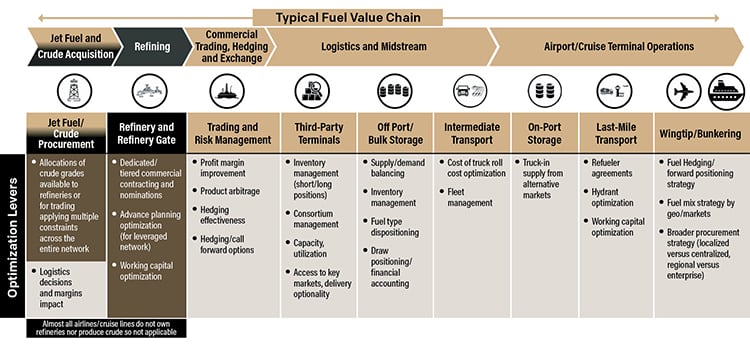
To address this challenge, airlines should change their thinking about fuel purchases, Russo said. “Most airlines look at fuel as just a cost of doing business. It’s a line item for them to pay and not necessarily get ahead of. But airlines need to start taking a bit more of a longer-term view on how they want to procure fuel and how to manage the fuel and the procurement process as a whole.”
Beyond reactive steps, like cutting routes or frequencies, or even fuel hedging, Russo believes airlines should closely examine the contracts they have with suppliers to guarantee some amount of fuel over the next 12 or 24 months.
“In those contracts, there are always terms and conditions around optionality,” he said. “There’s all these little things that can get inserted that often the airlines forget about. Who’s rereading the contracts? How is that information being bubbled up so that your fuel management team can make the choices? There’s lots of little examples like that.
“And then when things in the market change, you may have different levers within those contracts that could potentially help you acquire more at a better price or otherwise move product. Maybe you don’t want to pick it up in your Los Angeles market or your Amsterdam market, but in another location that’s important.”
Russo said working those options could save an airline one to four cents per gallon, a meaningful sum when so many barrels are being purchased.
“There’s so much that goes between signing a contract to buying fuel to ultimately putting the fuel into the wingtip and off you go,” he said. “And now you’re at a crossroads where this global supply chain of oil can cause real problems. I think that’s where airlines need to start to look beyond maybe just the next month or the next quarter for fuel and think about what would happen and have scenario planning sessions. If oil goes to this level, what do we do? That is what I would recommend more airlines think about.”
HEDGING REBOUND?
And while demand for air travel has remained strong worldwide, even at higher fares, Russo does not believe that will be sustainable. “I really believe demand is going to go down at some point. If fuel prices keep going up, eventually it’s going to hit some threshold where passengers will refuse to pay those prices. So, do you get ahead of it by trying to hedge in anticipation?”
Russo says fuel hedging, which has been avoided by US airlines since the 2008 financial collapse, will come back in favor if CFOs believe that this volatility and uncertainty is going to continue for more than six months.
“When I talked to a couple of [US airline] CFOs in March or April and I asked them, ‘What will it take for you to think about and consider going back to hedging?’ they said, ‘Nothing right now.’ But here we are six months later and things may have changed,” Russo said.
“There are some larger European airlines and some Asian airlines that do hedge, and that is part of their strategy,” he continued. “But to be clear, they’re not hedging more than 20% of their total fuel. It’s not like it’s their entire thing and they’re going to live and die by it, but it’s just some semblance of price certainty in an era of uncertainty. So going back to US airlines, to start up a hedging program and hire the right people and get your systems in place and become in essence energy traders again requires time and dedication. Are they there yet? This is the million-dollar question to me—literally the millions of dollar question: Is hedging attractive enough for them to look to do it again?”
Essentially, taking a different approach toward fuel purchasing comes down to better managing costs, which provides a competitive advantage.
“Anything that allows you to report better, stronger earnings to the streets obviously puts you in a better position for numerous different reasons,” Russo said. “Here in the US, look at United Airlines and Delta Air Lines versus American Airlines and how their books have looked over the last year. So, it can become a competitive advantage when you can reduce your costs for fuel. And by being smarter with fuel management, it opens up your working capital, which means then you can spend more money on things like buying newer planes or investing in better customer experiences because you freed up money that you otherwise may have tied down to fuel. It absolutely does become a competitive advantage.”
Russo also believes that some LCCs will not be able to survive a prolonged period of higher jet fuel costs. “No matter if you’re in the US or in Europe or in Asia Pacific, there is something to be said about the legacy carriers being in a little bit of a way excited about high fuel prices because of what that can do to the market in eliminating the low-cost carriers, such as Spirit Airlines. You are talking about eliminating your competition. That’s actually a good thing. So, there’s the silver lining for your legacy carriers. I’m not saying that they wish ill, but let’s be real. When it comes to business sense, the less competition, the better.”
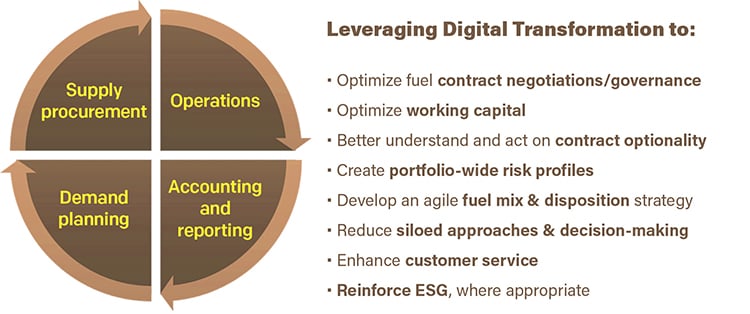
Ultimately, Russo has this advice for airline CEOs and CFOs in terms of fuel management strategy: “Take a good hard look at the macroeconomic conditions and ask yourself, do you believe that this uncertainty is going to last beyond nine to 12 months? If the answer is yes, the question becomes, what are you doing to empower and enable your fuel management teams to eke out every additional cent worth of savings? It would be very inappropriate of me to say that airlines are not doing anything around fuel management to improve. That is not the case at all. But are they leveraging tools like artificial intelligence? And are they leveraging it correctly to be able to bubble up the information to the front of house to make better decisions? That will ultimately help figure out which airlines will stand out stronger than their competitors.”
Listen to the full interview with Chris Russo on the ATW Window Seat podcast at https://aviationweek.com/podcasts/window-seat-podcast/podcast-jet-fuel-…

Related Content