This article is published in Air Transport World part of Aviation Week Intelligence Network (AWIN), and is complimentary through Oct 16, 2026. For information on becoming an AWIN Member to access more content like this, click here.
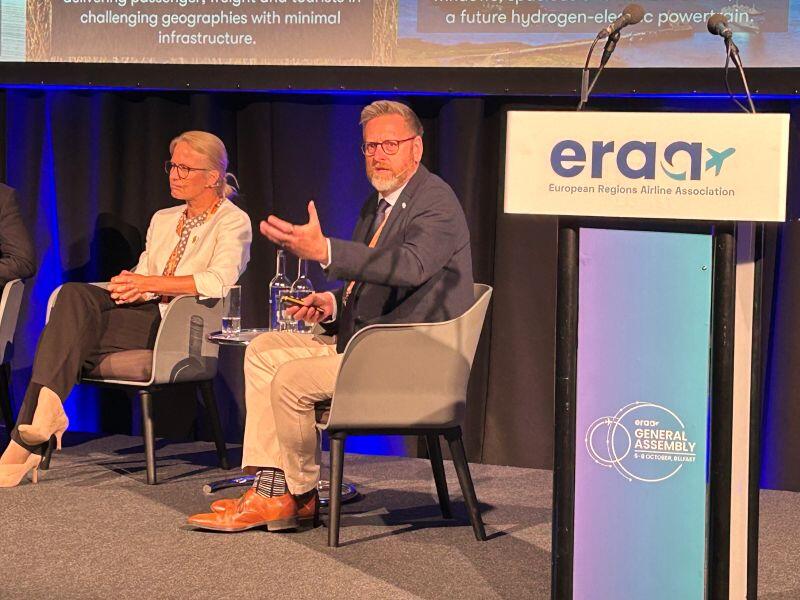
Hybrid Air Vehicles passenger markets director Jonathan Sumner.
BELFAST, Northern Ireland—After the Airlander 10 passenger variant, Hybrid Air Vehicles is planning a freighter that could be double the size of the Airlander 10, offering 250 tonnes of cargo capacity.
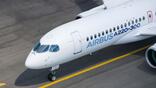
For context, the Airlander 10 cabin alone—positioned below the envelope—is about the same length as an Airbus A320.
“The Airlander 10 is already a 98-meter-long airplane. If you double that in size, the payload doesn't double; it goes up 25 times. So, an Airlander freighter twice the size of Airlander 10 will carry 250 tonnes,” Hybrid Air Vehicles passenger markets director Jonathan Sumner told delegates at the European Regions Airline Association (ERAA) general assembly in Belfast.
He said this will be a “major game changer” in the air cargo market, with pricing comparable to road haulage.
“Work is now already being done on freighter, and we are getting really enormous interest in that. The company is committed to doing both, so I'm confident we'll deliver both within a pretty aggressive timescale,” Sumner said.
However, Hybrid Air Vehicles still has a long way to go with the Airlander 10. Sumner shared a timeline, showing a product design review in 2026, followed by demonstrating means of compliance to the UK CAA in 2027. Between 2027-2028, the cabin and aircraft design will be frozen. Then, from 2028 onward, pilot training and the assembly of MSN001 will begin. MSN001’s first flight is anticipated after 2029, for certification and entry into service by the end of 2030.
“It depends on investment, of course, but we're doing well on our current round. We just announced a major partnership in the US, an anchor investor, so we need to complete that round by the end of this year, and we're on track then to build the first three aircraft. The technology and the design is very mature,” Sumner said.
According to the latest data from Hybrid Air Vehicles, the Airlander 10 will have capacity for up to 130 seats, or around 100 business class seats, or 10 tonnes of payload. Another potential configuration would be a combi variant with 50 passenger seats and eight tonnes of cargo. The aircraft has a 4,000 nm and five-day maximum range, with a 90-mph maximum cruise speed. The typical operating altitude will be up to 10,000 ft. “We can go to 20,000 [ft.], but nobody wants passengers with oxygen masks,” Sumner said.
Hybrid Air Vehicles began work on the Airlander in 2014 and flew its prototype in 2016. Sumner is “very confident” in the design, and the company is now making steady progress with the UK CAA toward regulatory approvals, supported by simulator testing.
“I think our first aircraft won't be hydrogen. They'll be conventional kerosene-powered airplanes. But, if we're serious about the hydrogen opportunity, the bigger challenge really is not in the powertrain, in my view, it's in the infrastructure we need to support that. And that work really needs to start now,” Sumner said.
Sumner said the sales price is still being established, but he guided at around $50-70 million per aircraft. “It's not a low-cost aircraft to purchase,” he said. “We will be competitive [on unit costs], certainly better than an RJ, and competitive with a regional turboprop with more seats to sell.”
Hybrid Air Vehicles sees potential demand for remote regions connectivity, tourism, cargo and defense surveillance applications. Sumner sees potential for “low and slow” air cruise sightseeing, where passengers can open the window. He does not see the Airlander 10 operating from larger airports because the aircraft’s slow speed could interfere with flightpaths for conventional aircraft.

Related Content